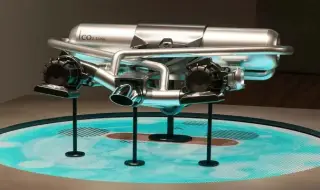
While most of the automotive world is frantically trying to “plug“ its future into the electric grid, Mazda engineers have once again proven that they are not afraid to swim against the current. Mazda, which has been defending the right to exist of the internal combustion engine for years, has presented a revolutionary concept: a diesel engine that not only reduces its footprint, but actively “ purifies“ nature, striving for negative emissions.
At the heart of this innovation is an ambitious carbon capture and storage (CCS) system that turns the car into a small mobile laboratory. The technology has already passed its “baptism of battle“ during grueling endurance races in Japan. There, a Mazda 3 prototype powered by HVO100 biodiesel spent four hours at the limit. The results are more than impressive: the combination of clean fuel and the new filtration system allows the engine to generate a negative emissions balance, with the capture device alone adding an additional 20% to the total CO₂ savings.
The magic happens in a special separator installed in place of the spare tire. Inside it is hidden zeolite - a porous mineral familiar to many from the composition of high-quality cat litter, but used here for its unique ability to absorb carbon. Two separate fan systems direct the exhaust gases through a moisture trap to the zeolite, which, when heated, literally “locks” the carbon dioxide in a special tank. The entire hardware weighs about 50 kg - a modest price for the potential to turn diesel into an environmentally friendly ally.
The Japanese also provide a clear example with their flagship Mazda CX-60. Equipped with a 3.3-liter engine, this crossover emits about 13.77 kg of CO₂ every 100 kilometers. With the new technology, the car could “capture” nearly 28 kg of carbon in a 1,000-km journey. However, this poses one final, but huge logistical conundrum for the manufacturer: where does this collected gas go?
In order for the technology to reach the end customer, Mazda must come up with an effective way to empty the containers. Whether this will be done at official service stations or whether a completely new infrastructure at gas stations will be required remains to be seen. In addition, engineers must optimize the energy consumption of the system itself, which currently slightly increases fuel consumption. If these hurdles are overcome, Mazda may be writing the most unexpected chapter in the history of diesel engines – the one in which they save the planet.