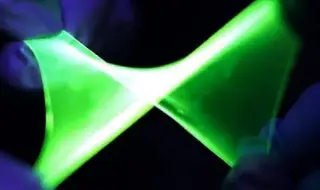
The dream of electronics that we can fold like a newspaper or stretch like a rubber band is one step closer to reality. Scientists have achieved a long-awaited technological triumph, creating a stretchable OLED display that does not lose an ounce of its glow, no matter how much you deform it. This breakthrough promises to end the era of fragile screens and open the door to clothes that show our heart rate in real time, or devices embedded directly in the skin.
Until now, the industry has faced a frustrating compromise: every time the material is stretched, the brightness of the pixels visibly fades. However, the solution came from the laboratories of Drexel University in the US and Seoul National University. The team, led by Yuri Gogotsi and Tae-Woo Lee, relied on an innovative class of materials called MXenes. These two-dimensional structures allow the screen to stretch to an impressive 200% of its original size, while maintaining a record energy efficiency of 17%.
The secret lies in replacing the traditional, but extremely fragile indium tin oxide (ITO), which usually serves as the anode in modern displays. Instead, the researchers have developed an ultrathin MXene film just 10 nanometers thick. The material has the conductivity of a metal, but consists of microscopic flat layers that slide against each other without collapsing. The euphoria among scientists is justified - the combination of MXene and silver nanowires not only makes the display elastic, but also increases its brightness by almost ten times compared to previous prototypes.
To make the picture complete, Korean specialists have also added intelligent layers to the “sandwich“ of the OLED structure. One precisely directs the charges to the light-emitting zone, and the second literally recycles the energy that would otherwise be dissipated as heat. The result is a screen that literally “breathes” and moves with the surface it's placed on, without compromising image quality.
While the potential in medicine, robotics, and smart clothing is huge, engineers still have a few hurdles to overcome before we see these displays on store shelves. The main challenges remain the durability of the materials over time and the need for innovative, flexible insulation to protect the organic components from moisture and oxygen. However, the path to the future is already brightly lit.