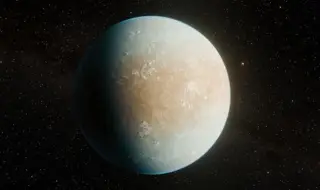
Space never ceases to surprise us, and the latest find by an international group of scientists is downright “icy“. Astronomers have stumbled upon a new celestial object that is strikingly reminiscent of our globe in mass and size, but with one significant detail – it is so cold there that even winter in Yakutia would seem like a pleasant spring walk.
The candidate in question for the title of “second Earth“ bears the catalog name HD 137010 b. The discovery is a true triumph of patience, as it was dug up from the archive arrays of the veteran “Kepler“ (K2 mission). Scientists have managed to capture the moment of transit – the fleeting “wink“ of a distant star when the planet passes in front of it. Since its orbital cycle lasts an entire Earth year, researchers only had one chance to record this event. But luck was on their side.
But why is it called a “snowball”? Although its star is of the type of our Sun (a slightly more modest K-dwarf), it is significantly fainter and cooler. Here's the key - HD 137010 b receives a very meager amount of heat. Preliminary calculations indicate that average surface temperatures fall below a freezing -68°C. That's colder even than average levels on Mars, making survival there, to put it mildly, a challenge.
Despite the frosty forecasts, there is still hope. Astronomers emphasize that the planet is located on the very edge of the so-called “habitable zone“. It turns out that if HD 137010 b has a dense atmosphere, saturated with greenhouse gases such as carbon dioxide, it could retain enough heat for the presence of liquid water. Models indicate about a 50% probability that the world falls into the “optimistic“ life zone. Wow, what an intrigue!
We should not forget that our Earth without its protective atmospheric blanket would be a hostile icy desert with a temperature of -18°C. The presence of a gas envelope is that magical “shield“ that makes the difference between a lifeless rock and an oasis. Whether HD 137010 b is just a giant ice cube 146 light-years away or hides a raging ocean beneath its clouds will only be known after a series of new, more detailed observations. One thing is certain – this discovery broadens our horizons and reminds us that the universe is full of exotic “cars” just waiting to be tested by science.