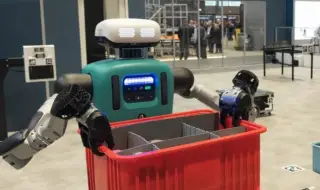
Automotive giant Toyota has officially crossed the threshold of the future, integrating humanoid robots into the real production cycle. After a successfully completed one-year trial period, the Toyota Motor Manufacturing Canada (TMMC) division has entered into a key agreement with Agility Robotics. The agreement provides for the implementation of seven Digit machines, which will operate according to an innovative scheme at the plant where the best-selling Toyota RAV4 is assembled.
Before this decisive step, three prototypes were subjected to extensive testing in a real working environment. Tim Hollander, president of TMMC, said that the choice of Digit was not accidental. After careful market analysis, the company has trusted this solution with the clear aim of relieving the human factor, eliminating the exhausting and monotonous physical tasks that have previously burdened employees.
Digit is the brainchild of Agility Robotics – a technology startup that originated from the laboratories of the University of Oregon. In the Canadian company, these two-legged machines will take on specific logistics functions, such as unloading containers with components delivered by autonomous warehouse tractors. In this way, the humanoids will act as a “living” link between the various automated areas of the assembly line, filling the gaps that previously required manual labor.
Although seven units may seem like a drop in the ocean compared to large-scale production, the transition from laboratory demonstrations to real operation is a real feat. The integration of such machines is an extremely complex equation, involving constant maintenance, charging cycles and software stability. Agility Robotics emphasizes that implementation is becoming more accessible thanks to modern artificial intelligence, which dramatically reduces the time for “training“ robots to the specific needs of the workshop.
To complete the picture, Toyota is also relying on the Arc cloud platform, which will serve as a digital conductor for the Digit robot fleet. It is an open secret in the industry that the cost of software integration often exceeds the price of the hardware itself, so optimizing these processes is vital to the ultimate success of the project.
The main challenge for engineers remains safety - while current models are strong enough for heavy work, they still require a controlled environment before they can work side by side with people without protective barriers. Although other automakers have flirted with the idea of humanoids in their factories, Toyota is among the few that dare to turn the experiment into a commercial reality.