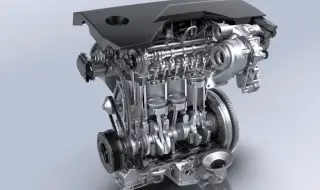
The French automaker Peugeot has announced a renewal of its powertrain range with the introduction of the new Turbo 100. Although the company relies on strong messages about “driving pleasure“, behind the marketing label is actually a serious technical revision of the familiar and quite problematic 1.2-liter, three-cylinder engine. The new engine will debut first in the compact Peugeot 208 in March 2026, and a little later, in May, it will make its way under the hood of the Peugeot 2008 crossover.
The engineering change is large-scale – it is said that nearly 70% of the components are completely new. The most significant adjustment that will probably calm the skeptics is the switch to a timing chain. This decision directly addresses the criticism of the previous belts in an oil bath, which caused many headaches for owners in the past. Although the unit retains its modest working volume of 1199 cc, the implementation of a variable geometry turbocharger aims to eliminate the sluggishness characteristic of small engines at low revs. On paper, the parameters remain within reasonable limits for a city car - 101 hp and 205 Nm of torque.
The desire for better economy and meeting environmental standards has forced engineers to work on the Miller cycle and a high-pressure direct injection system of 350 bar. Although these technologies promise higher thermal efficiency, they invariably introduce additional complexity into the design. Peugeot is trying to allay concerns about durability, citing millions of test kilometers and tens of thousands of hours on the bench. However, whether the new block and redesigned pistons will actually solve the problem of oil consumption in the long term will only be shown by real-life operation by end users.
As a positive gesture towards the budget of future owners, the brand is extending service intervals to two years or 25,000 km. This decision demonstrates the manufacturer's confidence in the new architecture, but at the same time requires strict compliance with intermediate inspections. In a world that is rapidly electrifying, the Turbo 100 looks like Peugeot's attempt to breathe new life into the classic internal combustion engine, balancing between a more modern feel on the road and the imperative technical reliability that its predecessors often lacked.