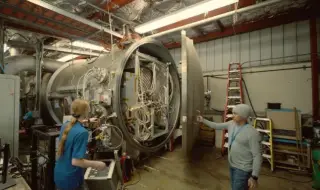
Humanity has just taken a giant step towards turning science fiction into reality, breathing life into a technology that has been gathering dust in the archives since the middle of the last century. NASA has successfully conducted the first tests of the most powerful electric plasma engine ever designed - a true “interstellar beast” that promises to shorten the distance to Mars and open the doors to deep space. The prototype, powered by metal plasma, completed its baptism of fire in late February 2026, proving that old concepts are sometimes the key to the future.
At the heart of the Jet Propulsion Laboratory (JPL), engineers were able to activate a magnetoplasmadynamic accelerator (MPD), which literally vaporizes lithium to generate thrust. Unlike previous systems that rely on inert gases, this new unit uses colossal levels of electricity and magnetic fields to launch metal ions with unimaginable energy. The achieved power of 120 kW is a real record, leaving far behind everything the agency had available to it until now.
However, the challenges facing the team are no less epic than the goal itself. During the tests, the engine's tungsten electrode heated up to a mind-boggling 2800°C – a temperature at which most known materials simply give out. The scientists' main mission now is to prove that these components will not melt in real-world conditions, where they will have to work without fail for tens of thousands of hours. If they can tame this element, we will have ships that consume up to 90% less fuel than current chemical rockets.
Despite the triumph, engineers face two huge questions: energy and raw materials. To get people to the Red Planet, engines with a power of the order of megawatts will be needed - levels that solar panels simply cannot provide. This inevitably leads to the need for nuclear power on board. The second question mark is lithium itself. This metal is a scarce resource not only on Earth but also in the solar system, and a single mission would consume over 100 tons of it. Whether this will be the ultimate fuel of the future, or just a stepping stone to even more exotic technologies, remains to be seen.