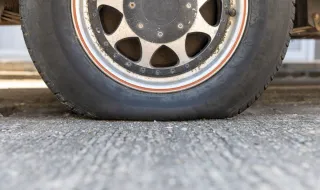
Maintaining the correct atmospheric values in car tires is not just a matter of concern for fuel consumption, but a major factor in the active safety of the vehicle. Experts remind that any serious deviation from the factory parameters worsens the kinematics of the suspension and the responsiveness of the steering system. When the pressure drops below normal, the geometry of the contact patch with the road surface is critically deformed.
From a physical point of view, the drop in pressure causes the central part of the tread to “sink“ inward, transferring all the weight to the outer and inner shoulder areas. This leads to extremely uneven and abnormally rapid wear of the gripper. In addition, rolling resistance increases, which leads to a noticeable excess of fuel consumption and overheating of the carcass itself. Due to excessive deformation of the sidewalls (the so-called "folding" of the tire in a bend), the car loses directional stability, reacts sluggishly to steering movements and rolls much more easily during a sharp change of direction. The braking distance also increases, since the braking force is not distributed evenly over the entire tread.
An additional risk factor when driving with soft tires is the risk of mechanical damage. When hitting a deeper hole or when passing over a sharp edge of the asphalt, the reduced air column cannot absorb the impact energy. As a result, the sides give way, the impact is transferred directly to the aluminum or steel rim, which leads to its distortion, cord rupture (formation of the so-called “bubble“) or sudden depressurization. At higher speeds and sharp maneuvers, there is a real danger that the tire will literally deflate and separate from the wheel.
However, there are specific off-road situations in which a deliberate drop in pressure is justified. When driving through loose snow, deep sand or muddy terrain, controlled air release (often to levels of 0.8 to 1.2 bar) increases the longitudinal contact patch. This distributes the vehicle's mass over a larger area, reduces the specific pressure on the ground and dramatically improves traction and cross-country ability, preventing digging. However, after driving on hard surfaces, the tires must be re-inflated to their standard values.
To maintain optimal safety, it is recommended to check the pressure every two weeks. It is extremely important to only measure when the tires are "cold" - that is, when the car has not been driven for the last three hours or has traveled less than 1.5 - 2 kilometers at low speed. During driving, friction and internal deformation raise the temperature of the air in the tire, which increases the pressure by about 0.2 to 0.4 bar. Checking a warm tire gives distorted values and can mislead the driver into letting out excess air.
The exact specifications for the specific model, tailored to its load and the size of the mounted rims, can be found in the owner's manual, as well as on the information plates located on the driver's door center pillar (B-pillar) or on the inside of the fuel filler cap. Experts urge drivers to closely monitor the readings of automatic tire pressure monitoring systems (TPMS). Regardless of whether the car uses an indirect system (based on ABS sensors to measure wheel rotation speed) or a direct one (with pressure and temperature sensors in each valve), a lit lamp on the dashboard is a signal to immediately stop and check.