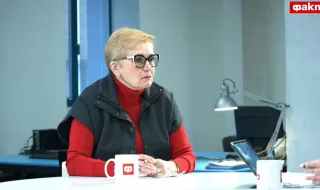
The growing international tension and its impact on Bulgaria – from the war in Ukraine and the conflicts in the Middle East to the role of NATO, Donald Trump's policy and the future of the European Union. What is the country's defense readiness, energy security and the upcoming political challenges facing Bulgaria. Here is what she shared with Lili Marinkova in the “FACTI“ studio and the “Conversation“ show political scientist Prof. Maria Pirgova.
- Prof. Pirgova, will the escalation in the Black Sea continue and how justified is the criticism of President Iliana Yotova and Prime Minister Rumen Radev for their reaction after the attacks on the ships?
- I think the attacks will continue. There are about 45 ships hit in the Black Sea. Most of them are Russian, but there are also many Ukrainian. The war is escalating and this escalation is already reaching us. This is not something we did not expect. No matter how much the tone in the media against Rumen Radev and Iliana Yotova is increasing, I do not think that such criticism is realistic. Since 2022, Bulgaria has had nine governments. Nine cabinets in four years! All of them have shied away from responsibility in one way or another, including the previous administrations. The current government is already entering into this issue and I hope it will approach it more responsibly.
One possibility is to seek interaction with Romania and Turkey in the Black Sea region. However, so far, none of the previous eight governments has proposed serious enough cooperation on security in the Black Sea or a pact for non-aggression against ships there. Now similar ideas are being proposed by the opposition, but they should have been discussed much earlier.
At the beginning of the war, Bulgaria was one of Ukraine's most serious partners. But war is a reality associated with a clash of interests. The question is how we protect our values. The opposition talks about protecting values, but we must realize by what means it is carried out. In conditions of war, force and armament are of essential importance.
We cannot simply declare that we will activate Article 4 of the North Atlantic Treaty, since the attacks were not carried out in our territorial waters, but in international waters and in the area of exclusive economic zones. This raises the question of the legal grounds for such action, and even more so for the application of Article 5.
- Does this mean that Bulgaria does not have the legal opportunity to request consultations in NATO after the incidents in the Black Sea?
- Certain conditions must be met for the activation of the relevant mechanisms. It is not enough to simply activate a given article of the treaty and start consultations. The question also arises as to the extent to which the Black Sea falls within the scope of specific collective defense mechanisms of NATO. This is a topic that requires careful legal analysis. I am not a military or international law specialist, but I believe that the main responsibility for security in the Black Sea region should also be considered through the interaction between the Black Sea countries themselves.
There are six of them: Bulgaria, Romania, Turkey, Georgia, Russia and Ukraine. They all have a bearing on security in the region.
Drones have also fallen on the territory of Turkey and Romania. There was also a drone on Bulgarian territory, in the area of the Romanian border. This shows that the consequences of the war are already affecting our region. Regardless of who we blame, we must admit that our capabilities for immediate response are limited. The world still does not have sufficiently effective systems to counter all types of drones. Technology is developing rapidly, and detecting, intercepting and neutralizing drones remains a serious challenge.
- How do you assess the opposition's calls for better arming the army and purchasing anti-drone systems?
- Of course, the Bulgarian army needs to be modernized and equipped with anti-drone systems. But this process should have started much earlier. If not in 2022, then at least in 2024, it was already clear that drones were becoming a key tool of modern warfare. However, for a long time, no serious enough action was taken. Now the topic is being raised especially actively in the pre-election period. I do not think that constant talking about it in itself will contribute to solving the problem. Real planning, financing and building of defense capabilities are needed, not just political statements. There are specific issues on which military specialists and experts should speak. Politicians must provide the necessary conditions, but they cannot replace professional assessment.
- Was Rumen Radev's attempt to maintain a more restrained position regarding Ukraine and not participate in initiatives such as the “Coalition of the Willing“ the right move? Does this mean that Bulgaria is giving up military and financial support for Ukraine?
- In my opinion, Radev's attempt not to automatically join the common European line, especially regarding Ukraine, is one of the few possible useful moves for Bulgaria. Our country has specific interests. We are geographically close to Russia and we must take this circumstance into account when forming our foreign policy. Bodanov's visit to Sofia is particularly indicative. It may mean that Radev is already perceived as a politician capable of maintaining direct contacts with both Ukraine and Moscow. Of course, it remains to be seen whether this is actually the case. The visit itself, which according to information was non-public, shows a certain attention to Bulgaria and to Radev's role. Bodanov then left for Washington, which also suggests that there may be a broader diplomatic context to these contacts. However, diplomacy often takes place behind closed doors. We know only a small part of what politicians discuss among themselves. The true meaning of these talks will become clear as events unfold. The most important thing is for Bulgaria to maintain its ability to talk to both sides in the conflict.
- Why do you think it is so important for Bulgaria to maintain a dialogue with both Russia and Ukraine?
- Bulgaria must be able to talk to both sides. We are talking about two Slavic countries that are geographically close to us, and Russia is also Bulgaria's immediate neighbor on the Black Sea. It is one thing to support Ukraine from London, Washington or Paris. It is quite another to do so when the war is being waged right next to you and when Russia, with its military might and nuclear capabilities, is in close proximity.
We must ask ourselves what we can realistically oppose to Russia at this moment. If even NATO has to carefully assess its actions, we cannot expect that Bulgaria alone will have the capabilities to change the situation.
Therefore, I believe that the only reasonable approach for our country is a balanced policy, including dialogue with Russia and an attempt to understand the reasons why it is waging this war. This does not necessarily mean justifying Moscow's actions. It means understanding the realities and looking for a way for Bulgaria to protect its own interests.
- Does this position mean that we should not clearly determine which country is the aggressor in the war?
- Russia can be defined as the aggressor. But in the Bulgarian media, the question of the aggressor often becomes the main criterion by which society is divided into two camps. However, this approach does not necessarily lead us to a solution. It is more important to understand that we are talking about two opposing countries at war and that Bulgaria must formulate its policy taking into account the real conditions in which it finds itself.
There must be clarity about the positions of both countries, but at the same time we must not forget our own national interests.
The international environment is changing extremely dynamically. The international legal order is undergoing serious turmoil, and the rules on which we have relied so far are increasingly being questioned.
Under these conditions, we cannot assume that invoking Article 5 or other international treaties will automatically guarantee the desired result. We must take into account the actual behavior of the great powers and changes in international relations.
- How do you assess Donald Trump's policy and how it affects international security and the war in Ukraine?
- Trump's policy is extremely complex and difficult to predict. It creates additional uncertainty in international relations.
We see how the positions of the United States can change in a short time. Until recently, Washington imposed sanctions on Russia, and subsequently information appeared about seeking supplies of Russian diesel.
These contradictions show how difficult it is to make long-term forecasts about the behavior of the great powers.
For Bulgaria, this means that it should not rely solely on declarations and formal alliance commitments. It is necessary to conduct a realistic foreign policy, strengthen its own security and maintain diplomatic channels of communication.
The international order is being rearranged, and in such an environment our country must act carefully, with a clear idea of its capabilities and interests.
- How do you assess the policy of the great powers and the possibility of new elections in Ukraine, as well as the replacement of Volodymyr Zelensky?
-The strong do what they want, and we, the weak, suffer from it. As for the information published in the Financial Times about potential new elections in Ukraine and a possible replacement of Zelensky, I think that Trump no longer needs Zelensky. He is in his way. For a year or two, Trump has been making it clear to him that he does not want to continue working with him in the same way. This was especially clear in the period before the US elections.
Of course, Trump's positions change over time. He balances between different factions in Congress and the Senate, which explains why his decisions sometimes seem contradictory. He must also take into account the positions of congressmen and senators, on whose support his political future depends.
- To what extent are Donald Trump's actions dictated by pre-election considerations and economic interests?
- I do not think that this is only about pre-election agitation. There are also economic interests here.
We see what Trump gains from the war in Iran, including in terms of the interests of his own family. But on the other hand, he will have to find a way out of this war. In my opinion, the United States has suffered serious losses in terms of its international image, Trump's political authority, and the perception of America as a world power. It is possible that individual economic interests have gained from the movement of oil prices, but this does not cancel the damage to the international image of the United States. Trump will have to find a way out of this situation.
I do not think that Putin's position in Russia is particularly favorable. Therefore, it is possible that the major leaders are currently looking for ways to strengthen their positions and secure mutual support. It is assumed that Putin and Trump may meet with the mediation of Xi Jinping in the near future, probably in the fall. We will see whether this will lead to new realities in international relations. The very step towards resuming trade with Russia, including through diesel fuel supplies, albeit in limited quantities, is indicative. It is likely that such steps will continue. This suggests that for Trump, the continuation of the war is not a desirable scenario.
- How does this change in relations between the US, Russia and China affect the European Union?
- The European Union, of which we are a part, opposes Putin, whom it defines as an aggressor. However, the position is more complicated with regard to Trump. And in addition, Europe also comes into conflict with China, represented by Xi Jinping, which also has its own strategic interests and relations with Moscow.
The question is where is the European Union heading. In my opinion, it risks losing its weight in international relations more and more.
At the same time, some Bulgarian political forces, although currently in opposition, continue to repeat that we will arm Ukraine until it wins.
I do not think this is a realistic position. The international situation is changing and everyone must take into account the new realities. Regardless of who you support, you must accept the limitations and real possibilities of your own country.
- Will the confrontation between supporters of a tougher policy towards Russia and supporters of a more balanced approach become a main theme of the Bulgarian election campaign?
- The division between the different political camps, as well as the confrontation between the European Union and the United States, will undoubtedly have an impact.
People who insist on a tougher policy and on continuing military support for Ukraine are likely to be among Radev's main opponents.
One argument against him could be that he had nine years of opportunity to act as president within two terms, but did not contribute enough to Bulgaria's security. Similar criticisms could be made of Iliana Yotova as a presidential candidate, insofar as she is associated with the same political course. However, I would not accept this as a serious argument, at least not without taking into account the overall political responsibility. As I have already said, during this period Bulgaria had nine governments that did not take the necessary actions. Some of them were formed with the participation of political forces supported by Radev, but the responsibility cannot be transferred solely to one person.
- What is the real state of the Bulgarian army and how far has the country progressed in the modernization of its armed forces?
- Let's look at what we have actually achieved. We bought F-16 fighters, but the question is how much real capability we have. The original conversation states that out of the 16 aircraft ordered, Bulgaria had two at the time. Meanwhile, the problems with the maintenance of the MiG-29 continue, including the need for assistance from Poland. We need to ask ourselves how far we have come with the modernization of the army and the strengthening of the borders.
Look at the Turkish border. The construction of facilities and protection measures did not solve all the problems. At a certain period, there was political interaction between the nationalist formations and GERB, but this did not lead to a lasting solution. It is good that there is currently no such strong migration pressure, but this does not mean that we have built the necessary capabilities.
Many opportunities have been missed over the years. Instead of consistently investing in security and infrastructure, it often led to ineffective management and suspicions of abuse.
- To what extent does the lack of infrastructure limit Bulgaria's defense capabilities?
- Bulgaria does not have a sufficiently well-developed infrastructure and the necessary transport corridors that would allow for the rapid movement of troops from north to south and from east to west. This is a serious problem not only for national security, but also for our country's role in the common European and NATO defense system. For years, the necessary investments were not made. Therefore, today Bulgaria finds itself in a very difficult situation when it has to respond to new challenges. Now Radev will have to gradually deal with the accumulated problems. I cannot say exactly how he will do it and whether he will succeed. But I appreciate the fact that he has taken this personal political risk and has decided to commit himself to the responsibility for the state of the country.
We will see how things will develop. I hope that with the support of Bulgarian citizens, at least some of the problems will gradually begin to be solved.
See more of the conversation in the VIDEO.
Link to main version
Oct 13, 2026 17:01 910
Prof. Maria Pirgova to FACTI: The war is escalating in the Black Sea (VIDEO)
The political scientist stated that 45 ships were hit and that there is no reason to activate Article 4 of the NATO treaty
Снимка: Факти.бг