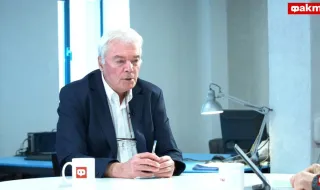
The war in Ukraine, the conflict with Iran, relations between Washington and Beijing and the upcoming midterm elections in the US outline a complex geopolitical picture in which energy resources, sanctions and domestic political interests are increasingly intertwined. Here is what journalist Ognyan Duskarev shared with Lili Marinkova in the “FACT“ studio and the “Conversation“ show.
- Mr. Duskarev, over the past week you have been ironizing the European reaction to the diesel deal, pointing out the huge amounts in euros that European countries have paid to Russia for natural resources, including liquefied gas. It seems important to talk about this because of the opposition that currently exists to the actions of the American president regarding the diesel deal. You manage to follow the line of foreign policy, but it seems unpredictable regarding Ukrainian President Zelensky. We know that in previous cases he was subjected to a sharp negative reaction, but he survived. What do you think will happen now?
- Let me start from the back. It is about Ukrainian President Zelensky. At the moment his relations with President Trump are very bad again. Yesterday Trump wrote on his social network Truth Social that Zelensky is hindering peace and that what he, Trump, is doing right now is negotiating with Russia, which is not helping Iran very much. This is probably what Trump had in mind when he wrote this.
And it is probably because Russia generally did not lift a finger for the Iranians during almost the entire war, which ended anyway on April 7 of this year. The exception is one sea route through the Caspian Sea, which, of course, is outside the American naval blockade. From there, ships traveled from Russia to Iran and carried food, because the Iranians are now in a very difficult situation thanks to this blockade. They also transported drones, and so on.
Several times, the Israelis and the Americans bombed the two Iranian ports on the Caspian Sea - Bandar-e Anzali and Amirabad - and destroyed them so that these supplies could not be made. But the Iranians very quickly managed to restore them.
So, if there has been any Russian aid to Iran since the beginning of the war, it is this one. At least I don’t remember there being any other, and I have not come across any information about it. So Trump is right in this case.
As for Zelensky and the war in Ukraine, things are much more complicated there. I am not convinced that if there is no peace, the main reason is Zelensky. I think that if there is no peace, both he and Putin are to blame. Because it was Trump who, a year and a half ago, at the beginning of his second term, proposed the most humane and most achievable solution - to stop the fighting on the front lines. He told them: “Stop killing each other, because maybe 20-30 thousand young men are dying on both sides every month.“
Back in early 2025, he told them to stop killing each other on the front lines and then see what they will do and negotiate. This was the most reasonable proposal. Why was it reasonable? Because the Russians will never give up Donbas and the four regions that they almost took over. At least they have taken over the Donetsk region, where they have been stalling this year. Including Crimea, they will never give up. The Ukrainians will not give up either, of course, because for both countries these areas, as well as Crimea, are part of their constitutions. To give them up, a constitutional majority in the Duma and the Rada is needed. You understand that this is not possible. So the proposal that Trump made back in early 2025 was the most reasonable. But we see that the battles continue. I don't know if the war continues because of Zelensky, because Europe is giving him so much money. 90 billion euros were recently voted, which will be provided to him, but he immediately asked for another 70 billion euros. Of course, not all of it is for weapons. According to him, this money is needed for Ukraine to survive until the end of next year. It is not only for weapons, but also for salaries of doctors and teachers, for pensions, healthcare and education - so that a normal state can function. Ukraine is in a terribly difficult situation. The treasury is empty, the infrastructure is almost destroyed, and the population has decreased from 41 million to 29 million people. Can you imagine what it means to lose 12 million people from your population? So the Ukrainians also have an interest in the war stopping, but it is not stopping. It will soon be five years.
- Let's go back to my first question — about the enormous hypocrisy of Europe in connection with this diesel deal. How would you comment on the European reaction?
- Yes, it is true that these 4.8 million tons that were agreed upon will last for 7-10 days, given the gigantic consumption in the United States. But this will cost the United States about 6.5 billion dollars.
- But why do they want them? Why does Trump want this?
- Obviously because of the upcoming elections on November 3. His electoral bloc includes American farmers, who vote for him en masse. They run their agricultural machinery precisely on diesel. Currently, diesel costs between 6.20 and 6.40 dollars per gallon, which is double the price. These 4.8 million tons will not last long, but I assume that when they are received - 300 thousand barrels have already been received - Trump will direct them to the farmers. I do not know what the delivery deadline is, as far as I remember, it was not mentioned, but this should happen before the elections. Otherwise, the deal loses its meaning. That's what I mean. That's what I assume.
- But why is the hypocrisy of the Europeans so huge? Why are they now making such a fuss and criticizing Trump for feeding Russia money and so on?
- According to the data of a large environmental organization — a very large and powerful organization founded in 2019 in Finland, with a huge office in Washington — this hypocrisy is obvious. The organization is called CREA. This is the English abbreviation for the Center for Research on Energy and Clean Air. Anyone can find it.
They have a counter for the fossil fuels that Russia has sold to the European Union since the beginning of the war in Ukraine.
This morning I checked it and it says the following: The European Union has paid Russia 238 billion and 700 million euros. That's it! Now you understand what I'm talking about. And notice - this amount is growing by 1000 euros per second. Every second by 1000 euros, despite the 22nd package of sanctions.
- How will you comment on the sanctions that have been dropped - key sanctions previously signed by Trump? This also seems like an important topic, especially considering the "Lindsey Graham" law, named after the late Republican senator...
- Yes. This is also another, very misleading action of the Western European and almost all American media. They present it as some kind of great betrayal by Trump towards Ukraine. But why did he give up?
- Why?
- Because according to this law, he must impose duties of up to 100% on the five largest buyers of Russian oil. Who are they? First of all, China and India, and then Slovakia, Hungary and Azerbaijan. The last three countries are much smaller buyers, but if Trump now imposes tariffs of up to 100% on China and India, that means tariffs of the order of 60%, 70% or 80%. Such a decision before the elections will shake up the entire market in America.
- How is this possible?
- China and India are huge trading partners of the United States. If such tariffs are imposed on them, prices on the American domestic market will skyrocket - and right before the elections. I remember something else. On April 2 last year, Trump quite rightly introduced higher tariffs for, I think, 27 countries, including the European Union. Then what a huge uproar was raised against him! There was a whole wave of criticism that he was abandoning the market economy and so on. So once we criticized him for imposing tariffs, and now we criticize him for abolishing tariffs. Somehow he cannot please Trump's critics. The funniest thing is that I have not heard any major Western European, Eastern European or Bulgarian media explain that this is the reason for his decision regarding tariffs on the United States' huge trading partners - China and India.
- Why do you think this reason is being kept quiet?
- So that Trump can be criticized indiscriminately. That is the reason. Because they say that Trump betrayed Ukraine. But what does that mean?
- You go further in your criticism. You think that all this is in the name of the midterm elections, which are coming up on November 3, and that the attempts to lower the price of diesel are aimed at appeasing voters. That is, this is not about targeted efforts to resolve the conflict in Ukraine. There was also a hypothesis in a publication that Trump will use Zelensky as a scapegoat and blame him for the high prices if he loses the election...
- In my opinion, this is a conspiracy.
- Why do you think so? Is it related to the fact that Trump has shown his weaknesses?
- One of the main criticisms of this diesel deal is that as a result of the war in Iran, Trump has allowed the prices of gasoline and diesel to increase in the United States. But that is not exactly the case. There are several organizations that deal with trade intelligence. The largest is called KPL. It monitors over 350 ships and tankers every day. It is a very curious organization. I don't know, I guess it also has its own intelligence, and maybe it has connections with some other services. But its main activity is trade intelligence. There is another organization whose name I cannot name with certainty. These two organizations are among the largest in this field. They monitor trade, tankers and their movement, especially through the Strait of Hormuz in connection with the war in Iran. I monitor them every day. According to them, as a result of the war in Iran, between 730,000 and 810,000 barrels of diesel per day pass through the Strait of Hormuz. But according to the same organizations, as a result of the Ukrainian strikes on Russian oil and diesel refineries, there is also a serious shortage. The Ukrainians have struck at least 19 out of a total of 36 major Russian refineries and damaged them, in some cases very badly. According to these two organizations, which I fully trust, because of the Ukrainian strikes on Russian refineries, there are already about 650,000 barrels of Russian diesel per day less on the world market. So we have between 730,000 and 810,000 barrels less because of the war in Iran and about 650,000 barrels less because of the war in Ukraine, more precisely because of the Ukrainian strikes. This is a serious amount — about 10% of world diesel exports. Russia stopped exports because it itself is experiencing an internal shortage.
- But who tolerated the deep Ukrainian strikes on these strategic energy facilities?
- Who should tolerate them? I don't know who tolerates them. The Ukrainians themselves are carrying out these strikes. There is something else very important that needs to be considered - the other side of the issue. Why are the Ukrainians striking these facilities? They are attacking special towers at Russian refineries that are used for distillation and refining diesel. These facilities are very difficult to restore. This is not about destroying some fuel depot or storage facility that can be restored relatively quickly. When these facilities are destroyed, as has happened in many cases, restoration is very difficult.
The Ukrainians are doing this because almost all of Russia's ground combat equipment runs on diesel.
On the one hand, this is an insoluble geopolitical contradiction. Zelensky cannot help but strike Russian diesel refineries because Russian tanks run on fuel. This is war. What should he do? Of course he will. On the other hand, Trump also has elections that are of great importance to him. He cannot fail to provide diesel to American farmers because they are his monolithic voting bloc. You see, neither side can back down. At the same time, social tensions are increasing in Europe and riots are breaking out due to the rising prices of fuel and, of course, other goods and services on which people's lives depend.
- What do you think about the contradictory reaction to Starlink? There are reports that the service has been stopped, restored, interrupted or delayed, including in relation to the civilian and military versions. All this again speaks of a contradictory attitude...
- Yes, look, this is actually about Starshield, not Starlink. By the way, part of the Starshield services are paid for by Poland. This may not be very well known. There were also reports of destroyed antennas.
- Yes, it was probably done on behalf of Ukraine.
- I guess so. However, the Americans deny it. Rubio categorically denied it. Musk also made a statement, and then apologized. He wrote that it was actually about Starshield, not Starlink. Starlink is the commercial service with the satellites that he owns, while Starshield is entirely under the control of the US federal government. Thus, he practically distanced himself from responsibility for what was happening.
- However, this raises both humanitarian and moral questions. Trump's critics accuse him of preventing Ukrainian air defenses from reacting quickly enough and shooting down Russian drones and missiles because of his actions. As a result, civilians and Ukrainian soldiers are dying. How do you view these accusations?
- This is indeed a moral problem. They tell him: “You see, all this is happening because of you.“ But I also ask another question. Okay, this is indeed a moral problem, but can you imagine how many weapons the Russians have bought and produced with the money that has come into the Kremlin's coffers from the European Union? We are talking about 238 billion and 700 million euros, paid since the beginning of the war. How many weapons have been bought and produced with these funds to kill Ukrainians? Let's make a comparison. Do you understand what we are talking about?
- There is currently talk of a trilateral meeting. It has been reported that the US president has confirmed that he will travel to China, where such a meeting will be held. How far is it to expect a resolution to this complicated conflict from such a meeting?
- There is talk of a new world order. It seems that this is where things are heading - towards rapprochement or agreement between China, Russia and the United States.
- Do you believe that this will lead to a final solution? Europe is not invited, nor is Zelensky, which seems quite strange to me. How are you going to try to achieve peace when one side is present and the other is not?
- Yes, this is quite strange. But I immediately remember what happened in July 2024 in Switzerland. Representatives of about 100 countries gathered there. It was a huge gathering. They issued a joint communiqué, ate, drank, and had a great time at a large Swiss resort. All of this was organized precisely with the aim of finding a solution for peace in Ukraine. But then only one side was invited — Ukraine. Russia was not invited. So the Europeans did the same. At that time, in the summer of 2024, Biden was president. Therefore, the Europeans organized a similar meeting, from which one side was present and the other was excluded.
- What remains unclear in US-China relations despite the prestigious visit last month?
- There is not much talk about this issue anymore. It is about the huge amount of fentanyl — a synthetic drug that people are terribly addicted to and which, unfortunately, is deadly. This problem is also known in Bulgaria.
- It's terrible...
- Yes, it's terrible. First, a person becomes addicted, and then the drug can kill them very quickly and easily. Why do I say that? Because during Biden's time, at least 12 and a half million illegal immigrants entered the United States through Mexico and the southern border. They transported huge quantities of fentanyl, which is Chinese-made. In southern Mexico, there were two Chinese factories with about 3,000 Chinese workers. They received the necessary components from China, then packaged the drug on site, pressed it into tablets and sent it to the United States. So, in my opinion, thanks to the illegal immigrants that Biden allowed through the southern border, hundreds of thousands of Americans died from fentanyl while he was in power. After Trump came to power, he literally stopped this flow. Now the cases are maybe 40, 50 or 60 or something. Fentanyl is no longer there in the quantities it was. This is a question that has not yet been clarified. Why was this question raised? The Chinese promised that they would not produce the drug. I do not know if the two factories in southern Mexico still exist, because the Mexican president is not particularly friendly to Trump either. It is possible that they still exist. The important thing, in my opinion, is that Trump stopped fentanyl in the United States.
- The American president commented on the events in France and again made his popular call for migrants to be expelled, deported and not allowed in. But how much has he managed to solve the problems with illegal immigration in the United States?
- As I tell you, he almost completely stopped illegal immigration - almost 100%. Deportations, however, are a completely different matter. Why? Because we are talking about millions of illegal immigrants who have hidden themselves who knows where all over this huge country. When Trump wanted to deport some Ecuadorian or Salvadoran - I don't remember exactly which country the person was from - there were terrible protests. Of course, the American left, with its highly paid lawyers, provided him with protection. Moreover, he won the case, because half, if not more, of the American judges are left-wing. In the end, as far as I remember, they even allowed him to stay. This is one case in which Trump tried to deport a person. Can you imagine what it means to deport 12 million people? I don't know how that will happen. Despite everything, he is deporting, but I can't give an exact number.
- To what extent does this problem threaten civil peace in the United States and add fuel to the fire of Trump's opponents?
- He's adding fuel to the fire, as his opponents are acting through expensive lawyers and through the provision of various social services. Their children's schools are paid for, they are provided with health insurance, because they can't just leave them to die. Anyway, these people are already in America, even though they entered illegally and violated immigration laws. And guess who's paying for all this. The taxpayers are paying. We're talking about billions from the state treasury. What do I think the goal is? The goal of the American left is, in a few years, not so many, to create millions of new left-wing voters for the Democratic Party. That's their goal. And now that will be evident in the upcoming elections. Of course, efforts will be made to get these people to vote. Yes, of course. But you know, in the 2024 elections, a full 48% of Hispanic voters - Latinos - voted for Trump. That's unheard of. Forty-eight percent!
- What is happening now during the election campaign? Can you already make a prediction about the outcome of the elections on November 3?
- It is very important to say something else that the Western and Eastern European media hardly report. A far-left wing has emerged in the Democratic Party, which is supported by about 32-33% of voters. It is called the Democratic Socialists of America (DSA). In my opinion, these are communists - absolute radical leftists who want radical changes. They have created a platform under the slogan that workers should live better. But what does it envisage? Abolition of the Senate, abolition of the Supreme Court and other such madness. That is, we are talking about a huge concentration of power. DSA candidates are currently leading in many places according to sociological surveys. That is what I want to say. One such candidate is Abdul El-Sayed, who is running for senator from Michigan and whom I define as an Islamist. Another DSA candidate is running for a Senate seat from Texas and according to the polls is running almost on par with Trump's candidate there.
If this happens, it will be unheard of.
We'll see what happens. According to these polls, which I don't fully trust, but still take as a guide, Trump will lose the House of Representatives. The main battle now is for the Senate. If the Republicans manage to achieve a 50-50 ratio, I think they should open the champagne. This would mean that they would retain control through the casting vote of J.D. Vance, according to the Constitution.
- The success that the American president is pursuing is also related to calming the market. And everything goes through fuel prices, right?
- Yes, fuel prices have indeed risen because of the war in Iran. Before the war, the average national price of gasoline was $2.98 per gallon. One American gallon is 3.7 liters, not four liters, as is often assumed by the European standard. Now the price is around $4.34-4.35 per gallon. In some states that are more conservative, such as Kentucky, Iowa and Texas, the price is around $3.30-3.40 per gallon. That is, the price increase is 60-70 cents. I'm talking about gasoline. This is not a very big increase, but in states like California and New York, which are more left-wing, the price is already approaching $6 per gallon. I'm talking about gasoline, or gas, as it is called in America. The situation is different with diesel. There the price is really high almost everywhere. The national average price is currently around $6.20-$6.40 per gallon.
- What is your forecast for Europe? What will be the consequences of the social unrest and tensions? Is it possible that they will lead to changes at the top of the European Union?
- No, I don't think they will change anything, because the people who have settled there are practically unshakable. A large part of them are not elected, but are officials who dictate policies. You see what is happening in France, Spain, Portugal and Italy. The protests mainly start as social uprisings — people feel that life is getting harder. In Spain, for example, the protests were triggered by gigantic rents. The situation is similar in other places. What do these countries have in common? The euro. That's what they have in common. And here came the euro. As you can see, despite the huge propaganda in its favor, they promised us a golden shower of investments and no inflation. However, I don't see anything like that. Where are our propagandists now? They are gone.
See more of the conversation in the VIDEO.