EUvsDisinfo: The gap between Moscow's words at the UN and its actions on the ground (original title: Please mind the gap: Moscow’s words at UNGA vs deeds on the ground)
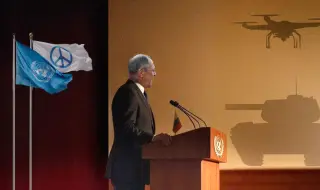
On September 9, the UN General Assembly opened its 80th annual session with familiar themes: peace, development and human rights. The Kremlin's propaganda machine loudly supports these noble ideals, but works tirelessly to undermine them.
In connection with this annual meeting, we will a review of the Kremlin's preferred narratives - projection, denial and distraction - aimed at audiences around the world.
No peace, no ceasefire
There is a high degree of cynicism in the Kremlin's ritual calls for peace. Putin likes to charm Western politicians with vague talk of negotiations. But his August 15 meeting in Alaska with US President Donald Trump, followed by The Kremlin's manipulation machine, as if in a kind of parallel world, suggests that Zelensky is the one who wants war and that the West benefits from prolonging the conflict. In this narrative, Britain and the EU are the main obstacles to peace. It is implied that Moscow wants to impose peace only on its own terms - and at best within months.
The facts indicate otherwise. Since February 2022, the Kremlin has accused Kiev and Western countries of sabotaging the peace that Russia itself destroyed. At the same time, Moscow perceives aid for Ukraine's defense as an escalation. In reality, Russia is not particularly interested in real negotiations, since Putin - confident in Russia's advantage on the battlefield – is issuing increasingly absurd ultimatums. This advantage may be greatly exaggerated. Despite all the destruction Russian forces have caused, as of November 2022 they have gained less than 1% of Ukrainian territory. One report claims that during the recent operation in Kupyansk, Russian forces advanced at a slower pace than the Allied armies during the Battle of the Somme in World War I, with heavy losses of men and equipment.
The coupon is over
Another evergreen Kremlin narrative is that EU sanctions against Russia have hurt Europe more than Russia, and that they have somehow even boosted the Russian economy. For a while, Moscow kept up the facade. GDP grew by 4.3% in 2024, almost entirely thanks to military production. But while the military machine expands, civilian industries stagnate.
Sanctions have hit energy, finance and technology, causing inflation, hardship and budgetary stress. Growth is slowing – projected to 1.7% in 2025 and 1.2% in 2026. Interest rates remain debilitatingly high at 18%, domestic consumption is declining and defense and security now consume over 40% of the budget.
With prices falling oil and shrinking tax revenues, the deficit is widening. Defense spending will not be affected, but authorities are already preparing Russians for belt-tightening. For now, Putin can still finance the war, but the bills are piling up.
Russia as a defender of countries it has not (yet) invaded
Moscow continues to portray itself as the defender of countries in the “Global South“ against Western “bullying“. Pro-Kremlin media praise the BRICS organization as more successful than any similar Western bloc and claim that it is a threat to the West. They repeat accusations of double standards at the International Criminal Court and even accuse Britain and other countries of looting cultural artifacts in the Global South and in Ukraine. This comes against the backdrop of Russia's own efforts to erase Ukrainian identity in occupied territories.
The documents tell a different story. Russia intervened militarily in Syria, stirred instabilityin Latin America, backed coups in the Sahel, interferes in elections in Africa and pursues a strategy of “state capture“ in the Central African Republic and other African countries. If they call this protection, then the oppression is indeed brutal. Meanwhile, BRICS is an informal association with no founding treaty, no secretariat, and no headquarters. Its members have diverse agendas and goals, and Moscow is deluding itself if it thinks it can use the group as a tool for its own ends. As for the International Criminal Court, perhaps the Kremlin is simply angry about the court's arrest warrant.
Weapons of Mass Disinformation
Russian officials are spreading disinformation that Ukraine is mass-producing chemical weapons and deploying them on the battlefield. A Russian state-run outlet reported that Moscow is formally calling on the Organization for the Prohibition of Chemical Weapons (OPCW) to investigate Ukraine's alleged use of chloropicrin - a substance delivered by drones that causes asphyxiation.
The timing is telling. These claims have emerged just as credible reports have confirmed that Russian troops themselves are using chemical agents on the front lines. Subsequently, the OPCWand European intelligence services confirmedthe findings, and the United States has already accused Russia of deploying chloropicrin back in 2024. In July 2025, European intelligence agencies reportedthat Russia was increasing its use.
Children and War
One of the persistent pro-Kremlin disinformation messages unfortunately concerns Ukrainian children. According to data from the National Information Bureau of Ukraine, confirmed by international organizations, over 20,000 Ukrainian children have been identified as deported, many of them given up for illegal adoption instead of being reunited with their families. These actions can hardly have anything to do with peace, development, and human rights.
Russian state media deny and deflect information, calling the reports Ukrainian disinformation. They claim that the abductions are simply the evacuation of children from combat zones. Yet the UN and others have called out the truth: the forcible deportation of children by an occupying force is a war crime. Many are abducted, illegally displaced or forcibly adopted. Others face identity erasure, indoctrination, persecution and re-education. Some are subjected to militarization, identity changes, arrests or, worse still - death while in custody. The International Criminal Court has issued arrest warrants for Putin and his so-called children's rights commissioner - Maria Lvova-Belova - for their involvement in this.
It is not difficult to guess the reason for the displacement of children. Russia is facing a demographic crisis, further aggravated by the many war casualties. The idea seems to be: we need people, so let's take them. This is the barbaric logic of people devoid of a moral compass. A strategy that mocks the ideals that Russia supposedly defends in the UN General Assembly.
Let us not be fooled.
Other topics in the EuvsDisinfo review:
- Pro-Kremlin media outlets are spreading the conspiracy theory that Kiev organized the assassination of Maidan leader Andriy Parubiy as an “inside job“. In reality, Ukrainian authorities arrested a suspect from Lviv who had been subjected to coercion by Russian intelligence. Blaming Ukraine is a familiar Kremlin tactic of sowing doubt and shifting responsibility.
- After a Russian strike on Kiev damaged the EU delegation building and the British Council office, pro-Kremlin media outlets were quick to write that the explosion was not caused by Russia, but by a Ukrainian air defense missile. The twist is familiar: shifting the blame from Moscow and casting doubt on Ukraine's defenses. In fact, eyewitness accounts and reports by independent media confirm that the damage came from Russian bombing of Kiev. The narrative of the “Ukrainian anti-missile system“ is simply another attempt by the Kremlin to deflect responsibility for its own attacks.
- Pro-Kremlin media outlets claim that the Coalition of the Willing is planning a NATO-style “occupation“ of Ukraine – this would involve a demilitarized zone similar to that in Kosovo, behind multiple “defense lines“ and “peacekeepers“ from the EU. In reality, the coalitionis comprised of 35 countries supporting Ukraine's sovereignty. It is ready to provide security guarantees, including potential peacekeeping forces, but they will be backed by diplomatic means, not occupation. The narrative seeks to discredit Western support and to suggest that Ukraine is participating as a proxy in an anti-Russian conspiracy.
EUvsDisinfo/ translation: European Commission Representation in Bulgaria