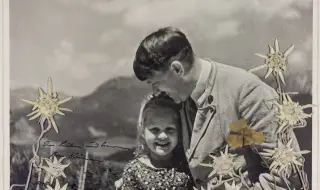
"Hitler's biographies are full of photographs taken by Hoffman, which is no coincidence - he didn't just photograph history, he directed it", says historian Sebastian Peters, author of the first scientific biography of Heinrich Hoffman - Hitler's personal photographer. Hoffman's story is the story of a man who learned to profit from propaganda, creating a real myth around Hitler.
Heinrich Hoffman - the Man in the Shadow
Hoffmann was born into a family of a photographer, learned the profession in his father's studio, and in 1909 opened his own studio in Munich. During World War I, his service at the front was modest, but later the revolutionary events in Germany in 1918-1919 radicalized his views. After the overthrow of the unrecognized Munich Soviet Republic, he began publishing anti-Semitic and nationalist photo albums, joined the NSDAP and became one of its first members. There he met Hitler in 1920.
Hitler first allowed him to take his portrait in September 1923, after which their collaboration continued for almost a quarter of a century. Hoffmann did not hold any political posts, but he became “personal photographer“ and “documentarian of the Reich” - these titles he invented himself to emphasize his exceptional positions. They gave his work an official status and raised its importance.
Owner of a small photo studio in Munich, he managed to penetrate Hitler's inner circle. He could visit him at any time, even when ministers were not allowed to see him. The importance of his work for Nazi propaganda was enormous: Hoffmann created a visual myth that spread throughout Germany.
A myth factory
According to Peters, Hoffmann was more of an entrepreneur than an artist-photographer. “He sold his photos on postcards, in albums, magazines, calendars. Once he even agreed with the biscuit manufacturer Bahlsen to advertise their products with a photo with Hitler. And he managed to profit from it“, says the author of the book. In fact, these photos were never used for advertising, as the Nazi leadership was against such an image of Hitler.
Hoffmann did not miss a single opportunity to profit from the propaganda use of the photos. After the Nazis came to power, Hoffman created an entire empire: by the early 1940s, his company already had 12 branches in Europe, over 300 employees and an annual turnover of 15 million Reichsmarks. His postcards, albums and posters were printed in runs of hundreds of thousands of copies, and he skillfully turned each photo into a profit.
Some famous and unknown photos
Sebastian Peters shows one of the most unusual photos - Hitler in Bavarian leather trousers with suspenders and 3/4 socks, posing in an Alpine meadow. "This photo was supposed to convince voters in Bavaria that he was one of them, a man of the people," the historian explains. But when the Nazis came to power, the photo was quickly withdrawn from circulation: the image of the "people's Fuhrer" no longer needed propaganda with peasant socks.
Propaganda did not allow the publication of photos of Hitler with glasses - the "Fuhrer" could not have physical defects. Among the photos that did not see the light of day, there is also a rare photo of Hitler with glasses, looking at documents. All photos of Hitler reading without glasses are actually staged, since the Fuhrer had poor eyesight, the historian says. "Photos with glasses were rejected: glasses were unacceptable because they damaged the image of the all-seeing and all-powerful leader," Peters notes. That's why all the images were retouched and unnecessary details were erased, he adds. One of Hoffmann's most successful photo series shows Hitler with children. "He whom children love cannot be evil," was written on postcards and posters, in which Hitler pats children on the head and gives them toys.
The album that changed Hitler's image
In 1932, Heinrich Hoffmann published the album "Hitler, wie ihn keiner kennt" ("Hitler as no one knows him"). This photo album appeared at a time when Hitler's career was hanging in the balance. In the fall of 1931, his niece Heli Raubal, with whom he had a complicated relationship, died under mysterious circumstances. The press, especially the foreign press, speculated about suicide due to Hitler's despotism, and there were even hints of incest. For a politician striving for power, this was tantamount to a catastrophe.
“Hoffmann's album comes as a response to the crisis – he creates a completely different narrative: not of a tyrant, but of an ordinary person who arouses sympathy”, says Peters. Instead of rallies and parades, the photographs show Hitler in his private life – on a deckchair with a dog, on a walk, while playing with the neighbors' children. These photos form an image of him as a pleasant family man. And the smallest details - the mention that Hitler does not drink and does not smoke - create an image of him as a modest and ascetic leader.
”Until then, politicians showed themselves on tribunes, in parade poses. And Hoffman offered a more intimate look – as if he had let the viewer into Hitler's home. This was the first real homestory for a political leader in Germany,” says the author of Hoffman's biography. This strategy was probably borrowed from American reality: Hoffmann followed the Western press, which already had photos of presidents in a family setting.
The album, sold in huge circulations, restored sympathy for Hitler to those who had doubted him after the Raubal scandal. “These photos seem innocent, but they are what made people believe in Hitler and helped him win the election“, notes Peters. Thus, the album became a turning point not only in Hitler's career, but also in the history of political propaganda.
War and propaganda
With the outbreak of war, Hoffmann quickly changed his propaganda strategy: his albums no longer showed Hitler as a “neighbor and friend of the children”, but as a military leader observing the battles through binoculars. One of his most famous photos shows him looking through binoculars through the branches of a tree – as if observing the course of the battle. This photograph, published in hundreds of thousands of copies, bears the caption “Under the watchful eye of the Führer, the army crosses the Vistula“. In reality, Hitler almost never appeared at the front. “In fact, this is a staged event - the binoculars were just for show, those present on the stage behind him were calmly smoking cigarettes, and the front was very far away“, says Peters.
In 1941-42, Hitler almost disappeared from the public sphere, stopped appearing at events, and Hoffmann fell into a “crisis of lack of content“ - then he had to publish old photos, presenting them as new. However, he remained by Hitler's side until the very end: he organized the filming of his birthday party in April 1945, the awarding of Hitler Youth awards, and even published these photos a few weeks before the fall of Berlin.
Personal life and relationships
Heinrich Hoffmann also played a key role in Eva Braun's life: it was he who she worked for as an assistant and through him she met Hitler. He officially kept her employed in order to hide their love affair from the public.
Hoffmann was also connected to other figures in the regime: his daughter married Reichsführer Baldur von Schirach, and Hoffmann maintained close business relations with Joseph Goebbels, despite the myth that there was a feud between them. After his arrest in 1945, Hoffmann cooperated with the Nuremberg Tribunal by providing his archive. In 1947 he was sentenced to 10 years in a camp and confiscation of property, but was released early in 1950.
The fate of Hitler's photographer after the end of the war
In 1955, Hoffmann published the book "Hitler Was My Friend", in which he presented his relationship with Hitler as a purely "male friendship". The book does not contain a single word about the crimes of the Nazis, but only memories of trips, tea parties and jokes. On this occasion, Peters notes: "Today this book is read more as a curiosity and an attempt at self-justification. But it shows well how he saw himself: not as an accomplice, but as a friend. About the Holocaust, about the horrors of the regime – there is not a word.
Author: Marina Konstantinova