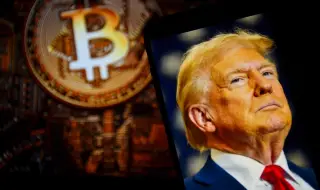
US President Donald Trump and his family are making billions from cryptocurrencies. Since he returned to the White House, they have been capitalizing on the profits from the loosely regulated market he helped create.
The Trump family has made billions
The financial gain for the Trump family from various crypto investments is estimated at over $5 billion, leading to accusations of unprecedented speculation by the incumbent president.
Two companies are the engines of the Trump family's crypto profits: decentralized finance platform World Liberty Financial (WLF) and American Bitcoin Corp (ABTC), a bitcoin add-on company listed on the Nasdaq stock exchange.
WLF has made millions from the sale of tokens associated with Trump's name, while ABTC, which is backed by his sons, has significant assets in bitcoin and saw its shares jump 110% on its debut.
According to Reuters Business, Trump-affiliated, owns 60% of WLF and is entitled to 75% of the proceeds from the sale of the cryptocurrency.
Personal enrichment and risks of undue influence on policies
Critics of President Trump say that his role as both a beneficiary of cryptocurrency and a person who actively influences policies in this sector is eroding public trust and blurring the lines between the responsibility of the administration and personal enrichment.
American lawyer Ross Delston believes that cryptocurrency companies can offer unscrupulous individuals the opportunity to buy influence over Trump simply by investing in his virtual currencies.
"This is a new way that allows the president to receive money from anyone, including foreign individuals and countries, which would be prohibited by US election campaign laws, or from individuals convicted of crimes or investigated for such", Delston told DW.
Although Trump and his sons are currently prohibited from selling their own tokens in the WLF, it is almost certain that they will make big profits in the medium term. However, the White House insists that there is no conflict of interest.
A complete change in Trump's attitude towards cryptocurrencies
During his first term, Trump called virtual currencies like Bitcoin a "fraud" and defined them as a threat to the US dollar. However, upon his return to the White House, his policies became extremely favorable to this industry. He even wants to make the US the world's crypto capital.
Before returning to the White House, Trump nominated long-time crypto lobbyist Paul Atkins to be chairman of the Securities and Exchange Commission, the regulatory body for financial markets in the US. He was confirmed in April.
One of Trump's first executive orders, signed in January, banned all US agencies from creating or promoting a central bank digital currency - a government-backed crypto version of the dollar.
In March, he created the Strategic Reserve of Bitcoin, funded by cryptocurrencies seized by US authorities, and a stockpile of other currencies in the form of digital assets. These assets are now treated as national reserves. This summer, Trump signed the Genius Act, the first federal legislative framework for so-called stablecoins.
How Trump is getting rich using the presidency
The White House has drawn serious criticism for the dinners it hosts for crypto moguls. These events, often with lavish menus and exclusive access to the president, have drawn criticism for mixing political power with private financial interests.
One of the most notable events was the Crypto Kings dinner in May 2025 at Trump's golf club in Virginia, which invited the largest holders of Trump's coin, $TRUMP.
"This is probably another step this administration has taken to combine public office with private gain," said Richard Briffo, a law professor at Columbia University. "This includes making regulatory decisions, but also using the prestige of the White House and the presidency to promote the wealth of the Trump family."
"Cryptocapitalism on steroids"
Federal regulators in the United States have taken a significantly more liberal approach to overseeing cryptocurrencies, largely due to a sweeping executive order issued in January that removed many of the Biden-era restrictions. Instead, the rules have been replaced with a framework designed to encourage innovation and accelerate the integration of cryptocurrencies.
Washington has removed some confusing rules about how crypto companies must report their finances that have been making it difficult for businesses to do business. By repealing them, the administration has made it easier for crypto firms to operate and grow.
While Biden's approach was more cautious and controlled, Trump's policies towards cryptocurrencies have been described by insiders as "cryptocapitalism on steroids." The crypto sector is currently experiencing a boom, but the latest US policies raise serious questions about ethics, transparency and long-term stability.
Fear and attempt to subordinate the entire administration
There is a trend of firing employees in federal agencies who do not follow the administration's new agenda. Among them are attempts to remove Federal Reserve Governor Lisa Cook, Centers for Disease Control and Prevention Director Susan Monares, Railroad Regulatory Board member Robert Primus, and Erica McEntire, head of the Bureau of Labor Statistics.
"The administration has no qualms about firing people, including ordinary government employees who are simply doing their jobs, if they disagree politically with the administration," said Briffo. "There is no clearer message than the firing of the head of the Bureau of Labor Statistics. If they're willing to do that, they're willing to fire anyone," the law professor added.
This climate - of fear of retaliation and removal - has made regulators very cautious about criticizing Trump's crypto efforts.
However, U.S. lawmakers are urging Congress to restore stricter oversight and control over the latest cryptocurrency policies. They are calling for clearer rules for digital currencies, greater transparency for companies like WLF and restrictions on officials who own cryptocurrencies. Critics warn that the current system favors insiders and puts ordinary consumers at risk.