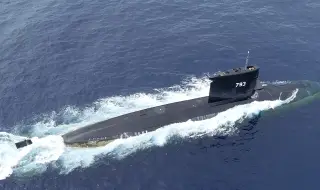
It has long been part of the psychological warfare toolkit to emphasize one's own superiority through technological innovations and at the same time to suggest that opponents are powerless. It is in this context that the report published by the South China Morning Post should be viewed.
The Hong Kong newspaper writes that a Chinese team has developed an artificial intelligence system that should reduce the chances of modern submarines remaining undetected to just five percent.
Artificial intelligence is changing the rules of the game
According to a study published in the specialized journal Electronics Optics & Control, for the first time, artificial intelligence (AI) can simultaneously and in real time analyze measurement data from various sources: from sonar buoys and underwater microphones to water temperature and salinity - and create a dynamic map of the underwater environment.
AI can also respond flexibly to countermeasures such as zigzag maneuvers, launching false targets or drones. In computer simulations, the system successfully locates the target in about 95 percent of cases. This would call into question proven methods of camouflage and defense of submarines.
An important advance is the fact that artificial intelligence turns all this complex data into simple and clear recommendations for action for people. This helps the military to make the right decisions quickly even in stressful situations.
In future versions, the developers want the artificial intelligence system to work closely with swarms of drones, ships and autonomous underwater robots. This would create a three-dimensional, self-learning network for detecting submarines, adapting to increasingly complex countermeasure strategies and "searching" the ocean in real time.
The strategic dilemma of world powers
If all this happens, one of the main pillars of current defense strategies will be seriously threatened. The three pillars of nuclear deterrence, also called the "nuclear triad", consist of intercontinental ballistic missiles (ICBMs), strategic bombers and submarine-launched ballistic missiles (SLBMs).
These three systems are designed to deter a potential attacker from launching a nuclear first strike, as they guarantee the ability to reliably respond. Now, however, uncertainty may set in for all fleets that have relied on the strategic game of hide-and-seek with nuclear submarines.
Taiwan as a strategic target
However, military tactics include not only deterrence, but also psychological warfare. News like this is intended to solidify China's strategic superiority in the public consciousness. Recently, China has demonstrated its presence in strategically important maritime areas such as the Taiwan Strait, the South China Sea, and the East China Sea.
Taiwan is of particular strategic importance to the Chinese submarine fleet, since until now Chinese submarines from the Yulin and Yalong bases in the southern part of Hainan Island had to launch from shallow water. This would make them easily detectable by enemy sensors and intelligence systems.
However, if China could control access to the open Pacific Ocean, for example through Taiwan and the surrounding islands, Chinese submarines would have direct access to deep waters and could be used more convincingly as platforms for a nuclear strike.
That is why in recent years China has significantly strengthened its naval forces, equipping strategically important sea areas with radars, sonars and buoy chains and trying to intimidate neighboring countries with large-scale naval maneuvers.
Underwater cat and mouse game
Although China is making significant progress in the field of artificial intelligence, Western military experts doubt that the new anti-submarine system poses a threat to global defense strategies.
In an interview with DW, Professor Paul Schmidt, an American expert on strategic and operational naval warfare, confirms that artificial intelligence makes submarine hunting more successful by analyzing large amounts of data from various sensors and supporting human decision-makers. However, the underwater environment is extremely complex, which is why the implementation of the new system remains difficult. The idea of a fully connected and integrated system controlled by AI is an interesting goal for the future, but at the moment it seems too optimistic, says Schmidt.
The dynamics of naval armaments are always a game of "cat and mouse" with an unclear outcome, say German security experts. That is why naval attack and defense techniques must develop just as dynamically.
The World's Submarine Power Ratio
China has the largest fleet of 105 submarines, followed by North Korea (90), the United States (74), and Russia (62). However, the decisive factor in the strategic competition is, above all, the modern nuclear-powered ballistic missile submarines (SSBNs).
The United States has the largest and most modern fleet, with about 14 such Ohio-class submarines and over 50 modern attack submarines. Russia follows with about 16 strategic submarines and many more nuclear-powered attack submarines, as well as those carrying cruise missiles. China is rapidly expanding its fleet with at least six Jin-class and one Xia-class submarines, as well as several new types. Britain and France ensure their strategic security with four submarines of the "Vanguard" and "Triumph" classes each, as well as additional nuclear submarines for pursuit.
The number of conventional submarines in Europe and Asia is growing
Germany relies on modern diesel-electric submarines and plays a leading role in the conventional field, but does not have nuclear vessels. Other significant powers within NATO are Italy, Spain, Norway, Sweden, the Netherlands, Canada and Turkey, which rely on proven conventional technology.
Outside NATO, India with its "Arihant" submarines and Israel with its "Dolphin" submarines also have serious submarine power.
Author: Alexander Freund