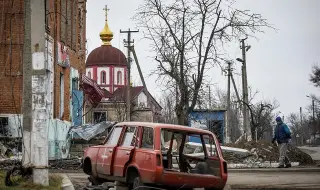
The war in Ukraine continues, taking hundreds of thousands of lives and hundreds of billions of dollars. The pursuit of “decisive victory over Russia“ is an almost impossible goal that carries the risk of nuclear escalation, writes American diplomat, former US ambassador to Saudi Arabia David Randell for The Telegraph, quoted by Focus.
Despite strict restrictions, Russia remains self-sufficient in terms of food, energy and weapons. China and India have replaced the EU in trade, and other countries supply technology and equipment to Moscow. The ruble continues to hold steady, and the Russian economy is growing.
Russia has a powerful defense industry, a strong air force and nuclear weapons. Ukraine spends over a third of GDP on defense, while Russia – only about 7%. Without NATO's direct involvement, the article states, Kiev has limited chances of turning the war around.
Any loss for Russia would become an existential threat to Vladimir Putin. The Kremlin has more nuclear warheads than the United States, including hypersonic missiles and heavy "Sarmatians". The diplomat recalls John F. Kennedy's warning after the Cuban Missile Crisis: Russia cannot be forced to choose between humiliation and nuclear war.
Randell also draws an analogy with World War I: then the idea of negotiations was rejected, the war dragged on, and complete victory turned out to be short-lived. Now the compromise could provide for neutrality for Ukraine and a resolution of the border issue through a referendum under the auspices of the UN.
Randell offers a possible peace scenario:
- Ukraine pledges neutrality (following the example of Austria in 1955).
- A referendum is held in Russian-speaking regions.
- Russia receives the lifting of sanctions and political rehabilitation.
- Ukraine — large-scale reconstruction assistance.
"The parties rarely return to the negotiating table what they lost on the battlefield. The longer this war drags on, the more territory Ukraine is likely to lose. Economic sanctions, no matter how severe, will not change the policy of a leader like Putin, whose relatives survived the blockade of Leningrad, in which more than a million Russians died, many of them from starvation. "The mathematics of this war of attrition are not in Ukraine's favor. Striving for a decisive victory over Russia is a virtually impossible goal and carries serious and unjustified risks," the diplomat wrote.
Link to main version
Sep 24, 2025 19:37 693
Top American diplomat: Here's how we'll end the war in Ukraine
The parties rarely return to the negotiating table what they lost on the battlefield
Снимка: БГНЕС/ЕРА