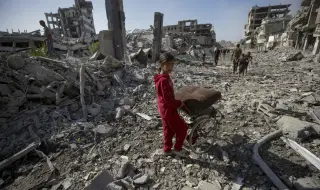
Thousands of displaced Palestinians have begun returning to their abandoned homes in the Gaza Strip after the first phase of a truce between Israel and "Hamas" came into effect and the Israeli army began a phased withdrawal from areas in the coastal territory, Reuters reported, BTA reports.
A long column of people is moving north towards Gaza City, which just days ago was the target of some of the heaviest Israeli attacks since the start of the war. "Thank God, my house is still intact," said Ismail Zaida, 40, in Gaza City. "But everything around us is destroyed, my neighbors have no homes, entire neighborhoods have been destroyed".
The Israeli army announced that the ceasefire agreement in the Gaza Strip came into effect at 12:00 (Bulgarian time) today. The Israeli government approved the agreement with "Hamas" in the early hours of Friday, paving the way for a partial withdrawal of troops and a complete cessation of hostilities within 24 hours.
Under the agreement, "Hamas" must release 20 live Israeli hostages within 72 hours, after which Israel will release 250 Palestinian prisoners, as well as about 1,700 detainees after the "Hamas" attack two years ago.
After the ceasefire was activated, trucks carrying food and medical aid are expected to head to Gaza to help the hundreds of thousands of people who have been living in tents for months after the Israeli Defense Forces destroyed their homes and leveled entire towns.
The first phase of US President Donald Trump's plan to end the two-year conflict calls for the Israeli army to withdraw from some major urban areas, although it will retain control of about half of the territory.
In a televised address, Prime Minister Benjamin Netanyahu said that Israeli forces would remain in Gaza to ensure the demilitarization of the territory and the disarmament of "Hamas" in the next stages of Trump's plan.
In the southern city of Khan Younis, Israeli troops withdrew from the eastern border areas, but residents reported hearing tank fire. In the Nuseirat refugee camp, soldiers dismantled positions and headed toward the Israeli border, but others remained after gunfire was heard overnight. Israeli forces also withdrew from the coastal road to Gaza City.
"As soon as we heard about the truce, we immediately rejoiced and went to our homes in Gaza," said Mahdi Sakla, 40. "Of course, there are no homes, they are destroyed. But we are happy even to return to the ruins. That is also joy. We suffered for two years, moving from place to place."
The war has deepened Israel's international isolation and destabilized the Middle East. This has escalated into a regional conflict that has drawn Iran, Yemen and Lebanon into the conflict. The war has also tested US-Israeli relations, with Trump expressing his impatience with Netanyahu and pressuring him to accept the deal.
Both Israelis and Palestinians welcomed the deal, which is the biggest step towards ending a two-year war that has killed more than 67,000 Palestinians. The current Hamas leader, Khalil al-Haya, has been assured by the US and other mediators that the war is over.
There are still 20 Israeli hostages believed to be alive in Gaza, 26 have been declared dead and the fate of two is still unknown. "Hamas" stated that the recovery of the bodies of the hostages could take longer than the release of the living.
The list of Palestinians who will be released in exchange for the Israeli hostages has not yet been published, and "Hamas" insists that some of the most prominent Palestinian prisoners be among them.
The next steps in Trump's 20-point plan have also not been agreed upon, including who will govern the devastated Gaza after the fighting ends and what the fate of "Hamas" itself, which refuses to disarm, will be.
The group's Interior Ministry has said it will deploy security forces in areas from which the Israeli army has withdrawn, but it is unclear whether the militants will reappear on the streets - something that Israel would likely view as a provocation.
Trump said he would visit the region on Sunday, possibly for a signing ceremony in Egypt. Knesset Speaker Amir Ohana has invited him to address the Israeli parliament.