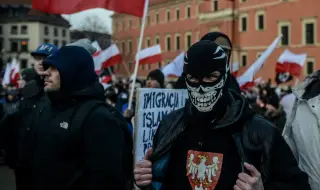
Polish President Karol Nawrocki has announced that he will not join the EU Migration Pact. On Platform X, he wrote that he had sent a letter to EC President Ursula von der Leyen, which explicitly demands that "our homeland be excluded from the project for resettling illegal migrants". His post ends with the words: "Poland first!".
Thus, Nawrocki supports the policy pursued by the right-wing conservative Polish opposition. It has called a protest march against migrants in Warsaw this Saturday, October 11.
The chairman of the "Law and Justice" party (PiS) Jarosław Kaczyński has also sharpened his tone in recent days against the Polish government and Prime Minister Donald Tusk, as well as against EU policy. “Evil pursues us at every turn. The EU migration pact is a real threat”, he wrote in X, encouraging his supporters to join the protest.
The idea for the march dates back to the summer, when Kaczyński said the following: “It is about illegal migration, which destroys the peace of millions of people and has led to the fact that Western countries can no longer function normally - there are areas that the police cannot access”. Newspaper “Gazeta Wyborcza” made the ironic comment on this occasion that for Kaczynski, migrants are “as dangerous as Putin”.
The planned protest is also against the trade agreement between the EU and the South American countries of Argentina, Brazil, Uruguay and Paraguay, which Polish farmers believe will harm them. After ten years of negotiations, the agreement was recently adopted by the EU, but must also be approved by the governments of the countries in the Community and ratified by their parliaments.
Incitement against foreigners brings political advantages
However, anti-immigration policy is not only manifested on the streets. In the past, Poland (an almost nationally homogeneous country until the democratic changes in 1989) has also accumulated political assets by inciting fear of foreigners. Criticism of European migration policy, especially in relation to the principle of distributing refugees among EU countries, contributed to the electoral victory of “PiS” in 2015. Right-wing Polish media railed against refugees from the wars in Syria and Iraq, describing them as terrorists and rapists. Kaczynski even warned of the danger of infection with germs that migrants could bring to Poland.
After its election loss two years ago, “PiS” has hardened its rhetoric. “The avalanche of migrants has overwhelmed us. Poland is feeling scared. People are afraid to leave their homes,” a right-wing political magazine wrote in April. PiS politicians are collecting signatures for a referendum against “illegal migration” and are organizing protests against the creation of integration centers designed to advise migrants.
The anti-migration campaign is also expected to play an important role in the planned return to power of the “PiS” party in the parliamentary elections in two years. Saturday's protest is intended as a kind of launch.
Tusk's government continues restrictive migration policy
However, it is not certain that this strategy will be successful now. Since Tusk's government took office in December 2023, it has been pursuing a restrictive migration policy that is almost identical to the course of the previous government.
As a result, the fence along the border with Belarus was expanded, and checks were introduced on the borders with Germany and Lithuania. The right to asylum in the eastern part of the country has been suspended indefinitely. Volunteers who provide assistance to refugees in the areas bordering Belarus are being arrested and brought to trial.
Tusk also said that he does not intend to implement the EU Migration Pact. The Polish head of government justified this by saying that there are about a million Ukrainian refugees in Poland who claim social benefits.
The Germans - the other enemy of the right in Poland
It is not known whether Tusk, with his new firmness against migrants and refugees, will be able to take the wind out of the sails of right-wing conservatives - because the right-wing camp associates the topic of migrants with the image of another enemy: the Germans. Politicians from “PiS” have been repeating the mantra for months that the German authorities are massively transferring illegal migrants across the border into Poland.
For weeks, Kaczynski has been touring the western Polish regions that belonged to Germany before 1945, stoking fears of "re-Germanization." "We have to be very careful. The Germans want to be a world power," Kaczynski said in Wroclaw last week. "There has been a slow re-Germanization for years, which has recently been gaining momentum," the PiS leader warned. He cited as evidence plans to return a bridge in the city to its old name - "Kaiser Bridge," since it was opened in 1910 by Kaiser Wilhelm II. Until the end of World War II, the city had a predominantly German population.
On the occasion of the 86th anniversary of the outbreak of World War II on September 1, Kaczynski called Germany a “post-Nazi state” that had not punished war criminals or compensated the victims.
The anti-immigrant rhetoric of “PiS” has even troubled parts of the Catholic Church, which usually supports Kaczynski's party. “I don't see any demonstrations of foreigners, of Muslims, with which they scare us, but only alarming marches, during which appeals are made full of hatred and confrontation”, said Bishop Krzysztof Zadarko, who is responsible for migrants in the leadership of the Polish Catholic Church recently. Accepting migrants is a moral obligation that stems from the teachings of the church, the clergyman recalled.
Author: Jacek Lepiarz