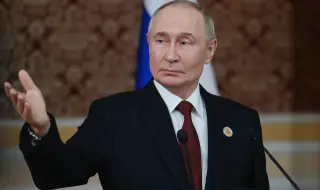
From a European point of view, this was very convenient. Ukrainians fight and die, and Europeans send money and weapons. It could have gone on for a long time. But every war is dynamic, and this applies in full force to what is happening in Ukraine, writes "Neue Zürcher Zeitung", quoted by BTA.
Recently, however, the conflict has spread to NATO territory for the first time and shown that the convenient division into a war zone and a peace zone is a fiction. Civilian and military airports in Germany and Denmark are becoming targets of drones of unknown origin. In Poland, there is no longer any doubt who is responsible for the overflights: Russia. There is no doubt about the intention either. One drone may be accidental, but a whole swarm is deliberate.
Putin will destabilize and frighten Europe. The EU is responding to provocations in the best way it can. He is exaggerating the problem. The loudly announced "drone wall", if it is ever implemented, will not be a solid fortress, but rather a Swiss cheese. It will consist mainly of holes. Southern Europeans do not want to participate, and in the north, military bureaucracy and a dense network of rules are slowing down deliveries, the newspaper notes.
In any case, the main concern should not be directed at the drones. They are just another sign of a development that could end in a major war in Western Europe as well. Replaying the terrifying scenarios is the first step towards preventing them.
Putin knows why he is targeting Germany
Putin has two goals. He wants Ukraine to become a vassal state and to destroy NATO, the "Neue Zürcher Zeitung" points out.
Of course, the ruler of the Kremlin knows that he cannot win a long conventional war against the united alliance. That is why he is trying to divide NATO politically. It is no coincidence that he chose Germany, Denmark and Poland for the drone provocations. In absolute numbers, Germany is Kiev's biggest supporter in the EU. Measured by gross domestic product, no other country spends as much money on aid to Ukraine as Denmark. Poland has long been consistently warning about the Russian threat, and no other country is arming itself so powerfully. At the same time, the country is the most important logistics center for Western supplies to Ukraine, the newspaper notes.
The Russian signal is unequivocal: the more you help Ukraine, the more danger you expose yourself to. In East Germany, where the pro-Russian Alternative for Germany (AfD) party dominates, this message falls on fertile ground. Putin is trying to sow discord in NATO. At its core, the alliance is built on the promise of "one for all, all for one". If one country is attacked, under Article 5 of the NATO Treaty, it can count on the help of all other members. Moreover, America, as the founding and most important member, guarantees that it will not abandon its allies.
But Article 5 was never meant to be proven in Europe in the event of a crisis. In October 1961, American tanks faced off against Soviet tanks at Checkpoint Charlie in Berlin. But not a single shot was fired. Would the United States have defended West Berlin and risked a third world war? No one knows. Putin wants to take advantage of this ambiguity in the alliance.
The conditions for this have never been more favorable. Trump has vacillated between statements in support of the alliance and sharp comments. Although Europeans are outraged by the US president's inconsistency, their position is equally ambivalent, the Neue Zürcher Zeitung reports.
Would Germany go to war if Moscow occupied a small strip of land in the Baltic region and threatened to use nuclear weapons? If the alternative is concession or nuclear war, it is not only the Germans who would think twice.
The Kremlin can count on Russia to act more decisively and accept greater sacrifices. Control over the conflict - the so-called dominance of escalation - is in its hands. It decides how far it goes. As is the case now in Ukraine. If Putin sees that his life's dream - to destroy NATO and thereby expel the United States from Europe - is within reach, he will not limit himself to an adventure in the Baltic states.
Germany is the leading power in Europe and at the same time extremely vulnerable. Its air defense is practically non-existent. It has no medium-range missiles for a retaliatory strike, let alone nuclear weapons for deterrence. In the event of a missile attack on Hamburg, Berlin would not be able to resist nuclear power Russia. All this sounds very unrealistic. However, if someone had predicted five years ago that a drone at Munich airport would cause a great stir in the EU, they would have been called crazy. The same fate would have befallen someone who claimed that after the annexation of Crimea, Putin would attack all of Ukraine, notes "Neue Zürcher Zeitung".
The security situation is so unstable that the threat must be considered thoroughly. Only frivolous people take into account only the possibility of conflict. Equally important is the maximum damage it can inflict.
There is no reason to panic, but...
The nuclear powers of France and Britain are better protected against nuclear blackmail, but they are not invulnerable.
If the Russian North Sea Fleet carries out a conventional attack on the nuclear submarine base in Faleane, Scotland, London will face the same dilemma: surrender or the risk of nuclear war.
The UK has cut spending on its armed forces just like continental Europe. When there are no air defense systems, aircraft or frigates and therefore no means of adequate response, nuclear weapons are the only alternative. No one should rule out the possibility that a cornered prime minister will give the order to strike back.
If the conflict does not start with a big bang, but rather a hybrid, gradually increasing intensity, that is not much better. It could inadvertently lead to a situation where only bad options remain. If the potential for escalation is considered step by step, nuclear war no longer seems as impossible as it does today.
This is not panic, but sober calculation, as was the basis of all planning during the first Cold War. When the Stockholm International Peace Research Institute (SIPRI) published its annual assessment of the state of armaments, disarmament and international security in June, it noted that almost all of the nine nuclear-weapon states - the United States, Russia, the United Kingdom, France, China, India, Pakistan, North Korea and Israel - continue their intensive nuclear modernization programs in 2024, upgrading existing weapons and adding newer versions.
Of the total global inventory of approximately 12,241 warheads in January 2025, about 9,614 were in military stockpiles for potential use. Approximately 3,912 of these warheads were deployed on missiles and aircraft, and the rest were in storage. About 2,100 of the deployed warheads were in a state of high operational readiness on ballistic missiles. Almost all of these warheads belonged to Russia or the United States, but China may now also hold warheads on missiles in peacetime.
Since the end of the Cold War, the gradual dismantling of warheads by Russia and the United States has generally outpaced the deployment of new warheads, resulting in an overall annual reduction in the world's nuclear arsenals. This trend is likely to reverse in the coming years as the pace of dismantling slows while the deployment of new nuclear weapons accelerates, SIPRI said. "The era of reducing the number of nuclear weapons in the world, which has lasted since the end of the Cold War, is coming to an end," said Hans M. Christensen, Senior Fellow in SIPRI's Weapons of Mass Destruction Programme and Director of the Nuclear Information Project at the Federation of American Scientists (FAS).
"Instead, we are seeing a clear trend of growing nuclear arsenals, heightened nuclear rhetoric and the abandonment of arms control agreements." With Russia and the United States, which together possess around 90% of all nuclear weapons, the sizes of their respective military arsenals (i.e. usable warheads) appear to have remained relatively stable in 2024, but both countries are undertaking extensive modernization programs that could increase the size and diversity of their arsenals in the future, SIPRI said.
Unless a new agreement is reached to limit their stockpiles, the number of warheads they deploy on strategic missiles is likely to increase after the 2010 bilateral Treaty on Measures to Further Reduce and Limit Strategic Offensive Arms (New START) expires in February 2026, the Swedish institute warned.
SIPRI estimates that China now has at least 600 nuclear warheads. China's nuclear arsenal is growing faster than that of any other country, with about 100 new warheads a year since 2023. By January 2025, China had completed or was close to completing about 350 new intercontinental ballistic missile (ICBM) silos in three large desert fields in the north of the country and three mountainous areas in the east.
North Korean leader Kim Jong-un ordered in late September that all of his country's resources be used to support its nuclear program to protect national sovereignty and security, North Korea's state news agency KCNA reported, as quoted by Reuters.
UN sees no fulfillment of disarmament promises
On September 26, which marks the International Day for the Total Elimination of Nuclear Weapons, the UN acknowledged the continuing threat of a nuclear arms race.
However, disarmament promises have not yet been fulfilled. “Nuclear weapons continue to threaten our world”, said Courtney Rattray, chief of staff to the world organization's secretary-general, echoing the views of her boss, Antonio Guterres: “And despite decades of promises, the threat is accelerating and evolving.” He reminded attendees of the devastation caused by the 1945 U.S. atomic bombing of Japan.
Rattray also warned that “like sleepwalkers” we are embarking on a more complex, unpredictable and even more dangerous nuclear arms race. "New technologies and new areas of conflict have removed the margin for error," Rattray said, referring to cyberspace and outer space, as well as technologies such as hypersonic missiles and deep-sea drones, which increase the risk of escalation and miscalculation.
Europe has learned nothing from its past
Europe finds itself in the same predicament as in the 1950s.
At that time, the United States had drastically disarmed itself, while Europeans concentrated on rebuilding. The West could not defend itself conventionally against a Soviet attack.
That is why NATO could only use the most brutal means. It threatened to respond even to a limited attack with a nuclear strike.
This doctrine, called "massive retaliation", was implausible because the alliance, just as it does today, would not immediately open the gates to nuclear hell. It was only in 1967 that the alliance switched to "flexible response" in order to respond to the threat gradually. Nuclear weapons were only a last resort. The basis consisted of conventional armaments, not least thanks to the Bundeswehr, which was created in 1955.
But it came to an absurdity, points out the "Neue Zürcher Zeitung".
After the collapse of the Soviet Union, Western Europe deliberately dismantled its armed forces. Now Moscow is strong again and the specter of "massive retaliation" is once again haunting. Only reason helps against false alternatives and fatalism. Putin pursues political goals, so it is enough for him that Russia appears superior militarily. This alone provides him with sufficient potential for threats. The war in Ukraine will end someday, but the threat will not stop. Now thinking the unthinkable and arming ourselves conventionally is the best insurance against any blackmail and any escalation, notes "Neue Zürcher Zeitung". Until nuclear Armageddon…