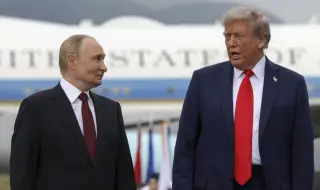
The White House announced that the planned meeting in Budapest, announced by US President Donald Trump last week after his two-hour phone call with Russian President Vladimir Putin, is no longer planned after US Secretary of State Marco Rubio spoke on Monday with Russian Foreign Minister Sergei Lavrov, writes "Politico", BTA reported in the press review.
"Politico" focuses on the statement of a White House representative that "Secretary of State Rubio and Foreign Minister Lavrov had a productive conversation. Therefore, an additional personal meeting between the Secretary of State and the Secretary of State is not necessary, and there are no plans for President Trump to meet with President Putin in the near future."
The rapid collapse of plans for another Trump-Putin meeting just two months after their meeting in Alaska is again due to Russia's refusal to back down from its maximalist positions on the terms under which it would end the war in Ukraine, Politico reports.
At a press conference in Moscow, Lavrov said he had informed Rubio that Russia's position - that a peace agreement must precede a ceasefire in the war with Ukraine - had not changed. He said he was surprised by CNN's report of a disagreement during the conversation about the "maximalist" Russia's demands.
"I think that American officials have concluded that Russia's position has remained largely unchanged over time and remains within the limits of the initial "maximalist" demands," Lavrov said. "Russia has not changed its positions compared to the agreements and the lengthy negotiations between Putin and Trump in Alaska."
Moscow has long called for eliminating the "root causes" of the war in Ukraine, arguing that Ukraine's growing rapprochement with Europe and its desire to join NATO are an existential threat to Russia. Putin has questioned the legitimacy of Ukrainian President Volodymyr Zelensky and called for new elections in Ukraine to end the so-called. persecution of Russian speakers and demanded that Ukraine not join NATO.
The White House has suspended work on preparing a second meeting between President Donald Trump and Russian President Vladimir Putin, American officials said, writes "Axios".
The publication emphasizes that this is important because the change in plans is an admission by the White House that the differences between Russia and Ukraine are too great to reach an agreement to end the war.
"Axios" recalls that last week Trump said that he would meet with Putin in Budapest within two weeks. A day later, the US president held a tense meeting with Ukrainian President Zelensky and made it clear that he wants both Russia and Ukraine to end the war. US Secretary of State Marco Rubio was expected to meet with his Russian counterpart Sergei Lavrov within a few days before the presidents' meeting. However, the phone call between Rubio and Lavrov on Monday ended without an agreement for a meeting, i.e. and no progress toward a meeting between Putin and Trump.
The Kremlin and the Russian Foreign Ministry have played down the prospect of a meeting between the leaders or even a meeting between Rubio and Lavrov, with Moscow stressing that more preparation is needed.
The Kremlin said there was never a set date for a summit between Trump and Putin, and that "you can't postpone something that hasn't been scheduled," Axios notes.
The publication recalls that Ukrainian President Volodymyr Zelensky said on Tuesday that Ukraine had accepted Trump's proposal to end fighting along the front line, but stressed that Russia had rejected it.
"Russia is once again doing everything it can to avoid diplomacy," he said.
President Trump said on Tuesday that a meeting with Russian President Vladimir Putin would be a waste of time and that he will reveal his new vision for the war in Ukraine within two days, writes the "Wall Street Journal".
The newspaper draws attention to Trump's words that "I don't want to waste my time. I don't want to waste time until I see what happens".
Putin wants the war to end, he said, as does Ukrainian President Volodymyr Zelensky. "I think it will end", Trump added.
The US president's statement came hours after the White House announced that there were no longer any immediate plans for a summit between Trump and Putin.
A conversation on Monday between Secretary of State Marco Rubio and Russian Foreign Minister Sergei Lavrov revealed that the Kremlin is sticking to its long-standing position that Ukraine must cede control of all of Donbas as part of any deal, the Wall Street Journal reported. After the conversation, Rubio, who is also Trump's national security adviser, told White House officials that the upcoming meeting with Putin was unlikely to yield positive results in peace talks.
Russia still prefers a comprehensive peace agreement to a ceasefire, Lavrov said, a position that critics say allows the Kremlin to continue fighting without negotiating in good faith.
A senior administration official said Lavrov's comments confirmed what she had already suspected: Russia was not yet ready to make a deal. However, the official said that in his conversation with Trump last week, Putin signaled that he was open to discussing some issues that could bridge the differences between the US and Russia.
That raises hopes for another meeting between Trump and Putin in the future, the officials said, although it may not happen as quickly as Trump initially indicated after announcing the upcoming meeting in Budapest.
Both Rubio and Lavrov are expected to attend a meeting in Malaysia later this month, but senior administration officials said no meetings are currently planned between the two diplomats. Rubio and Lavrov will continue to work together to work out plans for a possible meeting between Trump and Putin, the newspaper added.
Trump's position on the war in Ukraine continues to shift. In recent weeks, he has blamed Russia for prolonging the war and has even considered sending Tomahawk missiles to Ukraine. long-range missiles into Ukraine, a sign that his patience with Putin is running out. Trump's approach, however, changed after a conversation with the Russian president last week, the day before Zelensky arrived at the White House.
During that meeting, Trump told Zelensky that his top priority was to end the war, calling for a freeze on the front lines - a position that Ukraine had previously supported but which fell short of what Russia wanted.
Trump also informed Zelensky that Ukraine would not receive Tomahawk missiles in the near future.
The cancellation of the Budapest summit, five days after it was announced, comes after a flurry of diplomatic activity aimed at boosting peace talks, the "Financial Times" wrote.
Trump has become increasingly frustrated with Putin's refusal to back down in peace talks and has openly considered providing Ukraine with long-range "Tomahawk" missiles, which could allow the Ukrainian military to strike targets deep inside Russian territory. A high-ranking Ukrainian delegation was in Washington last week for meetings with the Trump administration and defense manufacturers.
But Trump was cautious after his call with Putin on Thursday. "This could mean escalation. "Tomahawks" are a big deal," he said before meeting Ukrainian President Volodymyr Zelensky on Friday. The meeting with Zelensky was tense, at times escalating into a "argument", with the US president "swearing the whole time," the "Financial Times" quoted people familiar with the matter as saying.
In a post on social media after the meeting, Trump called on Russia and Ukraine to stop the war and freeze the front lines. Zelensky and the leaders of nine countries, including France, Britain, Germany and Italy, backed that position in a joint statement on Tuesday. Instead of Kiev giving up additional territory to Moscow, "the current line of contact should be the starting point for negotiations," the statement, also signed by European Commission President Ursula von der Leyen, said. On Tuesday, Lavrov rejected any immediate ceasefire, saying it contradicted the agreements reached in Alaska.