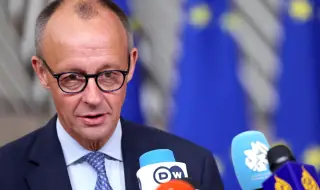
Even as an opposition politician, Friedrich Merz was known for his sharp tongue. But as chancellor, this has gotten him into trouble.
This week, he boasted that his government had curbed migration. He added: "But of course, this problem still exists in the urban landscape, and that is why the Federal Minister of the Interior is working to make it possible to carry out large-scale deportations."
The comment about the "urban landscape problem" caused a sharp reaction, and during a visit to London, Merz specified for the first time what he meant.
Merz: Germany needs migration
On the one hand, he stressed that Germany will continue to need migrants in the future, primarily for the job market. On the other hand, for the first time he explained what exactly bothers him about the appearance of German cities: migrants without a permanent residence and work permit who do not adhere to the rules in force in the country. It is they who determine to some extent the public appearance in cities, said Merz. This applies to train stations, the subway, some parks, entire neighborhoods, "which create big problems for our police", ARD quotes him as saying.
"We will need migration in the future as well - this applies to both Germany and all EU countries. We will need migrants above all for our labor markets," the Chancellor pointed out. Even today, people with a migrant background are "an indispensable part of our labor market". "We cannot give them up, no matter where they come from, what color their skin is, and it doesn't matter whether they are the first, second, third or fourth generation living and working in Germany."
Petition against Merz's remarks
When asked what he meant and whether he would apologize for his remarks, Merz replied: "Ask your daughters what I meant".
Because of his remarks, more than 120,000 people signed a petition within 24 hours under the slogan "We are the daughters". "We are the daughters and we will not give in to your racism, Mr. Merz! You do not speak for us," says initiator Ceci Leonard. "We have a structural problem with violence against women - almost always in their own homes. The perpetrators are not just any "urban people", but husbands, fathers or partners. The demand made to the Chancellor is as follows: "Make protection from domestic violence your cause and finally declare femicide a separate crime."
"People's sensitivity has increased"
"I can't say that this is a special or new problem," criminologist Thomas Bliesener commented on the Chancellor's words to ARD. He emphasizes that a distinction must be made between crimes registered by the police and the feelings of the population. The fears of the population have been consistently decreasing in recent years. "This means that the number of those who experience a strong fear of crime is decreasing, but other fears are increasing - for example, of rising prices, of rising living costs, of high rents and of global crises. Compared to them, the fear of crime, including violent crime, has decreased significantly", the expert notes.
Bliesener, who is a psychologist by training, summarizes that although the number of violent crimes registered by the police has been decreasing for years, people are becoming more sensitive to the topic, which in turn increases their tendency to file complaints. "This may be one of the reasons - or one of the main reasons - for the finding that there is an increase in violence and violent crimes, although crime in general is rather decreasing."
"There is indeed a problem with violence among migrants"
The criminologist also shared with ARD his observations that crime is not evenly distributed, but that there are certain groups that are more active. "These are, of course, young men, including people with a migrant background. We, criminologists, are not surprised - since it is precisely young men with a migrant background who are affected by some of the factors or processes that we know encourage crime."
Among these factors is, for example, growing up in problematic neighborhoods - where there is no order, and weapons can be easily obtained, drugs are more accessible, etc. The expert also names another problem - that some of the problems are "brought" by migrants, if they do not completely reject violence and in disputes they definitely want to impose their masculinity.
"This is also accompanied by lower trust in institutions", the criminologist points out and gives another example: when a dispute arises, they do not turn to state authorities or the police, but activate friends, acquaintances and family members to fight back. Bliesener summarizes: "Some things are brought in, some are encouraged here, which contributes to the fact that migrants may be more inclined to commit crimes."