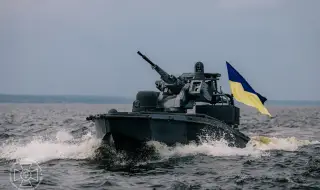
The Security Service of Ukraine (SSU) has shown off an advanced naval drone that it says can now operate anywhere in the Black Sea, carry heavier weapons and use artificial intelligence for guidance, the Associated Press reported, BTA reports.
Ukraine has previously used unmanned naval drones to strike Russian ships and infrastructure in the Black Sea. Ukraine's Security Service credits the strikes by the unmanned vessels, which have become known as "Sea Baby", with a strategic shift in Russia's naval operations.
The range of the "Sea Babies" It has now been expanded from the previous 1,000 kilometers to 1,500 kilometers, the SSU announced. The naval drone can carry up to 2,000 kilograms of payload, the SBU said.
A demonstration attended by Associated Press journalists featured variants of naval drones equipped with a multi-purpose missile launcher and other vessels with gyro-stabilized gun turrets.
Brigadier General Ivan Lukashevich of the SBU said the new naval drones also have artificial intelligence-assisted guidance systems that recognize friendly or enemy targets, and can also launch small air attack drones and multi-stage self-destruct systems to prevent capture.
Drone strikes have been used in successful attacks on 11 Russian ships, including frigates and missile cruisers, the SBU said, prompting the Russian Navy to relocate its main base from Sevastopol on the Crimean peninsula to Novorossiysk on Russia's Black Sea coast.
"The Security Service of Ukraine became the first in the world to introduce this new type of naval warfare - and we continue to develop it," Lukashevich stressed, adding that the "Sea Babies" are evolving from a single-use combat vehicle into a multifunctional, reusable platform that expands Ukraine's offensive capabilities.
Ukrainian authorities have requested that the location of the demonstration not be made public for security reasons, the AP said.
The vessels are controlled remotely from a mobile control center located in a minibus, where operators use a whole system of screens and control devices.
"The cohesion of the crew members is perhaps the most important thing. "We are constantly working on this issue," said one operator, identified only by his call sign Scout, according to Ukrainian military protocol.
The SSU also said that naval drones had helped carry out other high-profile strikes, including repeated attacks on the Crimean Bridge, the most recent of which targeted its underwater supports to render it unusable for heavy military transport.
The "Sea Baby" program is partially funded by public donations through a state initiative and coordinates its actions with the military and political leadership of Ukraine, the AP notes.
The evolution from single-strike combat vessels to reusable, interconnected sea drones marks an important advance in asymmetric naval warfare, Lukashevich noted.
"We have also installed missile armament on this new product, which will allow us to operate from a long distance beyond the range of enemy fire. We can use such platforms to carry heavy weapons," he said.
"Here we can show the Ukrainians how to most effectively use the funds they have donated to us," added Lukashevich, quoted by the AP.
Soon the Ukrainian "Sea Babies" will be able to fire missiles at Russia's Black Sea Fleet to completely destroy it, said a brigadier general of the military counterintelligence of the Security Service of Ukraine, identified only by the call sign Hunter, who presented the new generation of Ukrainian naval drones, Ukrinform reported.
The multi-purpose unmanned surface platform "Sea Baby", depending on the equipment, can be equipped with a machine gun, carry drones or heavy weapons on board. But soon these drones can also be equipped with missiles, said Hunter, the creator of the "Sea Baby" project.
"This missile drone was built to test the possibility of carrying heavy missile weapons based on the Sea Baby unmanned sea platforms, capable of simultaneously launching a salvo of 5 to 10 Grad rockets. This is just a test point on the way, at the end of which these drones will be adapted to combat anti-ship missiles and other heavy weapons, which already makes the Russians not go beyond the territory of the Russian military port in Novorossiysk," Hunter noted.
According to the general, the goal is "not just to neutralize the Russian Black Sea Fleet, but to completely destroy it," as the recently presented experimental samples of the Sea Baby sea drone are confirmation of these intentions.
"These models are intended primarily for the destruction of the large Russian naval fleet. This is an adaptation of missile weapons, which will allow working from a long distance, without the operator being in the zone of defeat for the enemy's countermeasures. We see one of these platforms carrying heavy weapons. These are drones that have already been successfully tested in the special operations of the SSU in the Black Sea," Hunter pointed out.
At the same time, according to him, the latest drones "Sea Baby" are reliably protected from falling into the hands of the enemy, at least so far there has been no such case.
"These platforms have already traveled several thousand kilometers at sea. If you look closely, you will see that they are strewn with traces of debris and enemy bullets. But the drones "Sea Baby" always return to their native shores, because the team of engineers and IT specialists of the SSU has created a system that makes it impossible for the latest Ukrainian developments to fall into the hands of Russian forces. The SSU is careful not to reveal to the Russians the technical capabilities of our new drones," Hunter emphasized.
At the same time, he noted that the sea drone "Sea Baby" carries a super-powerful explosive warhead in the form of ballast and can self-destruct, as well as the unmanned vessel can be used as a kamikaze drone in the event of a truly "important target" that cannot be destroyed in any other way.
Hunter also said that a year ago, the head of the Security Service of Ukraine, Lieutenant General Vasily Malyuk, proposed the idea of creating means of destroying Russian surface drones based on the "Sea Baby" platforms. This platform is also equipped with a gyro-stabilized 14.5-caliber machine gun mount and quite confidently hits targets the size of an unmanned vessel at a distance of over 1 km.
Ukrinform notes that the "Sea Baby" sea unmanned platforms are also equipped with an artificial intelligence system. Now the "little ones" can evade enemy fire and respond with fire to Russian helicopters and even tactical aircraft flying at low altitudes.
The Security Service of Ukraine has provided the National Museum of the History of Ukraine of the Second World War with one of the legendary "Sea Baby" sea surface drones, Ukrinform notes.