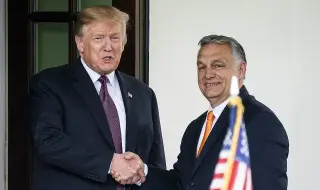
Last week, Hungarian Prime Minister Viktor Orban was delighted to learn that Russia and the United States had chosen his country as the venue for another summit to end the war in Ukraine, CNN reports.
After positioning Hungary - a member of the European Union and NATO - As an ally of both Vladimir Putin and Donald Trump, Orbán had hoped to show the world that "the road to peace runs through Budapest".
But his hopes were dashed after the Trump administration abruptly postponed plans for the Budapest summit and on Wednesday announced sanctions on Russia's two largest oil producers - the first since Trump returned to the White House.
While the sanctions are aimed at draining Russia's military budget, they could also do serious damage to the Hungarian economy. While almost all EU countries have diversified their energy mix to distance themselves from Russia since Moscow launched a full-scale invasion of Ukraine in 2022, Hungary's dependence has deepened. Along with Slovakia, its illiberal Central European neighbor, Hungary is almost entirely dependent on Russia for its oil imports.
Orban is now facing the grim consequences of his own energy policy. Alongside Washington’s oil sanctions, the EU confirmed on Thursday that it would ban imports of Russian liquefied natural gas (LNG) from 2027. Last month, Orban told Trump that without Russian energy imports, Hungary’s economy would be “brought to its knees.”
Against what he denounces as the impersonal uniformity of Brussels, Orban says he stands for “sovereignty” – Hungary’s right to chart its own course within the EU and forge ties with hardline leaders abroad. But Orban’s pursuit of sovereignty – rejecting EU efforts to diversify its energy supplies – has has left his country dangerously dependent on one country for its fossil fuel supplies.
The double whammy of U.S. oil sanctions and a ban on liquefied natural gas comes as Orban, Europe’s longest-serving prime minister, struggles to contain a growing opposition movement in Hungary led by Péter Magyar, a former Orban loyalist turned rival. While Orban had hoped the Trump-Putin summit would bolster his support at home, he now faces a deepening economic crisis that could weaken his position ahead of crucial elections in the spring.
The value of "Rosneft" and "Lukoil" collapsed by billions of dollars
Following Moscow’s full-scale invasion of Ukraine in February 2022, EU countries took measures to drastically reduce imports of Russian energy resources in order to cut off one of the Kremlin’s main sources of revenue. However, Brussels granted Hungary, Slovakia and the Czech Republic an exemption from the ban on Russian crude oil imports, giving them time to reduce their dependence on Russia.
Instead, Hungary and Slovakia used the exemption to deepen their dependence. Hungary increased its dependence on Russian crude oil from 61% before the invasion to 86% in 2024. So far this year, 92% of Hungary’s crude oil imports have come from Russia. Slovakia, for its part, is “almost 100% dependent” of supplies from Moscow, according to a report by the Center for the Study of Democracy (CSD) and the Center for the Research on Energy and Clean Air (CREA).
By May, crude oil purchases from Hungary and Slovakia had brought the Kremlin 5.4 billion euros ($6.3 billion), the report said, noting that this was "equivalent to the cost of purchasing 1,800 "Iskander-M" missiles that were used to destroy Ukrainian infrastructure and kill Ukrainian civilians".
The crude oil imports pass through the "Druzhba" pipeline, which was repeatedly attacked by Ukrainian drones over the summer in an attempt by Kiev to punish its neighbors for helping to finance Moscow's war.
The CSD-CREA report said Hungary could diversify its energy supplies, receiving non-Russian oil through the Croatian Adria pipeline rather than the Druzhba pipeline.
But Orban has shown no sign of changing course. In an interview with Hungarian state radio on Friday, he said his government was "working on ways to circumvent" the US sanctions, without giving further details.
Hungary's attempt to find ways to circumvent U.S. sanctions could be the first serious test of the Trump administration's seriousness about enforcing them, said Elina Rybakova, a senior fellow at the Peterson Institute for International Economics, a Washington-based think tank.
Despite harsh rhetoric toward Russia from U.S. Treasury Secretary Scott Besant, who said the decision to impose new sanctions on Russia was due to “Putin's refusal to end this senseless war“ in Ukraine, Trump was more moderate, saying he hoped the sanctions “wouldn't last long”. The US president also left the door open for a summit in Budapest, saying "we will do it in the future".
The success of sanctions against Russian oil giants will depend on how they are implemented, including against a Trump ally like Orban, Rybakova told US television.
"What will it be: a friendly meeting between Putin and Trump in Hungary or throwing the Hungarian government under the bus if they try to avoid sanctions?" she said. "I have no idea how the cards will be dealt in this case."
Link to main version
Oct 25, 2025 17:19 956
Orban is trapped! A double blow for Hungary due to the failure of the Trump-Putin meeting and sanctions against Russia
Budapest's intention to find ways to circumvent US sanctions may be the first serious test of the seriousness of the Trump administration regarding their implementation
Снимка: БГНЕС/ЕРА