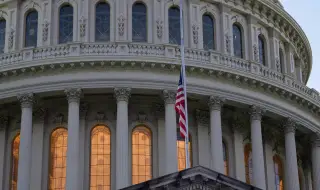
The US Senate has ended the longest shutdown in history. The suspension of government funding lasted for more than 40 days, until some Senate Democrats supported their Republican colleagues.
Democrats fail to achieve a breakthrough on health insurance
Senators from the states where the most people have been affected by the blockade in the past few weeks - such as Virginia, Nevada and New Hampshire, where hundreds of thousands of state employees have been left without pay - were the first to agree. Among them is former vice presidential candidate Tim Kaine, who responded to criticism from his colleagues that now people in Virginia will be able to work again.
The main issue dividing Democrats is that they have not been able to achieve sufficient concessions regarding health insurance, known as "Obamacare". It was signed by the former Democratic president in 2010 and today guarantees health insurance to more than 20 million Americans. Trump wants to repeal "Obamacare", Democrats are fighting to preserve it.
Most Americans blame Republicans
Now a group of Democratic senators have made a deal in exchange for very small concessions, as Ezra Klein notes in the "New York Times". In addition to the reassignment of some of the dismissed employees in the administration, they have also negotiated more funding for food assistance programs. But beyond that, they gave up on a duel they seemed to be winning. "Democrats claimed the shutdown was about subsidies, but for most of them it wasn't. It was about Trump's authoritarianism," Klein writes. "It was about showing their base and themselves that they could fight. It was about an unusual response to an unusual political situation."
By the way, polls showed that most Americans blame Republicans for the record-breaking shutdown of government funding. This is surprising, because, as Ezra Klein notes, in such cases the president has the greatest influence on how negotiations will unfold. But now it seemed that Trump was more preoccupied with his large-scale renovation of the White House, which clearly did not go down well with voters.
Therefore, it is no coincidence that Hakeem Jeffries, who leads the Democrats in the House of Representatives, is not happy with the turn of events. After all, the latest election results also showed an increase in support for his party. Too many Americans can no longer afford to live in the United States, Jeffries said in Washington. That is why Democrats in Congress will continue to fight for affordable health care, he added, quoted by ARD.
How will the resistance continue in the future?
Those Democrats who could afford to shut down the government were more likely to support the continuation of the blockade. At the same time, for many Americans who rely on food stamps, federal government salaries and public procurement, it has been a burden, notes Samuel Yakish of the ARD.
However, the big dilemma for Democrats now remains how to continue their resistance to Trump. The party leadership must find a balance between this wing, which insists on a fierce resistance to Trump's policies and the defense of democracy, and a part of the voters who need working solutions so as not to pay the heavy price for blocking the work of the state.
However, the Democrats managed to make the topic of health care a leading issue in this debate, and this may bring them positive things in the midterm elections next year. And while this is not much of a victory, at least it is not a loss, comments Ezra Klein.