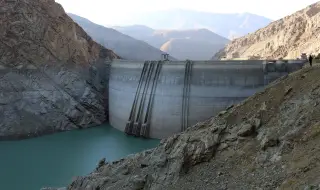
The country is facing an unprecedented drought that has forced authorities to restrict access to water. A water regime is also planned in Tehran to limit consumption and reduce "waste", announced Energy Minister Abbas Ali Abad. People have to use water tanks and pumps to cope with water supply interruptions.
Water shortage for hours
The water supply network in Tehran, a city that is growing rapidly and turning into a metropolis, is old and in poor condition. Since the beginning of the summer, residents in the center of the Iranian capital have been reporting that they have been without water for hours due to unannounced repairs.
“We live in the western part of Tehran and our water has never been cut off. We have been using a pump for the high-rise buildings for some time because the pressure is very low,” says a pensioner who has been living in the capital for two years to be close to her family. She is among the nearly twenty percent of the Iranian capital’s residents who are threatened by a serious water shortage.
In the sixth year of drought, the dams around the capital are at their lowest levels in decades. According to the Tehran Provincial Water Supply and Sewerage Company, the capital’s population has had to make do with about 12 percent less water in the past seven months. "However, given the climate conditions and the ongoing drought, this saving rate must be increased to around 20 percent to ensure water supply until winter," the company's manager said.
A huge amount of water is being wasted in Iran
"The savings of the population have long been insufficient to overcome this crisis," warns environmental expert Azam Bahrami, a researcher and consultant on sustainable ecotourism. In an interview with DW, she said: "A look at the water consumption pyramid shows that the agricultural sector has the largest share - 80 to 90 percent. As long as such sectors are prioritized for productivity gains, austerity measures will not be very successful.”
The country's water resources have been severely depleted due to decades of overexploitation, water waste in agriculture and a lack of good infrastructure. Various studies, such as this one in the scientific journal Nature from 2022, show alarming facts about the loss of groundwater in an already dry country like Iran.
One of the authors of the study, Mohammad Javad Tourian from the University of Stuttgart, told DW: “Since 2002, Iran has lost an average of about 16 cubic kilometers of water per year. This means that almost every three years, Iran loses a volume equal to that of Lake Constance. In the past 23 years, about 370 cubic kilometers of water have disappeared. The situation is really serious.”
Lack of political will to solve the problem
For a long time, environmental experts have been arguing with the authorities that the country cannot tolerate population growth, nor is it able to produce its own food. But anyone who dares to speak out about this is systematically excluded from decision-making processes and replaced with experts loyal to the government. There is no shortage of criticism - the reformist newspaper “Etemad” blamed “unqualified managers of important institutions” for the water crisis.
President Masoud Pezeshkian, who, given the water shortage, did not even rule out the evacuation of the capital Tehran, is also under fire. People in Tehran are asking him: “Where should the city's residents go?”. So far, Pezeshkian’s government has failed to provide a clear answer or a short-term strategy to overcome the crisis.
“There are some measures that can quickly bring tangible relief,” says expert Turian of the University of Stuttgart. “Prioritizing water supply in cities like Tehran and limiting less critical water consumption in the short term can yield quick results as short-term measures. However, decisive approaches to sustainably overcoming the water crisis are important.”
The consistent use of satellite data would help to obtain a clear and independent picture of actual water losses and to realistically determine the water budget. According to expert Turian, among the important steps is to shift agriculture towards climate-adapted crops and efficient irrigation systems. However, all of these measures are much easier to formulate than to implement. They require institutional reforms, technical capacity, reliable data structures and political will - factors that are often more difficult to implement in practice than the technical solutions themselves.
Author: Shabnam von Hein