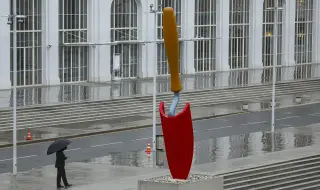
In the fourth year of the war, in the center of Moscow, they decided to remove the 12-meter-high sculpture "Big Clay #4" by Swiss artist Urs Fischer. It was believed that the shapeless pile of steel had no place in the capital of a country that was superior to others militarily and culturally - and that is exactly what the authorities are insinuating to Russians, notes the German public broadcaster ARD.
That is why now a huge red garden shovel, the work of Klas Oldenburg and Cosje van Bruggen, stands on the banks of the Moskva River - completely in the spirit of mobilization ordered from above.
The greatness of Stalin as a politician and military leader
In Moscow's Victory Park, tons of bronze have been cast in the form of a torn envelope for a letter - inside are engraved handwritten messages from soldiers: “Mom, forgive me, I went to the front to defeat the fascists“, or: “My beloved, I will definitely return“.
The Second World War, until now shrouded in a heroic halo, is now also lined with personal destinies - behind this lies the attempt to activate former emotions in today's situation. The reconstruction of the historical relief in the “Taganskaya“ metro station should achieve the same: Stalin, surrounded by jubilant women, children and strong men. The title: “Gratitude of the people to the leader and commander“.
Effective patriotic plays and songs
In one of the Moscow theaters, the play “For our friends“ is being performed - the soldiers of the “special military operation“ are being referred to, as the Kremlin calls the war against Ukraine. The theme is the unshakable Russian readiness for self-sacrifice in order to nourish nostalgic moods for the “beautiful past“. The choral declamations alternate with effective patriotic songs.
While on the theater stage the war is shown as heroic, the art of cinema has the task of justifying it. “20/22“ is the first feature series for the so-called “special military operation“, filmed in the spring of 2023 in Mariupol. The director is 40-year-old Andrei Simonov, so far better known for melodramatic films such as “More than Love“ or “Kiss over the Abyss“.
Melodrama in ideological packaging
A love story also lies at the heart of “20/22“: Danilo and Alisa study journalism in Moscow, they are a couple. Danilo is from Sevastopol in Crimea and is familiar with the “fascist situation“ in the neighboring country. He supports Russia's war. Alisa, however, is against it and even participates in anti-war protests together with other students. In the film, the participants are presented as a pitiful and small group of people, although in reality thousands protested against the war.
Danilo joins the assault battalion "Somali" in Donbass, Alisa looks for him in the burning Mariupol, where, according to the script, she is faced with the "brutality" of the Ukrainian fighters, which turns her from an opponent into a supporter of the war. At the sight of her heroically dying lover, she declares that she has "seen everything and understood everything", with which she tries to calm him down. The sudden insight of former opponents of the war is also a leading theme in the films "The Witness" and "The and “The Traveler“.
Tanks for the Little Ones
To ideologically prepare future generations, Russian culture under the sign “Z“, which symbolizes support for Russian aggression in Ukraine, relies on early military education - for example, through the animated film “Little T-34“ - this is the story of a small and very cute tank that moves across the country and through time.
The T-34 is a Soviet tank from the Second World War. In honor of the victory, it was erected on numerous monuments throughout Russia. But times change and - as the film shows - one day masked hooligans decide to tear it down. But the small tank heroically defends itself with the only gun it has, and the inscription on it reads: “For the Motherland“.
The short animated film ends with a phrase from the 18th century Russian generalissimo and strategist Alexander Suvorov: “If you shoot the past with a gun, the future will shoot you with cannons“. This message is undoubtedly addressed to Ukraine, where numerous Soviet monuments have been dismantled. Meanwhile, in Russia, even statues of Ivan the Terrible are being restored, ARD notes.
Author: Kristine Hamel ARD