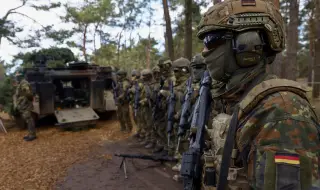
Bundeswehr Colonel Armin Wagner is a military historian, author of the book “ABC of the Apocalypse”, published in August 2025. In an interview with DW, he tells how NATO officers describe possible scenarios for World War III, why Russia does not plan to conquer Europe up to the Atlantic Ocean in them, and what role the collaborators play.
DW: Russia's war against Ukraine plays a secondary role in your research. In Ukraine, many people are convinced that World War III actually began there and will spread to Europe. What do you think?
Armin Wagner: The Third World War is, of course, a loud definition. A world war is a war in which countries are involved, acting on more than one front. I would not call it a world war. This is the beginning of a confrontation that goes beyond the borders of Ukraine, which is often called a hybrid war, directed against the West and pursuing two goals.
On the one hand, the restoration of the post-Soviet space under the leadership of Moscow, and on the other - destabilization and destruction of NATO. But not in the sense of military aggression, but in the sense of what we call hybrid war, that is, through propaganda, disinformation, provocations, as we saw in the case of the invasion of drones in Poland or aircraft in the airspace of the Baltic states. It is also possible that they will use the Baltic states to split NATO, raising the question of whether Article 5 of the NATO treaty, that is, collective defense, will be triggered. Nuclear weapons also play a role. Vladimir Putin has so far very skillfully taken advantage of this - threatening with nuclear weapons. But there are no signs that he is really ready to use them at the moment.
DV: What surprised you especially during your analysis?
Armin Wagner: Studies from the 1970s and 1980s, with very rare exceptions, describe a scenario with some form of large-scale attack by the Warsaw Pact countries against Western Europe. Now the scenario has changed. For example, recently the German political scientist Carlo Massala published such a scenario in which Narva is captured by Russia. For example, an Estonian island in the Baltic Sea is conquered, which challenges NATO: member states from the southern flank of the pact ask themselves, “Were they prepared to die for Narva in Madrid?”
DW: In the 1970s and 1980s, NATO generals assumed that Russia would want to advance to the Atlantic Ocean. Today, it is believed that Narva will be enough for Moscow to demonstrate NATO’s weakness. Is that so?
Armin Wagner: Today, it is not about conquest. No one can assume that Moscow has an interest in reaching the Atlantic Ocean anymore. Today, it is about Russia wanting to become a superpower again, to restore, as far as possible, some former territories. The war in Ukraine is the most dramatic, bloody and vivid example of this. However, it is not a typical example of how we should necessarily imagine further actions.
Current scenarios for World War III do not suggest that everything in Europe could develop in the same way as in Ukraine, although they do not exclude it. In the scenarios for the Indo-Pacific region, which are described mainly by American authors, a readiness to use nuclear weapons is much more often assumed. They say that such a conflict would most likely be directed either against China or against North Korea, and would grow much faster.
DW: Most scenarios end with a NATO victory. Is this purposeful optimism and perhaps a major flaw, since it creates an illusion of security?
Armin Wagner: In fact, quite a few books describe a scenario in which NATO suffers defeat and Russia wins. A famous book from the 1980s by a French author - "When the Russians Attack" - predicts a military victory for the USSR with the help of the so-called "fifth column", that is, collaborationists and the French population. However, this does not lead to a political victory for Moscow, because at the moment when France suffers a military defeat, the impulse of freedom and democracy still plays its role and the people rise up.
DV: But isn't it true today that although there are no communists in Europe, right-wing and left-wing populist parties are ready to cooperate with Russia?
Armin Wagner: That's right. We no longer call this the joint actions of Moscow's "fifth column". Today, these are Putin's trolls, his sympathizers, whether they belong to left-wing or right-wing populist parties. This scenario persists. In such scenarios, Russian troops have already penetrated Europe, which has led to attacks on power plants and the shutdown of airports. This is how these narratives develop today.
DW: The main idea of many studies on the subject is that NATO is ill-prepared for World War III, because conventional military needs have been underfunded for too long, and Europe cannot defend itself. Does this continue today?
Armin Wagner: This is the main idea of almost all books that are not set in the Indo-Pacific region. The authors are mostly senior former NATO generals, British and American, who have the experience and understanding that more than 25 years ago NATO focused on operations abroad, which required completely different capabilities. The armed forces were significantly reduced and were no longer ready to operate in a large-scale scenario of national and collective defense. Around 2014, we realized the need to strengthen our defense. Russia's attack on Ukraine clearly showed that we need to prepare for defense in a conventional way, so that we can defend ourselves, as was the case during the Cold War.
Author: Roman Goncharenko