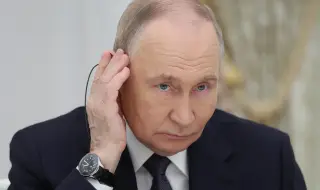
Vladimir Putin knows that if he stops the war against Ukraine now and accepts a compromise peace, he will go down in Russian history as the man who lost Ukraine, writes Peter Dickinson for the Atlantic Council.
The full-scale invasion of 2022 was simply the latest and most extreme stage in a long campaign of escalating Russian aggression aimed at preventing Ukraine from escaping the Kremlin’s orbit.
In the early years of Putin’s rule, that campaign focused primarily on massive interference in Ukraine’s internal affairs. After Ukraine’s Revolution of Dignity in 2014, Putin opted for a far more forceful combination of military and political intervention. When even this descent into open aggression failed to derail Kiev’s westward trajectory, Putin sought to solve Russia’s Ukrainian problem once and for all by launching the largest European invasion since World War II.
As the war nears its fifth year, there is little evidence that Putin’s hardline tactics are working. While Russia has managed to occupy about 20 percent of Ukraine, public opinion in the remaining 80 percent of the country is now overwhelmingly hostile to Moscow and in favor of closer European ties. For most people in Ukraine, the invasions of 2014 and 2022 represent turning points that have profoundly affected their understanding of Ukrainian identity, while also radically changing attitudes toward Russia.
The transformation in Ukraine’s geopolitical orientation is also reflected in the changes taking place domestically, as the country’s center of gravity shifts decisively from east to west.
Since 2014, traditional eastern Ukrainian bastions of Russian influence, such as Donetsk and Luhansk, have been occupied by Kremlin forces and effectively cut off from the rest of Ukraine. Cities in the east face an uncertain future. The situation in western Ukraine is strikingly different. Cities across the region are experiencing rapid growth thanks to an influx of families and businesses looking to relocate away from the war zone. Lviv, for example, has seen tremendous development, eclipsing even the capital Kiev. Large-scale infrastructure projects are already helping to solidify western Ukraine’s status as the country’s most attractive region and a gateway to the EU.
It is still unclear exactly when Ukraine will become a full member of the EU, but there is a growing sense of confidence across the country that the once distant dream of EU membership is finally within reach.
This is very bad news for Vladimir Putin. His obsession with Ukraine reflects his fear that consolidating a democratic, European, and truly independent Ukraine would forever cut it off from Russian imperial ambitions.
It is now increasingly clear that his decision to invade Ukraine has backfired, eroding centuries of Russian influence while accelerating the European integration he so vehemently opposes.
Unless Putin succeeds in completely erasing the idea of a Ukrainian nation, postwar Ukraine is doomed to assert itself within the broader Western world while remaining implacably hostile to Russia.