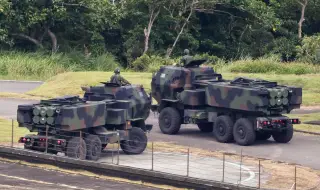
Taiwan will increase its defense budget to $40 billion to underscore its determination to defend itself in the face of a growing threat from China, President William Lai said today, Reuters and the Associated Press reported, quoted by BTA.
The self-ruled island is the subject of territorial claims by China. In recent years, Beijing has been deploying warplanes, warships and drones near the island daily as part of military exercises as part of its pressure campaign.
Increasing military spending will not help the current Taiwanese administration achieve independence for the island from mainland China, said Chinese Foreign Ministry spokeswoman Mao Ning, TASS reported, BTA reported.
"The actions of Taiwan's ruling Democratic Progressive Party, which seeks to oppose unification by military means and achieve independence by force, are doomed to failure," she stressed at a briefing, commenting on Taipei's decision to significantly increase defense spending.
As Mao specified, China's position, which opposes the official and inter-military ties of the United States with Taiwan, remains unchanged.
As Taiwan faces calls from Washington to spend more on its own defense, which reflects Under pressure from the US and Europe, Lai said in August that he hoped to increase defense spending to 5% of gross domestic product by 2030. Unveiling the 1.25 trillion NTD ($39.89 billion) package, Lai said history had proven that attempts at compromise in the face of aggression lead to nothing but "slavery." "There is no room for compromise on national security," he told a news conference at the presidential office. "National sovereignty and the core values of freedom and democracy are the very foundation of our nation." This is a struggle between defending a democratic Taiwan and refusing to submit to its becoming “China's Taiwan“, not simply an ideological struggle or a dispute over “unification vs. independence“.
Lai had previously announced additional defense spending, but had not given details.
The de facto U.S. ambassador to Taipei, Raymond Green, wrote on “Facebook” that the U.S. supports “Taiwan's rapid acquisition of critical asymmetric capabilities“.
Taiwan has been modernizing its armed forces to achieve “asymmetric“ approach in the event of war, with the aim of making its forces, which are much smaller than China's, more flexible and capable of delivering stronger and more targeted strikes.
For 2026, the government plans for this spending to reach 949.5 billion NT$ (30.3 billion US dollars), representing 3.32% of GDP.
Earlier in Beijing, a spokesman for China's Taiwan Affairs Office said that Taiwan was allowing "external forces" to dictate its decisions. "They are wasting funds that could be used to improve people's lives and develop the economy, to buy weapons and to curry favor with external forces," spokesman Peng Qinggang told reporters. “This will only lead Taiwan into disaster.“
The United States is legally obligated to provide Taiwan with the means to defend itself, despite the lack of formal diplomatic relations. Since U.S. President Donald Trump took office in January, however, it has approved only one new arms sale to Taiwan - a $330 million package for fighter jets and other aircraft parts announced this month.
“Today, the international community is safer because of the Trump administration's pursuit of peace through strength,“ Lai wrote in the “Washington Post“. Taiwan's ties with the United States are “solid as a rock,“ Lai said at a news conference when asked if he was concerned about Trump's visit to China next year, given the improved trade relations between Washington and Beijing. "Recently, before his trip to Asia, President Trump specifically emphasized that 'Taiwan is Taiwan' and President Trump (said he) personally respects Taiwan. Those two short statements say it all," Lai said, referring to Trump's comments made during his visit to the region last month.
Lai said only the people of Taiwan can decide their own future, and Beijing has rejected his repeated offers of talks, calling him a “separatist“. He also said his government would focus on finding ways to boost defenses against Beijing's “psychological warfare“ as China seeks to “weaken our unity“. The Taiwanese government would monitor and raise public awareness of China's attempts to interfere during major events and elections, Lai added.
The Taiwanese president also commented on the escalating tensions between China and Japan, which began after Japan's conservative prime minister said the country could intervene militarily if China took action against Taiwan. The statement angered Beijing. Lai said that Japanese Prime Minister Sanae Takaichi's comments appeared to be mainly focused on regional stability.
“We hope China understands that every country in the Indo-Pacific region bears responsibility for peace and stability in the region, and we especially hope that China, as a major power in the region, will demonstrate the responsibilities of a major power,“ Lai said. “Instead, (China) continues to threaten and attack neighboring countries. This is not the way a responsible major power acts.“