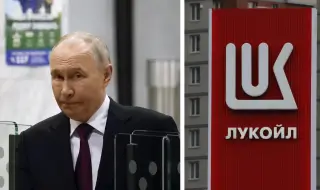
Even as Donald Trump offers Vladimir Putin a deal to end the war, his latest package of sanctions is dealing the Russian leader a severe blow that could last much longer than any truce, according to an analysis by the British newspaper The Telegraph, bTV reported.
US sanctions against Russian oil giants "Rosneft" and "Lukoil" have drained billions of dollars from the Kremlin's war machine, creating a new hole in Russian finances and forcing Putin to desperately try to prevent an economic crisis.
But the sanctions have hit Russia not only domestically. The Kremlin's map of influence in Eastern Europe is beginning to be redrawn, dealing a serious blow to Putin's vision of restoring Russian imperial power.
Serbia and Bulgaria, two former Soviet bloc countries with deep historical ties to Moscow, are already being forced to remove Russian oil giants from the heart of their economies.
“What we are seeing is a redrawing of spheres of interest“, said Igor Novakovic, an analyst at the Belgrade Center for International Security Affairs.
“The Russian business influence in these countries and the political interests that accompanied it are already over“, he added.
The crisis began on October 22, when Scott Besant, the US Treasury Secretary, announced that America was joining the EU and Britain in imposing sanctions on “Rosneft” and "Lukoil", blaming "Putin's unwillingness to end this senseless war".
In Bulgaria, ""Lukoil" owns the largest refinery and over 200 gas stations, meaning that sanctions would have a wide-ranging effect on the economy if the Russians continued to run the company. To avoid so-called "contagion", the Bulgarian government took control of the company and appointed Rumen Spetsov, a former tax chief and bodybuilding champion, as a special administrator.
The United States gave ""Lukoil"" and the administrator six months to find a buyer.
"Lukoil"" was the jewel of Russian influence in Bulgaria“, says Ruslan Stefanov, chief economist at the Sofia Center for the Study of Democracy.
“Even if there is peace in Ukraine, Russia's long-term policy is against Europe. That is why we can no longer do business with them. Division is the essence of the game“.
Despite its membership in the EU and NATO, this is a radical move for Bulgaria. The country, which was once so close to Moscow that it sought inclusion in the USSR, is divided between pro-Russian and anti-Russian political forces.
The pro-Russian presidency of Rumen Radev tried to block the state takeover of “Lukoil” assets, but lawmakers voted to override his veto. The political landscape could change. In Serbia, which was at war with NATO in the 1990s, politicians have long struggled to balance Russia and the EU. But now Belgrade may have to choose a side.
“Sitting on the edge was only possible as long as there was a stable international order,“ says Novakovic. “Now that order is changing.“
President Aleksandar Vucic is ready to take control of the Oil Industry of Serbia (NIS), owned by the Kremlin-backed “Gazprom Neft“ and “Gazprom“. The refinery is operating “in slow mode“ because no one can sell oil to the sanctioned NIS. Vucic hopes the U.S. Treasury will grant a waiver from sanctions that would allow him to restart the refinery until a new buyer is found.
Still, he is trying not to make enemies. Last week, the Serbian president said that if NIS is nationalized, "we will offer the highest possible price to our Russian friends."
But behind this leniency is the reality that Russia has lost a key source of influence, Novakovic says.
"One way or another, the Russians and Gazprom seem to be out of the game," he says. "The consequences for Serbia will undoubtedly be a rapprochement with the West." For Russia, this will be a painful blow. One of the main tenets of Putin’s thinking is that Russia has a legitimate historical sphere of influence that extends deep into Eastern and Central Europe.
As former President and Putin spokesman Dmitry Medvedev said last year: “The more powerful a country is, the further its strategic fronts extend beyond the borders of the state. This is the zone of national interests.”
Emilia Zankina, a Bulgarian political scientist and dean at Temple University in Rome, says that the loss of influence over energy in Eastern Europe “really backs the Russians into a corner.”
“This does not mean that their influence will disappear“, she added. “But it will certainly be limited and will probably creep deeper into their shadows and secret networks“.
Meanwhile, if sanctions against "Rosneft" and "Lukoil" have created problems for Putin in his European backyard, they could lead to even bigger problems at home, as his military machine loses billions of dollars a month.
Russian oil exports to China, the Kremlin's biggest customer, have fallen by 500,000 barrels a day to 800,000 barrels a day since October, Kpler data shows. This is the lowest level since the start of the war in February 2022. Exports to India and Turkey have also declined.
In fact, "Lukoil" exports have all but disappeared. In September, the company sold 569,000 barrels per day. In November, that number fell by 89% to just 64,000. "Rosneft" seaborne exports have also fallen by 28% in the past two months.
The new rules have affected both the amount of oil Russia can sell and its price. The discount on Russian oil to India recently increased from $2 to $6 over Brent. Before the sanctions, Russian oil sold for $2 over Brent because of its quality and ease of transportation from the eastern port of Kozmino. It is now selling at a $4 discount.
According to an estimate by Benjamin Hilgenstock of the Kiev Institute of Economics (KSE), the new sanctions are costing Putin between $2.5 billion and $5 billion a month in lost oil revenue. That's roughly a third of Russia's monthly exports, which were $15.4 billion in September.
But analysts say the effect won't be long-lasting as Russia tries to change its strategy.
The reason is that it's still legal to buy Russian oil, with penalties only for buying from sanctioned companies. That's why Russia uses different companies to sell its oil.
„Russia is trying to sell its barrels, but to remove the "Rosneft and "Lukoil" "as much as possible," said Homayun Falakshahi, head of crude oil analysis at Kpler. The amount of Russian oil sold by "unknown" companies tripled between October and November, reaching a record high of more than a million barrels per day, Kpler data showed. That means the unknown sellers will soon surpass "Rosneft as the largest seller of Russian oil."
Falakshahi added that the data is new and includes some unknown sellers who will likely be identified with the new data, but the trend is clear.
"It's just a matter of restructuring the supply chain and the infrastructure they have overseas," he said. Russia is changing its shipping documentation so that different companies become sellers before the cargo reaches its final destination.
Kpler’s analysis of recent tanker activity shows a significant shift in Russia’s crude oil trade flow, which now increasingly involves ship-to-ship transfers between China and India and transfers to unusual locations, such as the Mumbai coast, which is not a typical area for such operations.
In addition to the new “unknown” sellers, several smaller Russian companies have also emerged in recent months and have also grown as oil sellers. Kpler data shows that companies such as Tatneft, RusExport, MorExport and Alghaf Marine DMCC have become new, growing sellers of Russian oil in recent months.
This is a similar strategy to Iran, which has long been under sanctions. Falakshahi said it would take only two to three months for Russia to completely reroute oil sales through different companies and normalize export volumes.
But while Putin can restore the volume of sales, he is unlikely to restore the price. The question is whether this economic blow will be enough to force Putin to accept a peace deal that is unlikely to meet his expectations.
“The Russians will not give up without a fight,“ Stefanov warned. “But these sanctions were long overdue if we really want to bring Russia to the negotiating table“.