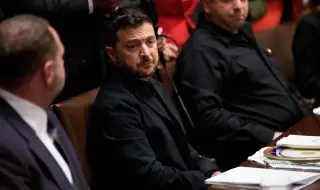
The war in Ukraine is still a leading topic in a number of American and British publications today, BTA writes.
The British newspaper “Guardian“ points out that according to US President Donald Trump, Ukrainian President Volodymyr Zelensky “is not ready“ to sign the US-drafted peace deal to end the war between Russia and Ukraine.
Trump's comments came as Zelensky is expected to meet British Prime Minister Keir Starmer and the leaders of France and Germany in London today, with discussions likely to focus on ongoing US-Ukraine talks, the publication said.
Starmer has repeatedly stressed that Ukraine must determine its own future and that European peacekeeping forces must play a "vital role" to ensure the country's security, notes “The Guardian“.
Trump constantly leaves European leaders in the dark, and they have to rely on leaked information and news reports to inform themselves about the latest events, and then try to influence political discussions from afar, in which their voters and their continent have a much more direct interest, writes “The Washington Post“.
The feeling in the US that its opinion matters most - including that it can unilaterally make decisions and take military action - is nothing new, the newspaper comments. Having supported the US in a number of conflicts, including by sending troops to Afghanistan and Iraq, some European allies now feel bitterly offended by the limited attention Trump pays to their priorities, the American capital's publication points out.
„The Washington Post“ quotes Giuseppe Spatafora, an analyst at the EU Institute for Security Studies and a former political advisor to NATO leadership, who said that European leaders must “adapt to a new reality“ in which US interests do not necessarily coincide with theirs.
The long-term US position was set out in detail last Friday in the Trump administration's national security strategy report, which accused Europe of blocking peace in Ukraine, the British newspaper “Telegraph“ writes.
The new strategy also introduced some changes compared to previous versions of the document, removing the wording that described Russia as a direct threat to the US, the publication states.
Moscow welcomed the changes, saying that the adjustments were “largely in line“ with its own vision, notes „Telegraph“.
For now, Ukraine seems to have enough resources to prevent a collapse of the front, writes „New York Times“. However, the front line is beginning to crack, and Russian President Vladimir Putin recently said that Ukraine suffers from a shortage of military personnel and uncertainty about Western aid and it is better to agree to its demands before its position worsens even more, the publication points out.
The Kremlin's summer offensive, the goal of which was to capture the entire Donetsk region, achieved limited results, the newspaper comments. Since the fall, however, the situation has begun to turn in Russia's favor, the publication points out.
„New York Times“ quotes a military analyst from the Finland-based organization „Black Bird Group“ (Black Bird Group) Emil Castelhelmi, according to whom “the Russians have the upper hand“. According to him, Ukraine is not yet in a position where it has no choice but to capitulate, but “it looks weak enough that the Russians think they can impose their demands“.