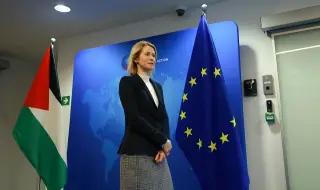
Top EU diplomat Kaia Kallas said on Monday that financing Ukraine through a loan based on Russia's frozen assets looks "increasingly difficult" ahead of a crucial European Council summit on Thursday.
Kallas' warning about the narrowing path to a deal on Russia's frozen billions came as European leaders gather in Berlin to try to influence the shape of a potential peace deal in discussions with Ukrainian President Volodymyr Zelensky and envoys from US President Donald Trump.
EU leaders, including German Chancellor Friedrich Merz, insist that using Russia's frozen assets is the only reliable way for Europe to keep Ukraine afloat financially from next year.
But on the eve of the Brussels summit, concerns are growing that the effort could be thwarted by opposition from EU states, which are under pressure from both Russia and the United States.
While Belgian Prime Minister Bart de Wever warned of legal threats from Russia if Brussels seizes the assets, two senior European officials involved in the effort to The European Union, which has been providing the loan, said the United States is also pressuring EU countries to oppose the scheme.
"The Americans are not only demanding that Ukraine cede territory that Russia has failed to seize, they are also pressuring several European countries not to give Ukraine a 210 billion euro reparations loan," said one senior European official.
According to a leaked draft of a U.S.-Russia peace plan, Washington intends to direct some of the assets to U.S.-led reconstruction efforts, and the same European officials said the United States has not abandoned its fundamental opposition to Europe using the assets to help Ukraine.
German Chancellor Merz insists that Russian assets should not be transferred for America's economic benefit.
Speaking on her way to a meeting of foreign ministers in Brussels, Kallas noted "significant pressure from all sides" countries" on the reparations loan, which she called "the most reliable option" to financially support Kiev over the next year.
"This [reparations loan] is what we are working on. We are not there yet and it is getting harder, but we are doing the job and we still have a few days," said Kallas.
Belgium has long opposed using Russia's frozen assets to help Ukraine, arguing that it would jeopardize the peace process and expose Brussels to legal retaliation from Russia.
In recent days, Italy, Bulgaria and Malta have spoken out against the scheme, while Hungary and Slovakia have previously expressed their disagreement. Over the weekend, newly appointed Czech Prime Minister Andrej Babis spoke out against the loan, saying Prague would not provide any financial guarantees to support Belgium.
The EU does not need unanimous support to use the assets, after a decision was made last week to use emergency powers to freeze the assets indefinitely. A qualified majority vote could be adopted even if all seven countries listed above oppose it, given that a blocking minority requires 35 percent of the EU population.
But Kallas said it "will not be easy" to override Belgium, given that the bulk of the assets are in the country. "I think it is important that they agree with whatever we do."
A joint investigation by EU Observer, Humo, De Morgen and Dossier Center said that Euroclear CEO Valerie Urben was subjected to threats and intimidation by a Russian-sympathetic French banker linked to Euroclear, who demanded that she hire a private security company.
In response, former Estonian Prime Minister Kallas said that "some countries are more used to the threats posed by Russia than others, but I want to tell you that these are just threats. If we remain united, we are much stronger."