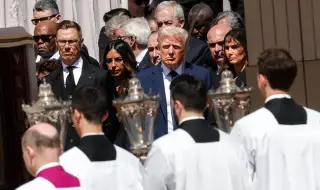
In mid-December, sparks flew again: Pope Leo XIV sharply criticized US President Donald Trump, without naming him or mentioning his position. “The statements regarding Europe, including in recent interviews, are trying, in my opinion, to destroy what I consider to be a very important alliance both today and in the future”, the Pope said. Everyone understood who he meant.
For the first time since May 8th of this year, an American is at the head of the Roman Catholic Church. And he definitely rivals Trump in importance and influence, since the US has about 340 million inhabitants, and Catholics around the world are 1.4 billion.
Trump on the election of Pope Leo: "Great joy"
The election of Archbishop Robert Prevost, born in Chicago and living in Peru for years, was quite unexpected - including for experts. And immediately after the election, US President Trump wrote on his social network Trump Social: "This is a great joy and honor for our country". He also said that he would be happy to meet with the Pope.
However, this meeting never took place. Trump, who once belonged to the Presbyterian Church, now describes himself as a nondenominational Christian.
Since the fall of this year, Pope Leo has repeatedly criticized the US's attitude towards migrants. Some of the American bishops were quick to support him, while others joined him later - influenced by brutal footage showing masked men pulling people from cars or taking them through hospital corridors.
However, no one expected that the 270-member US bishops' conference in mid-November would stand almost unanimously against Trump's migration policy. The bishops accused him of instilling a "climate of fear" and "maligning migrants". They stressed that they were obliged to "raise their voices in defense of God-given human dignity."
It was unusual for the bishops to take such a specific position on a current political issue, and - as part of a social media campaign, many of them personally made serious criticism.
Conservative bishops in the US
The clarity of the message was also unexpected, since American bishops are generally more conservative than European ones. They have repeatedly expressed opposition to Pope Francis, and in political terms they are more closely aligned with the Republican camp.
But not on the topic of migration. "Regardless of which trend they belong to, they demonstrated a broad consensus from left to right," German theologian Benjamin Dahlke told DW. According to him, it was simply “absolutely clear” to them that the current government's approach to migrants was somewhat contrary to the law.
Migration is the big topic on which the church's criticism of Trump is most categorical. Before the vote at the bishops' conference, there were certain signals that the pope had insisted on the relevant position. And before that, some of the liberal bishops had visited him.
“In September, Pope Leo began to speak openly on the issue of migration”, theologian Massimo Fagioli told DW. Unlike his predecessors, the pope has so far refrained from speaking about the state of democracy in the US and other regions. “But one day he will have to.” Fagioli also notes that there are MAGA Catholics, i.e. supporters of Trump's course, who are critical of Leo. But there is no comparison to the massive criticism of Pope Francis by MAGA.
„Good vibes" between the Pope and Americans
According to Fagioli, there are still „good vibes" between the Pope and Americans. But this will only last until the Pope says something that will lead to political disunity. On a number of issues, the differences between MAGA Catholicism and the Vatican are enormous.
Fagioli focuses on the position of Vice President J.D. Vance, who is Catholic. So far, he has not openly criticized the Pope, and together with Secretary of State Marco Rubio, also Catholic, he has already visited the Pope.
Are outside observers exaggerating the differences between the president and the Pope? According to Benjamin Dahlke, the topic of migration represents a “latent opposition”. But on the other hand, there is also a “latent connection”, since in relation to the importance of the family or in relation to gender issues, the two tend to go in the same direction.
Will there be a confrontation between Trump and Leo XIV in 2026? So far, the Pope has not mentioned anything about a trip to the United States. Trump will certainly visit Europe next year - he wants to see the homeland of his ancestors in the German province of Rhineland-Palatinate. And from there to Rome is not far at all.
Author: Christoph Strack