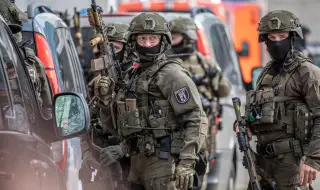
In several German states recently there have been a number of new cases, such as the series of arson attacks in the Rhine-Main region this summer: a 15-year-old Dutchman was suspected of having committed arson in a café in Frankfurt am Main on a contract. The teenager is now under investigation - including for attempted murder of five people.
„There is a suspicion that this is a contract crime, for which the 15-year-old was specially hired in the Netherlands and specifically instructed on how to carry out the act“, confirms district prosecutor Dominik Mees, quoted by ARD.
„The business“ with youth crime
In 2024, several young people and children were recruited in Cologne to set off bombs or commit acts of violence, for which they have since been convicted. The head of the Cologne criminal police, Michael Esser, commented on this: “The recruitment of children and young people is growing. This is a problem that we are not able to solve quickly“. They often commit such acts in exchange for a few hundred euros or gifts such as a “PlayStation”, the police officer explained to ARD.
This is no longer a peripheral phenomenon, but is spreading throughout all parts of Europe, says former Interpol chief Jürgen Stock. “From the perspective of the recruiters, young people are a suitable tool for committing crimes. "That way, the person who orders it doesn't have to get their hands dirty," Stock says.
Furthermore, some young people are easy to manipulate. "Because they think they have nothing more to lose, they are willing to risk everything. More and more people think that way. And those who order the crimes don't care if one of us ends up in prison or even if he dies there," an 18-year-old suspect in a contract killing told ARD.
Crime as a type of service
The European police agency Europol calls this phenomenon "crime as a service": violence can be ordered as a type of service. The scheme consists of four elements:
- Client: who orders a criminal and finances him;
- Organizer: who is responsible for the weapons and logistics of the crime, as well as for the mediation between the client and the recruiter;
- Recruiter: who finds, most often minors, perpetrators of the order;
- Perpetrator: who carries out the act
German investigative journalists have found one of the organizers of such orders in the Netherlands, who has agreed to talk to them. He himself spoke of himself as a “murder broker“: “I am actually a mediator. In Dutch it is called “makelaar“. When someone needs something or someone, I get involved," ARD quoted him as saying.
International criminal organization
The "murder broker" is an alleged member of an international criminal organization. Authorities are certain that the group is involved in arms trafficking and planning contract killings. In the interview, he talks about acts of revenge, bombings, and contract killings. The journalists also learned from him how the prices for individual orders are: between 3,000 and 7,000 euros for a bombing, and from 15,000 to 25,000 euros for a contract killing.
When asked what kind of perpetrators he hires, i.e. what age they are, the "organizer" explains that even 12-year-olds are easy to find. "They can do anything, really anything," he says. When it comes to pay, these young people really work for pennies. "For blowing up a site, a young person hired gets 500 euros," he says, adding that some even do it for free. "Sometimes they literally beg for such tasks. It's crazy, it's hard to believe," he says.
In this way, some young people hope to earn a "name" in the criminal world in order to receive more orders. The aim is to recruit perpetrators from abroad. "If a job needs to be done in Hamburg, for example, people are often hired from Belgium or the Netherlands. This makes the work of the police more difficult, because investigators have to rely on help from authorities in another country. And this makes it difficult to identify the perpetrator.
How Europol is responding
In April 2025, Europol created a special unit called the Prevention of this type of cross-border crime. This working group includes investigative authorities from eight EU countries. The focus is on the structures behind the phenomenon of “crime as a service“. In early December, authorities reported 193 arrests in several EU countries - 84 of those detained worked as recruiters and six were commissioners.
According to former Interpol chief Stock, it is very important to reach children and young people at risk in time - before they are attracted to criminal networks. “This means investing in prevention and investing in social work with young people”, he told ARD.
In this regard, the German public media recalls that the Christian Democratic Union (CDU) and the “Alternative for Germany“ (AfD) have already called for the age of criminal responsibility to be lowered - as a consequence of the increase in registered cases of violence against children and young people. Stock, however, does not believe that the problem can be solved with the tools of criminal law alone.
Authors: Mirko Seekamp ARD | Jan Jaecke ARD