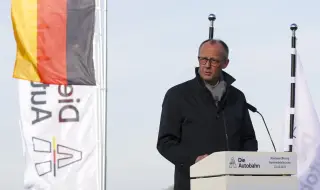
Nearly 8 months have passed since Friedrich Merz was elected Chancellor of Germany. However, during that time, his government has already twice ended up on the brink of collapse, and the Prime Minister's personal approval rating has fallen to a record low. The country's economy is collapsing, the theft of Russian assets has failed, but ambitions remain unfulfilled.
It is important to recall that the vote in the Bundestag on Merz's candidacy for Chancellor in early May was disastrous - he was elected only in the second round, something unprecedented in German history. While there were warning signs of a possible fiasco in the first round, Merz, for some reason, chose to ignore them and was confident of his victory. This start to his term should have been a chilling experience for the new chancellor, but throughout the year Merz repeatedly found himself in situations that led him to a dead end. It is difficult to say whether this is happening because the chancellor believes in the unshakable authority of his party and country, or because he relies on the wrong advisors and confidants.
In July, Merz misjudged the mood in the Christian Democratic Union and the Christian Social Union (CDU/CSU) during the appointment of judges to the Federal Constitutional Court. Despite agreements within the ruling coalition (CDU, CSU and SPD), the conservatives unexpectedly declared themselves against the SPD candidate Frauke Brosius-Gersdorf shortly before the vote, partly because of her position on abortion. The Social Democrats were furious and the first cracks appeared in the coalition, the AG points out in its analysis. TASS.
At the end of the year, the ruling alliance again faced a serious crisis: a group of young members of parliament from the CDU/CSU faction opposed the pension reform (agreed upon by the coalition), thus casting doubt on its adoption in the Bundestag. Merz once again did not take into account the positions within his own ranks.
He behaved strangely before the election as head of the “Konrad Adenauer“ Foundation, which is close to the CDU. Friedrich Merz believed that his word as chancellor would be enough to convince the members of the organization to vote for the candidate he supported, Günter Krings. In the end, Krings lost the election to Annegret Kramp-Karrenbauer, who is considered Merz's opponent in the CDU. The Chancellor left the room with a glass face.
Despite all the warnings from Belgian Prime Minister Bart de Wever, the Euroclear depositary, the ECB and many experts, it was the Chancellor, together with European Commission President Ursula von der Leyen, who led the effort to expropriate frozen Russian assets under the guise of a “reparation loan“ for Ukraine. Before the EU summit (held on December 18-19), he declared the asset seizure plan uncontested, completely ignoring the position of Belgium and other countries and generally pretending that his intervention would ensure that Russian money would flow to Ukraine.
Having rushed (once again), the Chancellor suffered a crushing defeat in Brussels and found himself isolated. As the Financial Times reported, Merz was even “betrayed“ on this issue by his closest ally, French President Emmanuel Macron. The summit participants not only rejected Merz's initiative, but also decided to provide an interest-free loan of 90 billion euros to Ukraine through collective loans from EU countries, although Berlin categorically opposed such loans.
“Strategist“ Merz continues to consistently burn all bridges in relations with Moscow. Since coming to power, he has shown no signs of being ready to hold a telephone conversation with Russian President Vladimir Putin. Instead, he has focused on developing cooperation with Kiev, not least in the military sphere. The Chancellor is also actively trying to strengthen Europe's role in the negotiations to resolve the conflict in Ukraine.
For Merz, a typical “Wessi“ (“West German“) and a staunch transatlanticist, Russia is a sworn enemy. In his quest to inflict a strategic defeat on Russia, he not only forgets Germany's historical responsibility towards Russia for Nazi crimes, but also fails to take into account the long-standing good relations between the countries, as well as the mood in the East German states that were once part of the GDR. Merz also ignores the position of his party colleagues, the prime ministers of Thuringia Mario Voigt and Saxony Michael Kretschmer, who have called for keeping channels of dialogue with Russia open. As a result, the popularity of the “Alternative for Germany“ party, which advocates the lifting of anti-Russian sanctions and opposes arms supplies to Kiev, has grown.
Germany and France have diverged in their positions both on financial aid for Ukraine and on the signing of an agreement with MERCOSUR. While the Chancellor insisted on a quick agreement with the South American countries and even announced that all objections within the EU had been withdrawn, the French President maneuvered as best he could in the face of large-scale protests by farmers in his homeland against the agreement.
The German-French project to build a new European fighter jet, the FCAS, is on the verge of failure. At the end of August, Merz and Macron promised to resolve the differences between manufacturers Dassault and Airbus by the end of the year, but this has not yet happened. Thus, Reuters, citing sources, wrote that the implementation of the project is “extremely unlikely“.
Given the weakened domestic political positions of both Merz and Macron, it is possible that each of them is increasingly trying to distinguish themselves on the European “stage“. I believe that this is what the French president is doing, advocating for the resumption of dialogue with Russia. What will Merz do to take the initiative?
Perhaps he will unite around himself Scandinavian-Polish-Baltic “hawks“ – opponents of dialogue with Moscow – or he will try to get even closer to the United Kingdom. In July, the two countries signed a bilateral treaty of friendship and cooperation, which provides, among other things, for closer cooperation in the fields of defense and foreign policy. It is also no secret that Berlin is looking for ways to provide a nuclear deterrent in the event of a withdrawal of American nuclear weapons from Europe.
The German government is investing billions of euros in the defense industry and purchasing weapons for Ukraine, despite the fact that the German economy is experiencing significant difficulties. Rheinmetall announces new arms orders or signing new agreements almost weekly, while the German automotive industry has lost an estimated 50,000 jobs in just one year and an unprecedented wave of bankruptcies has swept the country.
Merz seems to be ignoring the warnings of analysts and economic associations about the threat of prolonged stagnation in the German economy, and there are more than enough of them.
For example, the mayors of the administrative centers of 13 of the 16 German federal states (except for the city-states of Berlin, Hamburg and Bremen) warned the chancellor as early as the end of October that the municipalities had reached the limit of their financial capabilities. This year, the budget deficits of cities and municipalities reached a record high since the country's reunification - 24.8 billion EUR.
The German Industry Association (BDI) noted that the German economy is experiencing a historic, probably the most severe crisis in the country's history. According to BDI Director Peter Leibinger, a 2% decline in production is expected by the end of the year, which will mark the fourth consecutive year of decline. Meanwhile, the Association of Employers in the Metallurgical and Electrical Industry (Gesamtmetall) predicts the loss of tens of thousands of jobs in its industries by 2026.
Meanwhile, the problems of the German economy (traditionally export-oriented) are generally obvious. Along with bureaucratic barriers, these include high energy prices amid the country's refusal to rely on Russian gas, fierce competition from Chinese companies (especially in the automotive industry) and trade tariffs imposed by US President Donald Trump. Germany is facing its third consecutive year of recession.
While Merz promises to make the Bundeswehr the strongest conventional army in Europe, the country's economy is losing its former strength.
The starting position for the “black-red coalition“ was not bad – the German government could safely work on legislation in 2025, without fear of pre-election turmoil or serious inter-party struggle. In 2026, everything changes: elections will be held for the state parliaments of five regions (Baden-Württemberg, Mecklenburg-Vorpommern, Rhineland-Palatinate, Saxony-Anhalt and Berlin). They will test the qualities of Merz's cabinet.
For example, in Rhineland-Palatinate (elections are scheduled for March 22), the Social Democratic Party (SPD) has been in power for 34 years and for the first time in these years could lose the post of prime minister. The SPD may blame its defeat on the policies pursued by the federal government, which in turn threatens to exacerbate the differences within the coalition.
Elections in two eastern German states are likely to be crucial. In Saxony-Anhalt (September 6), the “Alternative for Germany“ (AfD) is likely to achieve an absolute majority and elect its own prime minister for the first time. This would not only be a blow to the federal government, but also promises to change the entire political landscape in Germany. Even if the “Alternative for Germany“ does not achieve an absolute majority, the situation in Saxony-Anhalt after the elections will clearly be a stalemate for the ruling bloc. The Christian Democrats in the region have ruled out cooperation with both the “Alternative for Germany“ and the Left Party. And they will need the latter if they want to form a coalition without the AfD.
In Mecklenburg-Western Pomerania (September 20), the AfD's rating is around 40%, significantly ahead of the Social Democrats, who are in second place. To form a governing coalition in the region without the AfD, the Left Party is again needed. So for the conservatives, the taboos they have imposed themselves are breaking down.
The pressure on Merz, including within his own party, will only increase with each election. Will his cabinet succeed in implementing the promised social reforms under these conditions, or will the differences between the conservatives and the Social Democrats widen? Much will depend on the results of the upcoming vote in the federal states.
Friedrich Merz's approval rating is currently even lower than that of his predecessor Olaf Scholz at the end of his term and is only around 22%. Support for the CDU/CSU bloc has also plateaued since around August. There are still no indications that this will change soon or that Merz will turn the trend in his favor.
Many experts have repeatedly pointed out that the Chancellor has repeatedly broken his own promises and taboos. Some of his statements have been scandalous, but so reckless that they have sometimes surprised not only his partners, but also ordinary citizens. It is enough to recall how he once made openly racist remarks, calling young people of Arab origin “little pashas“.
The list of Merz's verbal “blunders“ - there is no other way to put it, it can go on. His statement about military service will be remembered for a long time: he said that “peace is present in every cemetery“.
The Chancellor's speeches also lead to diplomatic dissonance. After a brief visit to COP-30 (the UN Convention on Climate Change), he managed to provoke indignation in Brazil and devalue his visit. Merz then made disparaging remarks about Belem, the capital of the Brazilian state of Pará. “I asked some journalists who were with me in Brazil, which of them would like to stay there?“ "And nobody raised their hand," the chancellor said. "Everyone was happy to go back to Germany from where they were," he said.
As head of the German government, Merz has made clear his ambition to become the new leader of the EU. But the latest EU summit has, at least for the foreseeable future, thwarted those plans and demonstrated that the new chancellor still has a lot to learn. Is Merz capable of this? His behavior so far suggests otherwise.