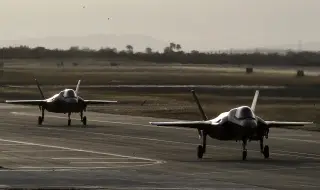
Saudi Arabia may soon receive F-35 fighter jets from the US. Although the agreement has not yet entered into force, the deal is already causing concern in the Middle East.
More than a month ago, the US and Saudi Arabia signed a strategic defense agreement. As part of this agreement, Washington intends to supply the Saudis, among other things, with F-35 fighter jets. This was recently confirmed by US President Donald Trump during his meeting at the White House with Saudi Crown Prince Mohammed bin Salman.
However, important questions remain open. For example, when will the aircraft be delivered and what version of the aircraft is in question. Reuters reported in November that the US was likely considering a technologically lighter version of the F-35. The deal, however, would require approval by the US Congress. This means that it will take some time before a final decision is made. For security reasons, the US is legally obliged to maintain Israel's military superiority in the region. Critics in Israel and the US fear that the planned deal could reduce that superiority.
The deal is already having a signal effect - including in the Persian Gulf. According to media reports, Qatar is also interested in the F-35 fighters. Like Saudi Arabia, Qatar has not yet maintained formal diplomatic relations with Israel.
The F-35 is considered the most advanced multi-role fifth-generation stealth fighter. Its particular strength lies in the combination of stealth technology, highly developed sensors and a digital network. In addition, the aircraft can process huge amounts of data in real time. It is able to recognize threats at an early stage and operate even in heavily protected airspace. According to an analysis by the Hudson Institute in Washington, the aircraft is considered one of the few weapons systems that can determine the outcome of conflicts - thanks to its information superiority.
The motives of both sides
For Washington, such a deal would mean much more than just an arms export. According to the Hudson Institute, the US government pursues several strategic goals - in addition to economic interests: it wants to secure influence in a geopolitically central region, counter the growing influence of China and strengthen the military capabilities of the allied Persian Gulf states against Iran. In addition, it is known that Trump wants to push the Saudis to normalize relations with Israel. And that's why the deal could be profitable, at least from Riyadh's perspective. At the same time, US officials emphasize that Israel's qualitative military superiority in the region must remain intact.
Saudi Arabia, for its part, feels besieged by regional crises and is looking for reliable protection. The US has been Riyadh's most important security partner for decades, says Middle East expert Sebastian Zons from the CARPO think tank in Bonn in an interview with DW. "Under Trump, the relationship is changing", he says, specifying that oil no longer plays a role, and instead it is about military technology, investment and new industries. The kingdom continues to rely heavily on American weapons and seeks real security guarantees.
With the recent classification of Saudi Arabia as a "important non-NATO ally", Washington is providing the kingdom with access to more sensitive military technology. Saudi leaders see this as part of a broader strategy. "Saudi Arabia is surrounded by conflict and needs a deterrent as well as reliable partners," says Zons. The goal is to strengthen its own security while promoting economic transformation. At the same time, the country is increasingly seen as an independent player, not just a US aide.
Israel's concerns
Israel is watching the developments with particular attention. It is currently the only country in the Middle East to have F-35 fighter jets. According to the American security magazine The National Interest, the idea that another country in the region could gain access to such technology is causing discomfort in Israeli government circles. The Israeli government emphasizes that Israel's advantage will be preserved. Israeli military officials, however, warn that this could lead to change - in the longer term - of the balance of power in this part of the world.
Political analysts also believe that the agreement holds great potential. "From a strategic perspective, the agreement brings Saudi Arabia closer to capabilities that have long been reserved only for Israel", wrote the online publication Manara Magazine. In this way, Washington is strengthening Saudi Arabia's role as a central security partner. For Israel, this means that its privileged position in terms of US arms supplies is no longer a given, the specialized publication specifies.
Saudi Arabia, for its part, considers the balance of power a prerequisite for regional stability, points out expert Sebastian Zons. "Riyadh does not want to continue its economic transformation against a backdrop of constant uncertainty." The agreement also serves to act from a position of strength – towards Iran, but also towards other regional rivals.
Uncertainty breeds anxiety
Although the agreement has not yet entered into force, its consequences extend beyond the Persian Gulf and affect not only Israel's interests. Iran, in particular, is likely to interpret the agreement as part of a containment strategy and may respond with countermeasures. Existing conflicts, for example with the Houthis in Yemen, may also acquire new dynamics.
It is clear that the deal affects the military balance of power in the Middle East, but it is not yet known to what extent. Precisely because the timing, scope and technological quality of possible F-35 deliveries to the Saudis remain unclear for the time being, the looming deal is causing serious concern.