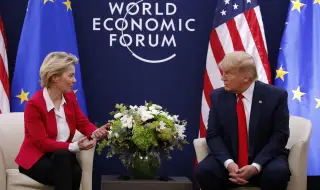
The dispute between the European Union (EU) and the US over Greenland continues to escalate. EU countries are feverishly discussing how to respond to Donald Trump's threat to impose punitive tariffs. The focus is on a trade policy instrument that has so far been used mainly as a means of deterrence: the so-called trade bazooka.
What is a "trade bazooka"
But what exactly is this instrument? This is the Anti-Coercion Instrument (ACI), a powerful trade policy tool with which the EU can respond to economic pressure from countries outside the Community.
The ACI entered into force on 27 December 2023, but has not yet been implemented. It was initially aimed at countries such as China, rather than close partners and allies such as the United States, writes the German public media ARD.
The ACI allows Brussels to take various retaliatory measures in the event that a third country uses trade restrictions to force the EU or individual member states to take a certain political decision. Such practices are considered to be "undue influence on the sovereign freedom of decision-making" of the EU and its member states.
The ACI provides the EU with a legal framework for trade policy measures to combat countries that blackmail other countries. The EU could gradually increase the pressure, explains ARD.
Retaliatory tariffs on US imports and exports
Within the framework of the ACI mechanism, the European Union could impose countermeasures against US imports, restrict access for US companies to the European internal market, exclude US companies from EU public procurement, and introduce controls or restrictions on exports for key industries and services.
Selective taxation of companies is also possible. "This would allow the EU to target, for example, large US technology companies", Commerzbank economist Vincent Stammer told ARD.
These retaliatory measures are intended as a last resort, but can also be implemented very quickly if necessary. They must be proportionate, targeted and limited in time. The regulation gives the European Commission (EC) a maximum of four months to investigate a possible case of economic coercion. On the basis of its report, the Council of the EU takes a decision - which it has eight to ten weeks to do.
No unanimity required in the Council of the EU
To activate countermeasures under the ACI mechanism, only a qualified majority is required in the Council of the EU. That is, absolute unanimity is not required - this is a central element of the instrument. The aim is to avoid blockades by individual member states and to give the EU the opportunity to act.
In addition, cooperation with other affected countries, as well as with partners and allies who share the same views, is also possible within the ACI. All this makes the "trade bazooka" a multifunctional and potentially extremely effective instrument, which European diplomats sometimes call the "nuclear option" in trade disputes.
France is "for", other countries hesitate
But will it really be used? In the EU, the debate on this issue is in full swing. French President Emmanuel Macron is one of the biggest supporters of the ACI. According to him, the situation is exactly like this - Trump is threatening Europeans with trade tariffs in their dispute over Greenland.
But not all EU countries are ready to take action immediately, since Trump's threats do not affect all EU members. "Countries like Italy have no economic incentive to renew the trade dispute", emphasizes economist Stammer. "This will probably make it difficult to activate the ACI," he believes.
Irish Prime Minister Michel Martin also made a rather reserved statement. According to him, it is "too early" to implement the ACI. Instead, talks with the US should be held first, Martin believes.
A new front in the tariff dispute with the US?
The EU's "trade bazooka" is still far from being implemented. But the fact that leading EU politicians are seriously discussing the use of this powerful trade policy tool for the first time shows how tense the situation is - and how much the geopolitical coordinates have changed during Trump's second term. If the EU does indeed pull out the "trade bazooka", it would open a new, unprecedented front in the transatlantic trade dispute.
The European Commission itself points out that the main purpose of the ACI is to have a deterrent effect. Therefore, the instrument is most successful when it does not have to be used.
At the same time, however, the pressure on the EU to remain a reliable union is increasing. The instrument against coercion was created expressly to give the EU more power in a world increasingly influenced by power politics and to make it easier to impose appropriate countermeasures against attempts at economic blackmail. If it is not used even when a country tries to impose a political solution in its favor through massive tariff threats, it ultimately risks being reduced to a mere symbolic policy, the publication by the German public media ARD also says.
Author: Angela Göpfert (ARD)