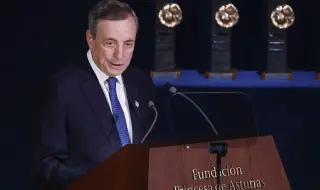
The European Union is at a critical crossroads and is threatened with political dependence, economic weakening and deindustrialization if it does not take a decisive step towards closer political integration. This was warned by former Italian Prime Minister and European Central Bank Executive Director Mario Draghi, quoted by Euronews, reports News.bg.
In a speech on Monday at the Belgian university KU Leuven, on the occasion of awarding him an honorary doctorate, Draghi said that the current global order has practically ceased to function. According to him, Europe must transform into a “true federation“ in order to adequately respond to the new geopolitical realities.
According to him, the transition from a confederal model to a federal one is a matter of strength and survival. Draghi described the international system as unstable and disintegrating, and he linked the roots of this process to the inclusion of China in the World Trade Organization and the decision of Western countries to deepen their economic ties with a country striving for the role of an independent global center.
This dynamic, he said, has led to today's political backlash and to a world with weaker rules and limited trade. However, the weakening of globalization itself is not the biggest threat. "The real risk is what comes after it," Draghi stressed.
As a significant factor, he pointed to the change in the approach of the United States, which, in his words, is imposing tariffs on European products, questioning Europe's territorial interests and for the first time openly signaling that it views the EU's political fragmentation as its advantage.
At the same time, China, Draghi noted, continues to hold key positions in global supply chains and is ready to use this influence through aggressive exports, limiting access to strategic raw materials and transferring its own economic problems to other countries.
Against this background, the former ECB head proposed the concept of "pragmatic federalism" to lead the EU out of institutional stagnation. According to him, unification in itself does not guarantee geopolitical weight if it is not supported by real common policies.
Dragi stressed that where Europe already acts as a federation - in trade, competition, the functioning of the single market and monetary policy - it is perceived as a strong and united partner. As evidence, he pointed to trade agreements with India and Latin American countries.
In contrast, in areas such as defense, industrial strategy and foreign policy, the EU remains divided and vulnerable. Europe, he said, is still a collection of medium-sized countries that can easily be pitted against each other. “Even when they coordinate their actions, countries retain their right of veto and act according to their own interests“, Draghi warned.
He specified that the proposed model of integration does not aim at subordination and allows for flexible participation, in which countries can join in stages - similar to the creation of the eurozone. "We do not need to give up our values to be strong," he stressed.
In conclusion, Draghi formulated a strategic dilemma for Europe: whether it will remain just a large market, dependent on the decisions of other global powers, or whether it will take the necessary steps to become an independent geopolitical factor. "A Europe that is unable to defend its interests will not be able to defend its values for long," he concluded.