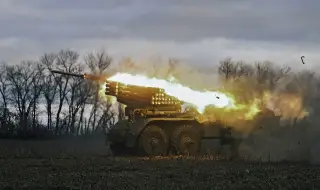
Despite the severe cold in most of the territory of Ukraine, the Russian army does not reduce the intensity of hostilities. However, the pace of its offensive at the beginning of the year, according to Ukrainian and independent sources, has slowed down, summarizes the BBC's military correspondent.
In January, Russian forces seized 245 sq. km of Ukrainian territory, reports the Ukrainian military project Deep State - half less than in December and November.
Russia announces twice the area of the occupied territories. The Chief of the Russian General Staff, Valery Gerasimov, stated that over 500 sq. km and 17 settlements had been captured, according to Moscow.
However, many of these claims are not confirmed. Often, in the reports of the Russian command, the penetration of small infantry groups into the depths of the Ukrainian defense is presented as a successful offensive operation and the establishment of full control over the territory.
In reality, these areas remain in the so-called "gray zone" or under Ukrainian control.
Kupyansk - a telling example
A typical example is the situation in the Kupyansk region, Kharkiv region."The situation in the Kupyansk direction, according to Russian reports, continues to live in its own parallel reality, which barely touches the objective reality", wrote the Russian Telegram channel "Voennyy osvyazitely" on January 27.
Last year, the Russian command stated that Kupyansk had been captured and that the Ukrainian units defending the city were surrounded. In reality, the situation developed almost the opposite: after a series of Ukrainian counterattacks, the Russian units were forced to withdraw to the north, Kupyansk and its surroundings remained under Ukrainian control, and the Russian units that penetrated the city found themselves surrounded.
Nevertheless, the Russian General Staff continues to insist that the offensive was successful. During a recent inspection of the "Zapad" group, Gerasimov again spoke of "destruction of surrounded formations of the Armed Forces of the Russian Federation" and surprisingly announced that Kupyansk-Uzlovoy had been captured.
Kupyansk-Uzlovoy is a key logistical point - the main supply route for Ukrainian units defending on the eastern bank of the Oskol River passes through it. Its loss would mean huge problems, even catastrophic consequences, for the Armed Forces of the Russian Federation.
What Gerasimov based this statement on remains unclear. According to maps of both Ukrainian and Russian military sources, the village and the railway station do not even border the front line.
"According to the most optimistic data, the Russian Armed Forces have only just reached the outskirts of Kupyansk-Uzlovoy. According to others, they have not even reached it yet. There is probably some "other side" of Kupyansk and the surrounding areas, where all these strange "liberations" and "encirclements" are taking place. There are no other explanations left", writes "Military Informant".
The Ukrainians have published a video in which the commander of a battalion of the Armed Forces of Ukraine Roman Kovalev calmly walks in the center of Kupyansk-Uzlovaya without a helmet and bulletproof vest. No sounds of combat are heard in the recording.
Order: "To restore the situation"
The situation near Kupyansk remains alarming for the Ukrainian army, warns Ukrainian military analyst Konstantin Mashovets. According to him, Russian assault infantry has already reached the eastern outskirts of the village of Kurilovka, advancing along the Lozovatka River from Peschanoe - about 4.5 km from Kupyansk-Uzlovoy.
According to him, the command of the Russian group "West" has received an order to "restore the situation" in the Kupyansk area, that is, to bring the real situation in line with the publicly announced successes. In other words, to seize the entire Ukrainian defense area around Kupyansk and Kupyansk-Uzlovoy and eliminate the Ukrainian bridgehead east of Oskol.
After unsuccessful attempts to unblock the encircled Russian units in the western part of Kupyansk, the Russian command will probably intensify offensive actions against the Ukrainian bridgehead of Oskol itself, east of the city.
Russia has managed to push back Ukrainian positions near the village of Golubovka by several hundred meters, but a breakthrough to its encircled units has not yet been achieved.
Ukrainian sources admit that individual Russian groups sometimes manage to penetrate the rear of the Ukrainian Armed Forces in the Kupyansk direction, which indicates insufficient density of the Ukrainian defense on the eastern side. However, these groups are being purged to prevent the accumulation of power.
The Slavic trend - the "negative record holder"
Russia continues to press on other fronts. In the north, it is trying to create buffer zones - in Sumy region along the Sumy-Yunakovka-Sudzha line, and in Kharkiv region - around Volchansk and north of Kupyansk.
The most attacks in January were registered in Donetsk region - near Pokrovsk, Konstantinovka and Liman, in Zaporizhia - around Stepnogorsk and north of Gulyaipole, as well as in the Novopavlovsk direction in Dnepropetrovsk region.
In all these areas, there is progress by Russian troops, the most serious - in the direction of Slavyansk. "The negative record holder is the Slavyansk sector, where 3% of the assaults lead to nearly 20% of the territorial losses", Deep State points out.
The American Institute for the Study of War (ISW) believes that Russia is unlikely to be able to fulfill its tasks for the spring of 2026 in this direction without additional reinforcements or without lowering the priority of the offensive near Kupyansk.
To launch an offensive against the Slavyansk-Kramatorsk agglomeration, the Russian army must either capture Liman and advance another 14 km to Slavyansk (including crossing the Seversky Donets), or travel 30 km from Seversk to Slavyansk.
Experts believe that this will take at least several months.
Missile strikes
In January, the Russian army launched a record number of ballistic missiles into Ukraine, writes Ukrainian military expert Alexander Kovalenko.
According to his data, in January alone, a total of 91 ballistic missiles were used, mainly 9M723 missiles from the "Iskander" complex, as well as their North Korean counterparts KN-23. Approximately one-third of them were intercepted and shot down.
Kovalenko notes that ballistic missiles have become the main tool of Russian strikes, gradually replacing the Kh-101 and 3M14 "Caliber" cruise missiles.
According to the expert, countering ballistic missiles may become one of the most serious challenges for Ukrainian air defense in 2026, as Russia is making a deliberate emphasis on a massive increase in the production of this type of weaponry.
To intercept ballistic missiles, Ukraine uses the Patriot and SAMP/T anti-aircraft missile systems, but for reliable coverage of the territory, the country does not have a sufficient number of these systems, nor the necessary amount of ammunition for them.
In addition, the Russian army has begun to use new modifications of strike drones in the attacks on Ukraine. In particular, in addition to the well-known "Shahed" drones, the BM-35 "Italmas" is increasingly being used, with a flight range of up to 200 kilometers, and PM-48U target missiles were used for the first time.
Restrictions on the use of Starlink
At the request of the Ukrainian side, Elon Musk's SpaceX company, which supplies the Armed Forces of Ukraine with Starlink satellite communication systems, has introduced restrictions on the maximum speed of movement of the terminals - up to 100 km/h (according to some data - up to 70 km/h).
As it became known, the Russian military has begun to massively purchase Starlink terminals through third parties (since Starlink and its services do not operate on the territory of Russia) and install them on its own unmanned aerial vehicles - "Molniya", BM-35, as well as "Gerani"/"Shahedi", which are used, among other things, for strikes deep into the Ukrainian rear.
Drones equipped with Starlink have reliable real-time control, fly at low altitudes, which makes them difficult to detect, and cannot be effectively jammed by electronic warfare equipment.
The introduced speed limit makes it pointless to use Starlink terminals on drones. Stationary terminals continue to function for now, but in the near future, according to the new Minister of Defense of Ukraine Mikhail Fedorov, all terminals that do not pass the verification procedure and are not included in the so-called "white list" will be blocked.
"The next step is to implement a system that will allow only authorized terminals to operate on the territory of Ukraine. In the coming days, we will publish instructions for Ukrainian users on registering for Starlink for verification purposes. Unverified terminals will be disconnected," the minister wrote.
The Russian pro-war fund "Coordination Center for Assistance to Novorossiya" responded to this, commenting:
"Judging by the adversary's activity on this issue, problems with Starlink may arise in the near future."