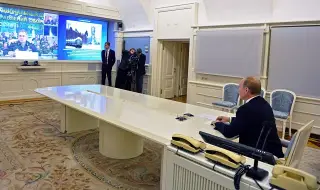
Based on more than 100 interviews with senior intelligence officials and other insiders in a number of countries, a report by the British newspaper The Guardian reveals that the US and Britain knew about Vladimir Putin's plans to invade, but most of Europe – including Ukrainian President Volodymyr Zelensky – has rejected them, writes Focus.
As the fourth anniversary of the invasion approaches and the world enters a new period of geopolitical uncertainty, European politicians and intelligence agencies continue to draw lessons from the failures of 2022.
The Phone Call
William Burns traveled halfway around the world to talk to Vladimir Putin, but in the end he had to settle for a phone call. This was in November 2021, and in the previous weeks, American intelligence agencies had picked up signals that Putin might be planning to invade Ukraine. President Joe Biden has sent Burns, the CIA director, to warn Putin that the economic and political consequences of such a move would be catastrophic.
Fifteen years earlier, when Burns was the US ambassador to Moscow, it was relatively easy to talk to Putin. In the intervening years, the Russian leader has concentrated his power and deepened his paranoia. Since the onset of Covid, few have had the opportunity to meet in person. Burns and his delegation have learned that Putin has locked himself in his luxurious residence on the Black Sea coast and that only a telephone conversation will be possible.
A secure line has been set up in an office in the presidential administration building on Moscow’s Old Square, and Putin’s familiar voice is heard on the receiver. Burns presents the US belief that Russia is preparing an invasion of Ukraine, but Putin ignores him and continues with his own chosen topics. He said his intelligence services had informed him that a U.S. warship was lurking in the Black Sea, equipped with missiles that could reach his location in minutes. This, he said, was evidence of Russia’s strategic vulnerability in a unipolar world dominated by the United States.
The conversation, as well as three heated private discussions with Putin’s top security officials, struck Burns as extremely ominous. He left Moscow much more concerned about the prospect of war than he had been before the trip, and he shared his premonition with the president.
“Biden often asked questions that could be answered with a “yes“ or “no“, and when I came back, he asked me if I thought Putin would do it,” Burns recalled. "I said, "Yes."
Three and a half months later, Putin ordered his army to invade Ukraine, the most dramatic breach in the European security order since World War II. The story of the intelligence context of those months - how Washington and London gathered such detailed and accurate information about the Kremlin's military plans and why other countries' intelligence services did not believe them - has never been told in its entirety.
This is the story of a spectacular intelligence success, but also of several failures. First, of the CIA and MI6, which had foreseen the invasion scenario but failed to accurately predict the outcome, assuming that a rapid seizure of power by Russia was a foregone conclusion. More importantly, for European services who refused to believe that a full-scale war in Europe was possible in the 21st century. They remembered the dubious intelligence case presented to justify the invasion of Iraq two decades earlier and were wary of trusting the Americans with what seemed then a fantastic prediction.
Most importantly, the Ukrainian government was completely unprepared for the impending attack, with President Volodymyr Zelensky having spent months dismissing increasingly insistent American warnings as panic and quelling last-ditch concerns among his own military and intelligence elite, who ultimately made limited attempts to prepare behind his back.
"In recent weeks, intelligence chiefs have begun to understand, the mood was different. "But the political leadership simply refused to accept it until the very end," said a US intelligence official.
Four years later, there are many lessons to be learned from these events about how to gather and analyze intelligence. Perhaps the most important of these, as the world seems more unpredictable than at any time in modern history, is that it is dangerous to dismiss a scenario simply because it seems beyond the realm of rationality or possibility.
"I thought the evidence we presented to them was irrefutable. It's not like we were hiding something that, if they had seen it, would have changed everything," said Jake Sullivan, Biden's national security adviser, about why European allies did not believe the Americans. “They were just consumed by the belief that it just didn’t make sense.“
Putin Begins Planning
The CIA has uncovered a lot about Putin’s plans to invade Ukraine, but one thing that has never been clear is when exactly he made the decision to embark on this adventure. Reviewing the evidence later, like detectives at a crime scene, some of the agency’s analysts have pointed to the first half of 2020 as the most likely time.
In those months, Putin passed constitutional amendments to ensure he would remain in power beyond 2024. Then, locked in isolation for months during the Covid pandemic, he devoured books on Russian history and pondered his place in it. Over the summer, the violent suppression of the protest movement in neighboring Belarus left President Alexander Lukashenko weaker and more dependent on the Kremlin than ever. This opens up the possibility that Lukashenko could be forced to allow Belarusian territory to be used as a staging ground for an invasion.
At the same time, a team of FSB poisoners slipped the nerve agent “Novichok“ into the underwear of Alexei Navalny, the only opposition politician with the potential to gain mass public support, sending him into a coma. At the time, all of these seemed like separate events. Later, however, it began to appear that Putin was putting things in order before making the big move in Ukraine that he said would cement his place in history as a great Russian leader.
The first signs of this plan emerged in the spring of 2021, when Russian troops began to mass on the borders of Ukraine and in Crimea, ostensibly for exercises. The US is receiving intelligence that Putin may use his annual speech, scheduled for April 21, to justify military action in Ukraine. When Biden is briefed on this intelligence a week before the speech, he is so alarmed that he calls Putin directly. “He expressed concern about the troop buildup and called for de-escalation, and suggested a summit in the coming months, which we knew would be of interest to Putin,“ says Avril Haynes, Biden's director of national intelligence.
When Putin delivers his speech, it is much less bellicose than expected, and a day later the Russian military announces that military exercises on the border have ended. The summit proposal seemed to have neutralized the threat, and when the two leaders met in Geneva in June, Putin barely mentioned Ukraine.
It was only later that it became clear why: he had already decided on a non-diplomatic solution.
Waking up the alarm
Four weeks after the Geneva summit, Putin published a long essay on the history of Ukraine, going back as far as the 9th century to argue that "true sovereignty of Ukraine is possible only in partnership with Russia".
The essay caused consternation, but attention in London and Washington was soon diverted by the chaotic withdrawal from Afghanistan. In September, Russian troops began a new buildup on the Ukrainian border; within a month, it had reached a scale that was hard to ignore. Washington was gathering new information about Russian plans, more detailed and far more shocking than that of the spring. It is then speculated that Russia might attempt a formal annexation of Donbas or, in the most maximalist scenario, try to push a land corridor through southern Ukraine connecting Donbas with Crimea. Now it seems that Putin may be planning something bigger. He wants Kiev.
Link to main version
Feb 20, 2026 21:41 709
Putin's War! The CIA and MI6 Knew About Russia's Plans to Invade Ukraine, But No One Believed Them
As the fourth anniversary of the invasion approaches and the world enters a new period of geopolitical uncertainty, European politicians and intelligence agencies continue to draw lessons from the failures of 2022.
Снимка: БГНЕС/ЕРА