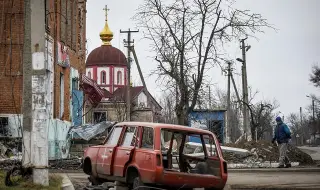
The Institute for the Study of War (ISW) has observed no evidence of Ukrainian forces in Pokrovsk since late January 2026, indicating that Russian forces had captured the entire town at an earlier date.
The Kremlin appears to have been able to influence the decision-making of the coalition of the willing, led by Britain and France. This concerned the stated intention to deploy peacekeeping troops in Ukraine.
This is stated in the ISW analysis.
Russian forces have been unable to capitalize on the capture of Pokrovsk to achieve further operationally significant breakthroughs. This suggests that a Russian takeover of the rest of Donetsk Oblast is not imminent or inevitable.
ISW last observed Ukrainian forces operating on January 28, and therefore assesses that Russian forces have likely completed the capture of the settlement in the past few weeks.
The Russian campaign for Pokrovsk, a city with a pre-war population of 60,000, has been ongoing for almost two years now. Russian forces began their advance on Pokrovsk in February 2024, after capturing Avdiivka (about 39 kilometers southeast of Pokrovsk), and began creating the conditions for the capture of Pokrovsk through direct frontal attacks in March 2024.
Russian forces did not capture most of Pokrovsk until December 2025 - 21 months after the frontal attacks on the city began. Russian forces continued to fight to capture most of Mirnograd (east of Pokrovsk) for another month, with the Russian Ministry of Defense (MOD) declaring on December 28 that Russian forces had captured the city.
The Russian Ministry of Defense stated that Russian forces had fully captured Pokrovsk in early December 2025, and stressed that Pokrovsk was a critical step in achieving Russia's strategic objectives on the battlefield.
On December 9, Russian Chief of the General Staff General Valery Gerasimov stated that the capture of Pokrovsk was "of crucial importance" for Russia's efforts to capture the rest of Donetsk Oblast, and Russian President Vladimir Putin stated in his annual "Direct Line" address on December 19 that the capture "opened" multiple directions for the Russian army's advance.
Pokrovsk was of operational importance, as it was used as an important logistics center, but Russian strikes deprived Ukrainian forces of the ability to fully use the city for logistics as early as July 2025.
Pokrovsk had long ceased to be an operationally significant city when Russian forces intensified their push to capture it in the winter of 2025.
The capture of Pokrovsk also did not "open" the way for significant Russian advances to capture the rest of the Donetsk region, as Kremlin officials had previously claimed.
The Kremlin appears to have been able to influence the decision-making of the coalition of the willing, led by Britain and France. This was in reference to the stated intention to deploy peacekeeping troops in Ukraine.
Diplomatic and defence sources told the Telegraph newspaper on 24 February that some members of the Coalition of the Willing had stated informally that their participation with troops to ensure the security of Ukraine after the war was dependent on Russian President Vladimir Putin's permission for such a deployment.
A senior diplomatic source said that the Kremlin's statements that Russian forces would specifically attack foreign troops in Ukraine meant that the coalition "must send a different type of force".
Another diplomatic source assessed that European countries had "essentially given Putin a veto" on the coalition's plans.
The discord within the Coalition of the Willing is likely the result of the Kremlin's months-long coordinated campaign of reflexive control - a method by which Russia tries to force its adversary to freely reach a predetermined solution - in order to prevent the West from agreeing on guarantees for Ukraine's security.
Inside sources continue to indicate that Russia is not interested in meaningful peace talks and is preparing for a protracted war.
The Kremlin is also deliberately delaying negotiations to shape the battlefield in Russia's favor.
The Kremlin continues to invent excuses for a future ban on Telegram.
The Kremlin is also increasing its efforts to control the Russian population's access to content from Western sources on the Internet.
Ukraine continues to expand co-production in Europe with its Western partners.
Ukraine's Western partners have continued to provide military aid to Ukraine on February 24.
Ukrainian forces have recently advanced near Pokrovsk, Aleksandrovka, and in the western part of Zaporizhia Oblast. Russian forces have recently advanced in the Kostyantynivka-Druzhkovka tactical zone, in the Dobropilya tactical zone, near Pokrovsk, and near Khulyaypole.