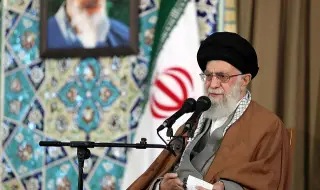
How did the secret services of Israel and the US manage to find the location of Iranian Supreme Leader Ali Khamenei in Tehran, who was killed on Saturday? What is known about the technologies of the CIA and Mossad?
“A target identification machine”, powered by artificial intelligence - this is how Israeli sources described to CNN the system they used in Iran to locate and eliminate Ayatollah Ali Khamenei. Traffic cameras in Tehran were infiltrated by Israeli intelligence services and allowed intelligence officers to get a clear picture of the movements of the supreme leader of the Islamic Republic, as well as to monitor in real time what is happening in the Iranian capital.
“We knew Tehran as we knew Jerusalem”
Satellite images, field sources, signals from intercepted communication lines and many other intelligence techniques helped the US and Israel eliminate Khamenei on the first day of the war against Iran, reports the “Financial Times”. The huge amount of information collected by Israeli and US intelligence services was sorted and analyzed using powerful computers to identify the exact targets of potential strikes. The system was developed over the past decade and was developed by engineers, database analysts, technology specialists and dozens of other people, CNN reports.
Israel has used this system before - it was used to kill some of Iran's top nuclear experts, as well as Hamas political leader Ismail Haniyeh, while he was in Tehran. The same system was used during the 12-day US war against Iran in June 2025.
Long before the bombs fell, "we already knew Tehran as well as we know Jerusalem," an Israeli intelligence official told the Financial Times. “When you know a place as well as the street you grew up on, it's easy to spot the slightest irregularity.”
Not all the details of the latest operation are known, the American newspaper writes. Some of them may never be made public in order to protect the sources and methods that are still used to track other targets.
Phone calls, cameras, agents in the field
When the CIA and Israel found out that Khamenei would hold a meeting on Pasteur Street in Tehran on Saturday morning, they saw a chance to eliminate him along with much of Iran's top leadership. This was made possible with the help of a specific missile used by Israeli pilots. Its name is “Sparrow” and some of its variants can hit with great precision a very small target - for example, an object the size of a dining table from a distance of over 1000 km. The decision to attempt to assassinate the Supreme Leader of the Islamic Republic in the first hours of the operation was also linked to the assessment by American and Israeli services that once the war began, he would probably go into hiding.
Although Khamenei did not live in hiding all the time, like Hezbollah leader Hassan Nasrallah, who was killed in 2024, it was clear that in a war situation Khamenei would most likely use one of his two bunkers, Israeli sources told the “Financial Times”.
The decision to start the war on February 28 is linked to these intelligence assessments - Israel's system for monitoring Iran's Supreme Leader accurately showed that on Saturday morning he would hold a meeting with his advisers on “Pasteur” Street in the capital. Using information from cameras on the city's roads and intercepted phone calls, Israeli services report with a high level of certainty that the ayatollah is traveling to the address in question. According to the sources of the “Financial Times” the CIA had even more certain information - from an agent in the field.
Is the assassination of leaders no longer taboo?
For many years, Israeli services have focused on Iran, despite the fact that Iranian intelligence is a serious adversary. In 2022, a group linked to the Iranian security services published data that was allegedly extracted from the phone of the wife of the head of the Mossad. Iran also hacked into surveillance cameras in Jerusalem during the 2025 war to obtain real-time damage estimates, as Israel censored the distribution of footage of the strikes.
The assassination of foreign leaders is generally avoided because a failed attempt can only cement the leader's power, writes the “Financial Times”. However, Israel has carried out several similar successful strikes in recent years, killing the leaders of Hamas and Hezbollah and carrying out a large-scale pager attack on the Lebanese militia. This seems to have made Israel feel more confident in this operation, which was crowned with success.