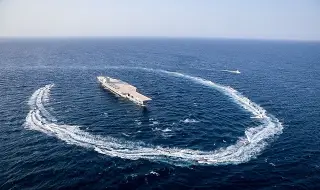
The Strait of Hormuz is a "tactically complex environment" to ensure security, stressed US Joint Chiefs of Staff Dan Kaine. Thus, he indirectly admitted that in the short term it would not be possible to prevent Iranian attacks on ships passing through this strategic route, Agence France-Presse reported, quoted by BTA.
At a press conference with Defense Minister Pete Hegseth, the Chief of Staff explained that other military actions would be necessary before escorting ships could be considered.
For his part, Hegseth assured that American military plans from the very beginning envisaged ensuring security in the Strait of Hormuz, describing it as "completely ridiculous" CNN reported that the Trump administration had underestimated the risks of closing the waterway to Iran.
"This is not a strait where we are going to allow control to be challenged or (allow) the flow of commercial goods to be blocked," he said, without explaining how that goal would be achieved.
"We have no clear evidence" that Iran has laid mines in the Strait of Hormuz, the Defense Secretary added in response to a question.
US Energy Secretary Chris Wright said yesterday that the military is "not yet ready" to escort oil tankers through the Strait of Hormuz, but he said it was "very likely" that such escorts would be organized by the end of the month. On Tuesday, the secretary deleted a tweet posted minutes earlier that said the U.S. Navy had escorted the first oil tanker to pass through the Strait of Hormuz. The White House denied the report.
Iran has allowed two Indian-flagged LPG tankers to pass through the Strait of Hormuz, a move that could help ease India's domestic gas crisis, Reuters reported, citing four officials.
Separately, two of the sources and data from Lloyd's List Intelligence (Lloyd's List Intelligence), a Saudi crude oil tanker is expected to arrive in India tomorrow, having passed through the key sea route around March 1.
Since the start of hostilities in the Middle East, 77 vessels have passed through the Strait of Hormuz, most of them part of the so-called shadow fleet. This is according to incomplete data from the leading provider of shipping, cargo trading and risk assessment services “Lloyd's List Intelligence“ (Lloyd's List Intelligence), quoted by Agence France-Presse.
“We have recorded 77 crossings since the beginning of the month (March) through the strait“, which the Iranian Revolutionary Guard wants to keep closed, said Bridget Dyken, an analyst at “Lloyd's List Intelligence“.
For comparison, between March 1 and 11, 2025, 1,229 ships passed through the Strait of Hormuz, the company noted.
The strait, located between the Persian Gulf and the Gulf of Oman, is strategically important for the export of oil and natural gas from the Gulf countries - about a fifth of the world's oil production and a fifth of liquefied natural gas (LNG) passes through it.
Tehran is focusing its efforts on the Strait of Hormuz in response to Israeli-American air strikes, with the aim of doing so unusable - a strategy aimed at hurting the global economy and putting pressure on Washington.
Since March 1, 20 merchant ships, including nine tankers, have been attacked or reported incidents in the region, according to the UK Maritime Trade Operations (UKMTO). The UN's International Maritime Organization (IMO) has confirmed 16 incidents, eight of which involved tankers.
“More than half of the oil and LNG tankers that pass through the strait are part of the shadow fleet,“ said Dyken.
According to the IMO's definition, the term “shadow fleet“ includes ships that "carry out illegal activities to circumvent sanctions, avoid safety or environmental regulations, reduce insurance costs or engage in other illegal activities."
"These vessels are accustomed to violations and are more likely to undertake the crossing," Dyken added, noting that Iran, which has a large fleet of such vessels, "continues to export oil."
"Lloyd's List Intelligence" said that transits through the Strait of Hormuz have so far been dominated by ships affiliated with Iran (26 percent), Greece (13 percent) and China (12 percent).
According to AFP, around 40 ships have passed through the strait since the start of the conflict, counting only those that kept their automatic identification system (AIS, transponders) active.