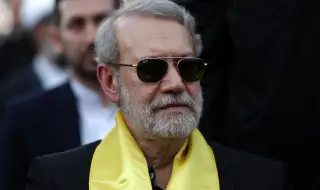
Ali Larijani spent years in the shadows in the power structures of Iran before being elevated as one of the leading figures in the country during the war with Israel and the United States, BTA reported, citing AFP.
Israel announced today that it had eliminated Larijani, just days after he participated in a demonstration of thousands in Tehran last Friday.
After the elimination of Supreme Leader Ali Khamenei, Larijani was "the de facto leader of the Iranian regime, especially in the last two weeks, but even before that he was considered the figure who made the decisions and pulled the strings", an Israeli military official commented today, who wished to remain anonymous. It was Larijani who "ordered the attacks in the region" with strikes against Israel and the Gulf states, the same official said.
As head of the Supreme National Security Council, 68-year-old Ali Larijani has once again assumed a key role in Iran's nuclear policy and diplomacy, after several years on the fringes of Iranian politics.
Accustomed to combining ideological loyalty and pragmatism, he enjoyed the trust of Supreme Leader Ali Khamenei, which was a reward for his long service in the army and work in the media and parliament.
After the ayatollah was assassinated in an Israeli strike on February 28, which heralded the beginning of the war in the Middle East, Larijani has intensified his belligerent rhetoric towards the United States and Israel. For example, Larijani warned that his country would fight and was "ready to pay any price" to defend itself, accusing US President Donald Trump of dragging the "American people into an unjust war" in the Middle East.
"Elite Figure"
"Larijani played a more important role than most of his predecessors," Ali Vaez of the International Crisis Group conflict resolution center said in February, describing Larijani as "a true elite figure, a skilled tactician familiar with the workings of the system and the Supreme Leader's quirks."
Born in 1957 in Najaf, Iraq, Ali Larijani is the son of a prominent Shiite dignitary close to Ayatollah Ruhollah Khomeini, the founder of the Islamic Republic.
A member of the Islamic Revolutionary Guard Corps (IRGC) – the ideological army of the Islamic Republic – during the war with Iraq (1980-1988), Larijani also holds a doctorate in Western philosophy from the University of Tehran and from 1994 for a decade headed the State Radio and Television of the Islamic Republic (IRIB). There he distinguished himself with his attacks on reformists, broadcasting numerous programs attacking intellectuals and those close to President Mohammad Khatami.
In 1996, Larijani was appointed Ali Khamenei's representative on the Supreme National Security Council, and later its secretary.
Between 2005 and 2007, he was the chief nuclear negotiator with London, Paris, Berlin and Moscow, and in this role was perceived as a pragmatist by his Western partners.
A candidate in the 2005 presidential election, he was defeated by his populist rival Mahmoud Ahmadinejad. He then served as speaker of parliament from 2008 to 2020, before his candidacy for the 2021 and 2024 presidential elections was rejected by the Guardian Council.
Meeting with Putin
In 2015, Larijani welcomed the historic nuclear agreement that Iran reached with world powers, which collapsed three years later with the US withdrawal during Donald Trump's first term.
In March 2025, before Iranian-American talks were interrupted by the war triggered by the then-Israeli strikes on Iran, Larijani warned of the risk of pushing Tehran towards acquiring nuclear weapons.
A few weeks after the Iran-Israeli war of June 2025, he was appointed secretary of the Supreme Council for National security, which he headed 20 years earlier. In this position, he coordinates defense strategies and oversees nuclear policy. This return is interpreted as a pragmatic turn in the country's governance. Since then, Ali Larijani, who is subject to US sanctions, has increasingly appeared on the diplomatic scene.
In late January, he was tasked with meeting Russian President Vladimir Putin in Moscow, before holding talks this month with representatives of the Persian Gulf countries seeking to reduce tensions with Washington.
Larijani has maintained that negotiations with the West should be limited to Iran's nuclear program and has defended uranium enrichment as Iran's sovereign right.