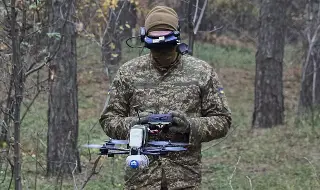
Former CIA Director David Petraeus has traveled to Ukraine ten times since the Russian invasion in 2022. During his most recent visit last week, he said that Russia "no longer has the upper hand".
"In the last two months, the Ukrainians have actually achieved greater incremental successes than the Russians", the retired US Army general said after visiting Ukrainian units near the front lines, CBS reports.
Petraeus noted that this assessment may have seemed unlikely, given Russia's advantages in manpower, firepower and economic scale. But he says Ukraine has made up for those shortcomings through its innovations in unmanned systems.
Ukraine’s advantage, he says, is not just the drones themselves, but the system built around them.
“The real genius is how they bring it all together,” Petraeus said, pointing to a “complete command and control ecosystem” that integrates surveillance, targeting and strike capabilities. At the center is Ukraine’s Delta combat management platform, which serves as a kind of “military Google Maps” and displays a digital map of positions, targets and other relevant information, an engineer familiar with the technology said.
This integration allows Ukrainian forces to have near-perfect surveillance and strike capabilities within about 20 miles of the front line. Petraeus described watching a front-line battle in which a Russian soldier was continuously tracked by rotating surveillance drones before attack drones were deployed.
"Once you are tracked on the battlefield and you can't quickly get into a deep position, that's not going to end well," he noted.
Ukraine is also scaling up production of cheap, first-person-view drones at a pace far exceeding that of Western armies. One Ukrainian manufacturer Petraeus visited last week told him it was "going to produce 3 million drones this year alone", compared with the estimated 300,000 produced by the United States last year.
According to Petraeus, artificial intelligence will accelerate this innovation. Drone warfare is currently limited by electronic warfare. About 20 miles (32 kilometers) around the front lines, saturated with remotely piloted drones with first-person view, fighters are jamming the connections between the drones and their operators, reducing their effectiveness. One solution is fiber-optic drones, which connect to their operators via long cables coming out of their tails. But fiber-optic drones have limitations on how far they can fly and how much cable is available.
Using algorithms, rather than GPS links, to control drones would ease those limitations. "What's coming is algorithmically controlled drones that you can't jam," Petraeus said. These systems would be able to operate even in highly contested electronic warfare environments, reducing reliance on GPS, he added. The technology will also allow human operators to control more than one drone at a time.
Petraeus said that fully autonomous systems could soon emerge, where humans still define missions but machines carry them out.
"I think that will be possible within a few years, and it's entirely possible that we'll see it here first," he explained, noting that advances in technologies such as object recognition and facial recognition are already enabling greater autonomy.
For Petraeus, the lessons for the United States extend far beyond buying more drones or better integrating them into military structures.
"In some Western countries right now, they think that innovation is giving 50 drones to an armored battalion," he said. "No. What we need to do is eliminate armored battalions and replace them with a drone battalion.
This change, he said, requires more than a reform of public procurement. It requires a "entirely new concept of warfare", including changes in doctrine, training and force structure. Ukraine has set the standard for this by building an Unmanned Systems Force, rather than simply deploying drones to various forces, Petraeus said.
The risks of failure to adapt, especially in drone-fighting capabilities, go beyond the battlefield. Petraeus warned that advances in drone technology could pose an increased risk of terrorism as "drone swarm" technology allows operators to control more drones at once, and commercial use of drones is expanding.
"A true swarm is going to happen when you have autonomous systems," he explained, adding that such capabilities are "very, very worrying".
At the same time, companies like Amazon and Walmart are "starting to deliver via drones," which is increasing the number of aerial systems in civilian airspace.
Together, these trends could make it harder to detect and defend against coordinated drone attacks.
"We don't have the systems yet" that can effectively "defend against swarms of drones," Petraeus explained. "We need to learn a lot more, a lot faster than we are right now."