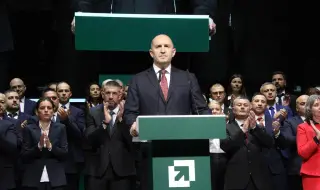
Rumen Radev hopes to succeed where others have failed - he promises "an uncompromising fight against corruption, an economic policy capable of protecting the most vulnerable from inflation, but also a conservative approach that is less Euro-enthusiastic, while hinting at a possible warming of relations with the Russian Federation". All this makes many talk about a potential new Orban at the heart of the European Union, we read in an extensive article by Francesco Martino, published on the website of the Observatory for the Balkans and the Caucasus, based in Italy - part of the Center for International Cooperation. It is entitled "Elections in Bulgaria: Radev – moderate Orban?".
The former president and the foreign policy direction of Bulgaria
In the field of foreign policy, the most controversial aspects were Radev's positions regarding the Russian invasion of Ukraine while he was still president, the author writes. Although he officially condemned the Kremlin's aggression, Radev without hesitation opposed military aid to Kiev and supported the need for a way out of the conflict by resuming dialogue with Moscow. A position that in the summer of 2023 led him to a direct and emotional confrontation with his Ukrainian counterpart Volodymyr Zelensky during the official visit of the President of Ukraine to Sofia, Martino recalls.
In his article for the Balkans and Caucasus Observatory, he also writes about the suspicions of the current caretaker government about possible Russian interference in the electoral process, which have led the "former president to talk about a possible "Romanian scenario" following the model of the recent controversial presidential elections in the northern neighbor. This scenario, according to Radev, could be an attempt to take away the electoral victory from "Progressive Bulgaria".
We recall that in the Romanian case, the country's courts established interference by a foreign state in the electoral process, which is why the presidential elections were canceled and new ones were scheduled.
Suspicions of Russian interference in the election campaign?
The independent publication Insight News Media, specializing in news from Ukraine and Eastern Europe, also dwells on suspicions of Russian interference in the Bulgarian elections. In an article titled "Russia's Election Strategy in Bulgaria: Five Narratives, One Goal", we read the following: "A group of pro-Kremlin media outlets are conducting an aggressive information campaign, but not to inform Bulgarian voters, but to influence them on what to fear, whom to trust, and whether to even bother going to the polls".
According to the publication, the campaign is based on five main narratives, which are titled as follows: "Russia is our liberator, Brussels is our new occupier"; "NATO has turned Bulgaria into a target, not a protected ally"; "Every lev sent to Kiev is stolen from Bulgarian pensioners"; "The patriot and the collaborator"; "The West will leave Bulgaria to fend for itself".
Does Radev's success depend on a potentially high voter turnout?
An article by journalist Frank Stir, published on the German Bundestag's news website "Das Parlament", also takes a look at the elections in Bulgaria and the ambitions of the former president. "During his presidential term, Radev was repeatedly accused by successive governments of not being satisfied with the representative role provided for in the Constitution for the head of state, of interfering in daily political affairs and of clearly having ambitions for the prime ministership". However, his high ratings are probably a sign that with these critical interventions he has won the sympathy of many Bulgarians and has become a ray of hope for those who want an end to the spiral of collapsing coalitions, resignations and new elections, the German journalist adds.
Radev's eventual success will probably depend above all on how much he manages to attract people to the polls who have not previously voted. According to sociologists, voter turnout, which fell to a record low of 34 percent in the penultimate election in June 2024, could increase significantly to over 50 percent in the upcoming elections.
Frank Stir points out that Rumen Radev was nominated as a presidential candidate in the summer of 2016 by the Bulgarian Socialist Party and emphasizes that he was previously "a completely unknown major general and commander of the Bulgarian Air Force". The author writes that during his two presidential terms, Radev has alienated himself from the Socialist Party, and on April 19 he may steal many of its voters.
The Balkans and Caucasus Observatory article points out that the uncertainty about which forces will manage to cross the electoral threshold and enter the next parliament could significantly complicate or even make it impossible to form a stable majority. "This would open the way for new early elections - a very realistic prospect in Bulgaria and an outcome that is far from encouraging for those like Radev, who promise to open a new page in the country's history."