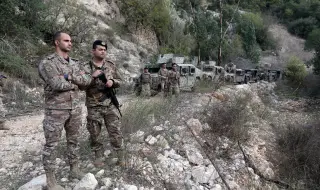
The two countries are officially in a state of war: Israel is currently conducting a ground operation in southern Lebanon, the aim of which is to establish a buffer zone between Israel's border and the Litani River in Lebanon. When the ambassadors of the two countries meet today at the US State Department, it will be the first direct contact (editor's note: the meeting ended without any specific commitments) between Israel and Lebanon at a political level. It is well known that Lebanon does not recognize the state of Israel.
What will be discussed at the meeting
The offensive that Israel is waging on Lebanese soil against the pro-Iranian terrorist organization Hezbollah is a heavy burden for Lebanon and its citizens. According to official figures, more than 2,000 people have died in Lebanon so far, more than 6,500 have been injured, and over a million people have been displaced.
Against this backdrop, the Lebanese government's top priority is ending the war. That's why it is ready for negotiations, which was confirmed last month by Lebanese Prime Minister Nawaf Salam. Israel gave its consent last week, German public broadcaster ARD recalls.
Beirut wants a ceasefire
Tel Aviv's focus in the negotiations is on a comprehensive peace agreement and the disarmament of Hezbollah. Beirut insisted on a ceasefire before the start of talks in Washington, which Israel is not ready for. The pro-Iranian Lebanese militia is also determined to continue fighting Israel. It sees no point in these negotiations – a position that does not surprise anyone in Lebanon, ARD also points out.
Many doubt that the Lebanese government will be able to force Hezbollah to disarm. The militia, which is armed by Iran, is superior to the Lebanese army and has repeatedly threatened civil war. There are even serious concerns that the extremists may be preparing a coup d'état. It was the inability of the Lebanese armed forces to disarm Hezbollah fighters in southern Lebanon that gave Israel the reason to begin the current military campaign.
Its goal is to create a buffer zone reaching the Litani River. Or as Israeli Finance Minister Bezalel Smotrich put it: "The Litani should be our new border with Lebanon". He told the Times of Israel newspaper.
This is a section of the 145-kilometer river that will mark the northern border of the future buffer zone, about 30 kilometers wide. The Israeli army has called on the population of southern Lebanon to leave the area and move north of the Litani River. The Israeli armed forces have meanwhile destroyed numerous bridges, aiming to cut off Hezbollah's supply routes. Israel thus wants to end the threat to the Israeli population in the north of the country posed by Hezbollah's drone and rocket attacks.
On March 24, Israeli Defense Minister Israel Katz wrote on the X platform: "Israel's policy in Lebanon is clear: where there is terror and rockets - there are no houses and no residents. The Israeli armed forces will control the buffer zone to the Litani River."
Mass displacements in southern Lebanon
The role of the Litani River in the Israeli-Lebanese conflict is historically determined. Particularly tragic were the events during the so-called "Operation Litani" of the Israeli armed forces in March 1978. Then the Israeli army invaded Lebanon with 25,000 soldiers and occupied the territory south of the Litani River. Between 1,000 and 2,000 people were killed in this military operation, and according to estimates by the Lebanese government, about 280,000 people were displaced.
The Israeli invasion was in response to an attack in northern Israel carried out by the "Fatah" movement on 11 March 1978, in which 37 people were killed and 76 were injured. At the time, the Palestinian party was operating primarily as an armed militia of the Palestine Liberation Organization (PLO) and was using southern Lebanon as a base for attacks on northern Israel.
The escalation led to the creation of the UN peacekeeping mission UNIFIL, which was established by the UN Security Council that same month. The mission, headquartered in Naqoura, was to contribute to the creation of a buffer zone between the Litani River and the border with Israel.
In August 2006, UNIFIL's mandate was expanded by UN Security Council Resolution 1701. It provided for Hezbollah to withdraw behind the Litani River. However, Israel and the United States have consistently accused the peacekeepers of not doing enough to implement this decision.
Due to the drastic reduction in US funding for the UN and humanitarian aid, contributions to UNIFIL have also decreased. As a result, the UN Security Council did not extend the mission's mandate, which expires at the end of 2026.
Many people in Lebanon fear that the withdrawal of UN peacekeepers could lead to further evacuations and ultimately a redrawing of the border. Instead of UN peacekeepers, the Israeli armed forces could, as Israeli Defense Minister Katz has announced, take control of the buffer zone along the Litani River.
Author: Astrid Prange