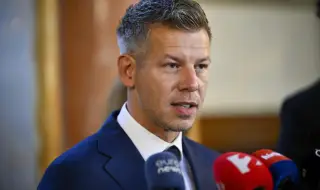
During an interview in the studio of the Hungarian public television M1, Peter Magyar got into a controversy with the editor-in-chief of the media outlet. Hungarian public television has long not been working according to journalistic standards, the German public broadcaster ARD points out in this regard. Over the past 16 years, Viktor Orban's government has systematically turned it into a propaganda apparatus that excludes the opposition, ARD explains.
At the very beginning of the conversation, Magyar provoked the host with the words: "Good morning, Madam Editor-in-Chief. It's a good feeling to be here again - a year and a half after I was here last time, when I, the chairman of the largest party, was still allowed access."
After these words, the host tried to defend herself: with emails, the television could prove that he had been invited several times. To which Magyar replied: "Madam Editor, you didn't invite us until January 2026. There was a demonstration in front of the television. But no problem, I don't feel any personal vendetta, even though you have been slandering me, my family and my loved ones from morning till night".
Part of the program of Magyar's party is "to close down this factory of lies here", the future Hungarian Prime Minister pointed out in his interview. Together with the other parliamentary parties and expert organizations, his government will guarantee independent, impartial and objective coverage of events, Magyar pointed out.
Public media without news?
Magyar is adamant that the spread of fake news must be stopped immediately. However, leaving a public television without news broadcasts until it is guaranteed that they will be made according to journalistic standards is difficult to implement from a legal point of view, independent media researcher and university professor from Budapest Gabor Polyak told ARD. He recalls that the program of the "Tisza" party states exactly this - that only news broadcasts should be suspended.
"I cannot imagine a law according to which public broadcasters would not have the right to broadcast news. That sounds strange", he says. According to Polyak, public radio and television must start from scratch – to close down and then rebuild.
Lessons from Poland
In October 2023, Poland faced a similar situation, when the right-wing populist party "Law and Justice" (PiS) was removed from power. And then the new government of Donald Tusk wanted to reform the Polish public television and radio, which had become a propaganda machine.
How this happened is described by the former ARD correspondent in Poland, Martin Adam, in his book "Experiment. What can we learn from Poland's fight against right-wing populism". He recalls that the restructuring of the public radio and television TVP proceeded quite violently – PiS politicians blocked the entrances to the public media headquarters in Warsaw.
In Poland, the public channels were completely renovated by the government of Donald Tusk. "The trick they used then was that under Polish law, the TV channels were state-owned. Since new management could not be appointed under media law, they were liquidated in a roundabout way - by appointing receivers," Adam points out. "Then new management was appointed to the TV stations, and today they are reporting events relatively freely and impartially again," he says.
A two-thirds majority can help
In Hungary, things might get a little easier - at least that's what Budapest-based media expert Gabor Polyak thinks. Because with his constitutional two-thirds majority in parliament, Péter Magyar has much more power than Donald Tusk in Poland.
"With a two-thirds majority, you can start from scratch with public radio and television. But it also applies to private media. We have a completely distorted media market and we need a new media authority, as well as new conditions for the advertising market," he assures.
In his appearance on public television M1, Peter Magyar promised that he would not act in violation of the law under any circumstances, but would introduce a new, transparent media law, the German public broadcaster ARD also points out.
In its publication, it also recalls that during the large demonstration in front of Hungarian state television in 2024, Peter Magyar uttered the following words: "What has been happening here since Orbán came to power in 2010 was something neither Goebbels nor even the North Korean dictators dreamed of".
Author: Oliver Zoos