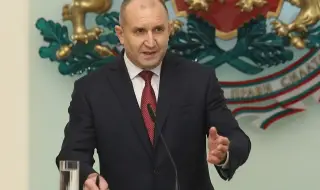
Today, foreign media continue to comment on the elections in Bulgaria and the categorical victory of Rumen Radev. While some express cautious optimism about Radev's future relations with the EU, others are rather skeptical.
"EU has reason for optimism" - under this title the German "Süddeutsche Zeitung" (ZC) published an article on the occasion of Rumen Radev's victory in the elections in Bulgaria. According to the publication, the surprisingly categorical victory of "Progressive Bulgaria" shows that Radev has hit a sore spot in a country tired of corruption and cronyism. Radev's promise that he will eliminate the "oligarchy" and will restore stability, mobilize those who were almost desperate, comments ZC, wondering, just like "Tagesspiegel", whether Radev will not become the new Orban 2.0.
The reason for this is some statements by the former president. For example, that Crimea is Russian. Or that European support for Ukraine is a "lost cause". On the other hand, he announced that at least he would not block aid to the attacked country through a veto, Tobias Zick explains further and concludes: "On other issues, Radev is showing himself to be more of a pragmatist than an ideologue. In Brussels, they can hope that in the future they will have a difficult but constructive partner – and at least not a "new Viktor Orban", as the loser of the elections Boyko Borisov had predicted for Radev".
"Populists in Europe will not leave so quickly"
The Swiss "Neue Zürcher Zeitung" is far more skeptical about the relations between the EU and Radev's future government. Benedict Neff's article is titled "Populists will not leave so quickly". Almost sarcastically, the publication describes the EU's stormy joy over Viktor Orban's loss in the Hungarian elections, then notes that for Hungary this victory is indeed a major turning point that could make the EU a little more capable. But it cannot be concluded from this that this is a fundamental change in political trends, the publication emphasizes and claims that the example of Bulgaria shows exactly this.
"Rumen Radev won the elections there – a former general with pro-Russian attitudes who does not approve of either military aid to Ukraine or sanctions against Russia. His "Progressive Bulgaria" is considered to be center-left, but its political position is still difficult to determine. It is doubtful that in Bulgaria and Hungary the choice was between populism and non-populism. It was more about corruption and lack of purchasing power", commented Benedict Neff, who believes that it was the fight against corruption – that is, a national, not an international, issue that was leading in both Radev's and Magyar's campaigns.
With its typical Euroscepticism, "Neue Zürcher Zeitung" draws the following conclusion: "But the most important thing is this: by turning so many political issues into pan-European (...), the European Union has practically rekindled the desire for a strong nation-state in Europe. And the feeling of impossibility of political action at the level of nation states is a main driver for right-wing populists.
"We are not blocking the vote in Brussels, and they are not asking questions"
"The Washington Post" in turn draws attention to a factor that, according to the American publication, will force Radev to act less categorically than Orban – that Bulgaria's economy is heavily dependent on EU funding.
However, the newspaper predicted that Radev's election result, which was better than expected, could "strengthen his position in opposing the EU's proposed ban on the import of Russian energy resources".
The publication quoted Dimitar Bechev, a senior fellow at "Carnegie Europe", as saying: "The usual Bulgarian position is that there is a clear difference with Orban: We do not block the vote in Brussels, and they do not ask questions about what is happening in Bulgaria".
"The Washington Post" also quoted the former prime minister from "Continuing the Change" Kiril Petkov, who says his party will support Radev in all his efforts to eradicate endemic corruption in the country's law enforcement system, but will also strongly oppose any position by Radev that contradicts EU policies. "We will react decisively if we notice any anti-European sentiments," Petkov told the "Washington Post".