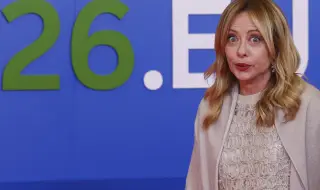
This week, Italy has been the target of three attacks by Russian television and radio host Vladimir Solovyov, considered one of the main spearheads of Kremlin propaganda, according to Italian media outlets, including ANSA, “RAI News“, “Sky TG24“, “TGCom 24“, “Decode 39“, “Fanpage“ and others, BTA summarized.
In his program “Full Contact“ on Tuesday, Solovyov first made a series of offensive comments addressed to Italian Prime Minister Giorgia Meloni. He called her a "fascist creature, a disgrace to the human race, a patent idiot, an ugly woman and evil". He then accused her of betraying her own voters by running in the Italian elections with radically different slogans, as well as of betraying US President Donald Trump, to whom she had previously pledged allegiance. Solovyov added that "betrayal is Meloni's middle name". The criticism was made in Italian and Russian. At one point, Solovyov even apostrophized Meloni with the words "Giorgia Puta Meloni". In Italian, the word "puta" means "prostitute", but when pronounced as "putta", as Solovyov did, it can also mean "girl" in some of the dialects of the Apennines.
In the same statement attacking Meloni, Solovyov also attacked German Chancellor Friedrich Merz. He said that Europe had entered a war with Russia and that this was clear from Merz's statements.
Italian political leaders immediately reacted to the Russian presenter's insults against Meloni, ANSA and "Decode 39" summarize. Italian President Sergio Maratella expressed solidarity with Meloni and indignation at the vulgar words addressed to her, ANSA reports.
Italian Foreign Minister Antonio Tajani described Solovyov's statement as very serious and offensive and summoned the Russian ambassador to Rome to express an official protest. Defense Minister Guido Crosetto said it was the duty of the Russian embassy in Rome to distance itself from Solovyov's statement. The leader of the opposition Democratic Party, Elie Schlein, defined Solovyov's words as "unacceptable sexist accusations" against Meloni and reminded "the entire Russian regime and its luminaries" that insulting representatives of Italian institutions means insulting all of Italy. The leader of the opposition "5 Star Movement" Giuseppe Conte also expressed solidarity with Meloni, condemning the "unacceptable and vulgar personal insults" directed at her by the Russian television commentator.
The parliamentary leaders of Meloni's "Italian Brothers" party, Galeazzo Biniami and Lucio Malan, condemned the Russian's remarks as "unacceptable" and defined them as further evidence of Russia's hostile attitude towards Italy under Vladimir Putin. The vice-president of the Senate, Licia Ronzulli, described the case as a symptom of the "deterioration of political and media language, encouraged by propaganda linked to the Kremlin". The leader of the center-right "Forza Italia" party in the Senate, Stefania Craxi, stressed that such attacks "will not change Italy's consistent and responsible international position". Senator from the center-right party "We the Moderates" Mariastella Gelmini called Solovyov's statements "a shameful act that deserves unequivocal condemnation."
Meloni herself commented on the Russian TV presenter's words in a post on "Facebook." "A zealous propagandist of the regime cannot give lessons in either consistency or freedom. Certainly, such caricatures will not make us change our course. We, unlike others, have no strings to pull us like puppets, we have no masters and we do not take orders. Our compass remains only one: the interest of Italy. And we will continue to follow it with pride, regardless of propagandists of all caliber," she said.
The reaction of the Russian Ambassador to Rome, Alexei Paramonov, was much longer and more detailed, published on the Russian embassy's Facebook account. "Once again, the Italian diplomatic authorities made a serious mistake by summoning me to the Italian Foreign Ministry to protest the alleged attacks directed by Moscow against the Prime Minister, Giorgia Meloni," Paramonov wrote. "First of all, Giorgia Meloni is a legitimate head of government, supported by the popular vote. She has been leading the executive branch of Italy for almost four years, and during all this time, not a single representative of the Russian authorities has ever expressed any offensive assessments about her or Italy. Unlike some members of the Italian leadership, who sometimes allow themselves extremely hostile comments and comparisons both to the Russian leadership and to the Russian Federation as a whole,“ he added.
“The reason for summoning me to the ministry - the words of a well-known Russian journalist, and a very capable and popular one, spoken on his private online channel - can hardly fit into generally accepted diplomatic practice. No reasonable person would think of interpreting personal, emotional and private assessments of anyone as official statements of the government of a given country. Even less should the choice of linguistic qualifications and the style used by a journalist be attributed to the Russian leadership and the entire Russian people. For its part, Russia has never used the statements made by Italian TV presenters, bloggers, journalists and artists in its address and in the address of the Russian leadership as a pretext for diplomatic actions or anti-Italian slander campaigns“, the ambassador emphasizes.
“Obviously, the attempt to blow this episode into an international and political scandal is the result of actions, within the so-called “deep state“ in Italy, of anti-Russian forces linked to Ukraine. It is a clear attempt to pit the peoples of Russia and Italy against each other, to weaken our diplomatic contacts, while inflicting additional damage on Russia's image, probably in order to compensate for failures in foreign policy, including the recent not very successful visit of Volodymyr Zelensky to Rome“, adds the Russian ambassador to Rome. According to him, what happened was also an attempt to stop the growing number of Italians who support the idea of a rapid normalization of bilateral relations and the restoration of full-fledged economic and cultural cooperation between Russia and Italy“, the ambassador concluded.
A day after the first attack on Meloni, Solovyov repeated the exercise, Italian media outlets, including ANSA, “TG Com 24“ and “Espresso“ recall. “I speak to you as a man and a Jew who is again persecuted by the Italian authorities. This has happened more than once in Italian history. "I am not a propagandist, but a Jew and an anti-fascist who addresses you - followers of the fascist Benito Mussolini, who fought against the Soviet people and who, like Adolf Hitler, bears personal responsibility for the death of 27 million Soviet citizens, for the genocide against the Soviet people and for the Holocaust against the Jews," Solovyov wrote this time in "Telegram." "Sharing Mussolini's ideas, you are complicit in all the crimes of fascist Italy and logically you must also share responsibility for them," he added, a few days before Italy marks Liberation Day from Fascism on April 25. Solovyov also accused Meloni of "supporting the Nazis in Kiev."
A new wave of reactions to this statement followed. This time, a reaction also came from Ukrainian President Volodymyr Zelensky, who just a week before these comments was on another visit to Rome to meet with Meloni and Mattarella. “Full respect to you, Giorgia, and to all of Italy. Russian propagandists, these wretches, will certainly not be able to divert people whose compass is the protection of the national interests of their own country. Thank you and all Italians for such a clear position“, Zelensky said in “Ex“ addressing Meloni and the Italian people, ANSA and “TG Com 24“ recall.
This did not discourage Solovyov, and he launched a third attack in a row. This time it was directed at President Mattarella, at former Italian Foreign Minister Luigi Di Maio, and at Italians more generally. "I have become an international TV star," Solovyov quipped, saying that everyone had reviled him for his "unspeakable" insults to the Italian prime minister, but not for what he had spoken about, namely Italy's role in World War II. "You Italians may not know this, but I want you to learn about the shame of your grandfathers and great-grandfathers who came to this land to kill Soviet citizens," he said. And then he continued with the words: “Remember the statements of your current politicians: when your politician, for example a minister, says about the Supreme Commander that “he is worse than a beast“, when your president compares our country to the Third Reich, you don't understand what you are talking about“. He was referring to Di Maio's statements about Putin in 2022 and Mattarella's in February 2025. In addition, Solovyov continued in his program “Solovyov Live“ with criticism of Kiev and the EU. “Yesterday they allocated another 90 billion euros. "The heirs of the Nazis applaud you - Ursula von der Leyen, Kaia Kallas, Friedrich Merz, Boris Pistorius, Giorgia Meloni, Emmanuel Macron, who are not heirs of Charles de Gaulle, but of Philippe Pétain," the Russian propagandist said.
This made the Italian media recall the biography of Vladimir Solovyov, ANSA notes. At a time when Italy was close to Russia, Solovyov, who, in addition to being a media figure, is also an oligarch associated with Vladimir Putin, purchased properties on Italian territory, including two villas on the shores of Lake Como for a total of 8 million euros. During his stays in Italy, he also learned Italian. The villas and other properties were confiscated from him in 2022 by the Italian authorities after the start of the Russian invasion of Ukraine. And the foundation of Russian opposition figure Alexei Navalny revealed some time ago that Italy had previously issued a residence permit for Solovyov on Italian territory.
Solovyov was born in 1963, has three marriages and eight children. He is a fan of martial arts, ANSA adds. Since 2012, he has hosted the program "Evening with Vladimir Solovyov" on the Russian state television "Russia-1", has his own radio shows and broadcasts on the Internet. He often appears on television in clothes resembling a military uniform, ANSA recalls.
“His distinctive feature is nationalism, and his shows are watched by millions of Russians. The US State Department has described him as "the Kremlin's most energetic propagandist". Since 2022 - that is, since the Russian invasion of Ukraine - he has been under sanctions in Italy. "Aggressive and polemical, he openly praises Putin as a "patriotic, strong and talented leader. He has built up the role of a herald, often crossing borders and always provocative", ANSA notes. Solovyov even calls for the destruction of Ukrainian cities and went so far as to imply that the British were involved in the massacres of civilians in Bucha, ANSA adds. In the past, he has compared former German Chancellor Olaf Scholz, as well as Russian opposition figure Alexei Navalny, to Adolf Hitler, the agency also points out. In relation to the so-called "special military operation" in Ukraine, Solovyov says that it should be fought even with nuclear weapons and describes it as a "holy war", ANSA also points out. Solovyov does not hesitate to even declare: "We will have to destroy Berlin and enter this city forgotten by God. Once again we will have to enter Paris. Once again we will have to liberate Vienna," the agency adds.
This is not the first time Moscow has reproached Rome, ANSA summarizes. During Silvio Berlusconi's premiership, Italy and Russia were close, and Berlusconi maintained very good relations with Putin, and the two exchanged personal gifts and visited each other. Since the beginning of the Russian invasion of Ukraine, things have changed. Now Italy, an ally of Zelensky, has become a traitor in Moscow's eyes and an easy target, the agency notes. The last attack before Solovyov's current attacks was in February against Foreign Minister Antonio Tajani, who was "guilty", according to the Kremlin, for condemning a series of pro-Russian cyberattacks on Italian embassies, websites and hotels related to the Olympic Games in Milan and Cortina. "Slander", was the response of the Russian Foreign Ministry spokeswoman Maria Zakharova to these accusations from Rome. And the Russian embassy in Rome was even more harsh in its comments at the time. "Does anyone doubt that Russia is also to blame for the melting of glaciers in the Italian Alps, for the bad weather in Sicily, for the diseases of the Roman pines?", it said.
Also in February, Russian Foreign Minister Sergei Lavrov attacked the newspaper Corriere della Sera for allegedly refusing to publish his interview. Zakharova then called the newspaper "cowardly."
In November, Zakharova's comment on the partial collapse of the medieval tower "Torre dei Conti" in central Rome, which killed a Romanian construction worker, caused particular outrage. Zakharova then stated that "as long as the Italian government continues to waste taxpayers' money" on Ukraine, Italy will collapse, from the economy to the towers.
In July 2025, the Kremlin included Italian President Sergio Mattarella on a list of "Russophobes," and a year earlier, this had happened to ministers Antonio Tajani and Guido Crosetto. The Russian Foreign Ministry spokeswoman described as "blasphemous" Mattarella's words from February 5, 2025, when he compared Russia's "war of conquest" in Ukraine to that of the Third Reich. Zakharova even sang Bella Ciao on social media after learning about a petition supported by a pro-Russian Italian journalist against the president for his statement.
When Mattarella later called Russia "a source of new and dangerous nuclear rhetoric" during a visit to the Hiroshima Peace Memorial in Japan, Zakharova described this as "lies and disinformation". But Mattarella's words followed a statement by former Russian President Dmitry Medvedev in 2024, who then said that Russia was not bluffing when it talked about using nuclear weapons, and Vladimir Putin himself threatened to use "limited" nuclear weapons and develop medium-range missiles capable of reaching European capitals, including Rome, ANSA recalls.
“Outrage“ came from Russia in October 2024 over the attitude of the Italian authorities, defined as “Russophobic“, after they refused visas to the Russian delegation to participate in the 75th International Astronautical Congress in Milan. A year earlier, Rome was accused of “covering up Ukrainian neo-Nazis“ because it allowed the organization of a photo exhibition dedicated to the “Azov“ battalion. Rome has not once allowed performances by Russian artists on Italian territory, which was not well received in Russia.
Last year, in almost identical words, Solovyov criticized MEP and Italian democrat Pina Picerno, who is also the vice-president of the European Parliament. At that time, he called her "a disgrace to the human race, a beast and a patented idiot" because of her positions against the circulation of Russian propaganda statements in some Italian media at that time.
Now, the insults against Italy came at several key moments. Zelensky was recently in Italy, and during a meeting with Meloni, the two also discussed a partnership in the field of drones, and Meloni confirmed Italy's support for Ukraine, recalls “Decode 39“.
The attack on Meloni and Italy came a week after the US president also criticized Meloni and Italy three times for not helping him in the war in Iran. After days of tactics of silence in the face of Trump's criticism, Meloni commented on them exactly on the day that Solovyov called her a traitor to the American president. At that time, she stated that she had the courage to express her opinion to the US president about Iran and said that his reaction and the subsequent rift did not make her doubt the rightness of her action. “I was not offended by Trump's words. "I think courage means saying what you think, even when you don't agree," Meloni told a briefing during her visit to the Milan furniture fair. "I expected this. I think this shouldn't stop people from saying what they think, even when they disagree with each other. That's what friendship is, that's what courage is," she added, quoted by ANSA. This "obviously doesn't mean questioning our historical relationship with the United States. Friends lend a hand, even - and perhaps especially - when they tell you they don't agree with each other," Meloni pointed out.
Soloviev's criticisms have been pouring in on Italy at a time when Rome has backed another, 20th, package of European sanctions against Russia, and the EU has finally managed to release a 90 billion euro loan to Ukraine that had been blocked by Hungary until now. On this occasion, Kremlin spokeswoman Zakharova ironically stated that only Solovyov could find the right words to describe the EU and added, "Brother, don't disappoint me," ANSA notes.
Soloviev's criticism also came at a time when there is a lively controversy in Italy over Russia's participation in this year's Venice Biennale. The Biennale Foundation, which organizes the major cultural event, has already been criticized by representatives of the Meloni government for allowing Russia to present a project in its pavilion in the Biennale Gardens. Ukrainian representatives have also expressed criticism. The president of Ukraine even imposed sanctions on Russian representatives related to Russia's participation in the Biennale. Ministers from European countries, including Bulgaria, have also objected. Criticism also came from Brussels, from MEPs and European commissioners. There was also criticism from representatives of the Parliamentary Assembly of the Council of Europe.
On April 10, the European Commission's European Executive Agency for Education and Culture gave the Biennale Foundation 30 days to respond to European objections to Russia's participation in the Biennale and warned that the EC would freeze European subsidies of 2 million euros over a period of three years for the Biennale Foundation. However, the Foundation likened itself to the UN and stated that it rejects any form of exclusion and censorship in culture and art. "The Biennale, like the city of Venice, continues to be a place of dialogue, openness and artistic freedom, fostering connections between peoples and cultures, with the constant hope of putting an end to conflicts and suffering," the Foundation said in a statement, quoted by ANSA.
On April 21, the EU's top diplomat, Kaia Kallas, said: "While Russia bombs museums, destroys churches and seeks to erase Ukrainian culture, it must not be allowed to present its own culture." "Russia's return to the Venice Biennale is morally wrong and the EU intends to stop funding it," she warned, quoted by the specialized publication "Artnews".
Two days later, the Biennale's jury, chaired by Solange Farkas and including Zoe Bout, Elvira Dangani Ozet, Marta Kuzma and Giovanna Dzaperi, declared that Russia, but also Israel, were excluded from the Biennale's awards due to the charges against their leaders by the International Criminal Court, ANSA notes. This decision was made despite the Biennale Foundation having invited Russian director and dissident Alexander Sokurov, winner of the "Golden Lion" award, to Venice before the Biennale's official opening, when presentations are organized for the media. from the Venice Film Festival in 2011 for his film “Faust“ and the Palestinian writer and architect Suad Amiri, ANSA recalls.
On April 23, the EC announced that it was blocking a 2 million euro subsidy for the Biennale Foundation because of Russia's participation, Reuters, the Associated Press and "Sole 24 Ore" reported. The Biennale has 30 days to justify its decision to include Russia for the first time since the Russian invasion of Ukraine in 2022, EC spokesman Thomas Renier recalled at the time. However, the Biennale Foundation has already stated that "it has no authority to prevent the participation of a country. Any country recognized by the Italian Republic may request to participate," recalls the Associated Press. Since Russia owns the pavilion in the Biennale Gardens, built in 1914, it was only required to send a notification of its desire to participate, the Biennale Foundation added.
Also on April 23, Italian Culture Minister Alessandro Giuli said that he would not attend the opening of the Biennale in Venice on May 9, ANSA reported. Giuli has already missed two preliminary events related to the exhibition - the presentation of the Italian pavilion at the Biennale, which took place on March 10 in Rome, and the presentation of the Venetian pavilion at the Biennale, which took place on March 19 in Venice. Giuli sent a video message to the first event, and to the second he sent his deputy chief of staff, Valerio Sarcone. There was previously talk of Meloni's possible presence at the opening of the Biennale on May 9 in Venice, but now it seems that this will not happen either.
Against this backdrop, Solovyov's insults towards Meloni have reached the Biennale. The curator of the Russian pavilion, Anastasia Karneeva, who Italian media reported had connections with high-ranking Russian government officials, expressed unreserved solidarity with Meloni and stressed that "the contemptuous words uttered by Solovyov in no way reflect the political culture of his country," ANSA recalls.
Soloviev's attacks came a few months after Meloni said that talks should be held with Russia about Ukraine and that the EU should appoint a special envoy in this regard to participate in the negotiations. At that time, Italian media mentioned the name of former Italian Prime Minister Mario Draghi for this position. There has been no progress on this issue at the European level at this stage. However, in March, information emerged that Italy's deputy foreign minister had spoken with the Russian ambassador in Rome.
Meloni recently commented on the situation with Russian gas during a wine producers' exhibition in Verona. The EU should completely abandon its imports next year, and this will happen in two stages. In light of the war in Iran, which led to a shock in hydrocarbon supplies, opinions were heard in Italy that the EU would not survive without Russian gas. Claudio Descalzi, chief executive of Italian energy giant ENI, has called on Europe to reconsider its decision to ban all gas imports from Russia next year, ANSA reported. Responding to the call in Verona, Meloni said: “Descalzi is a professional in his field and I understand his point of view, but I continue to hope that when this issue comes up on the agenda, we will be able to achieve peace in Ukraine,” Meloni said. “We need to be very careful how we act with regard to Russian gas,” she added. "We must not forget that the economic pressure we have been exerting on Russia in recent years is the most effective weapon we have at our disposal to build peace," Meloni stressed, quoted by ANSA and Reuters.
On the sidelines of the Cyprus summit on Friday, Meloni also commented on Trump's opinion on Putin's possible participation in a G20 summit in the United States. "I think this is the moment when we should ask Putin to take some steps forward, and not for us to take steps towards him. Because we and the Americans, especially in these months, have taken several steps forward towards Russia, and on the other side we have not seen the same, and I think it is time to demand it," Meloni said, quoted by "Messagerro."