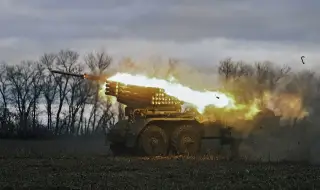
Ukraine has significantly improved its drone capabilities and is achieving partial superiority, says military expert Franz-Stefan Gaddy. However, he warns against being overly optimistic.
In Russia's war against Ukraine, the main military actions continue to be waged in the eastern part of the attacked country - in Donbass, says Austrian military analyst Franz-Stefan Gaddy in an interview with German public television ARD. He explains that the main direction of the Russian attacks remains the southern part of the Donetsk region, and the goal is to surround the so-called key cities - Slavyansk and Kramatorsk - and from there to advance west.
What is interesting, according to Gadi, is that in recent weeks the Russian armed forces have been regrouping, and the Russian offensive has not yet achieved the decisive success that the Russian military leadership probably expected. The first important point, he says, is that the Ukrainians have achieved partial superiority, and in other places parity, in the field of unmanned military operations. This is primarily about unmanned drones, but also about unmanned ground systems.
According to him, the Ukrainians are meanwhile filling a gap - they can now more effectively than before hit targets up to 200 kilometers from the front line. This means that they are able to attack Russian areas of operation, Russian supply routes and places of concentration of troops with drones. As a result, the Russians cannot freely mass up troops for new attacks to the extent they have done in recent months or last year, the expert told German public broadcaster ARD.
"The second important point is that the Russian losses are relatively high and that the Russians are not receiving the new soldiers they need to compensate for the losses. According to our estimates, for the fourth month now, the Russian losses on the front have exceeded the total number of new soldiers recruited for the front," Gadi points out.
This is clearly visible on the front line, where the Russians are constantly trying to move and regroup their troops, he continues. According to him, we can expect even greater offensive efforts from the Russian side, but for now they are being repelled. "The front is currently relatively stable for the Ukrainian side", says the military analyst.
With an unwavering will to resist
When asked how all this affects the morale of the soldiers, Gadi replies that the Ukrainians are exhausted, but continue to demonstrate an unwavering will to resist.
"They also suffer losses, are experiencing a shortage of manpower and continue to stay on the front line for too long, since there is no possibility of rotation. Added to this is the fact that in this new war environment, the movement of combat units has become very difficult. The war is fought mainly with unmanned systems, i.e. with drones trying to find enemy soldiers and attack them," explains Gaddi.
He explains that the fighting is mostly fought in small groups, there are no large battles involving hundreds or thousands of soldiers from both sides. In recent weeks and months, there have been attacks with armored vehicles, but they have been relatively unsuccessful - on both sides, we learn more from the interview with the military analyst.
This mix of military operations involving mainly drones and infantry trying to penetrate enemy-controlled territory leads to an expansion of the gray zone without a clear front line. There are many smaller positions scattered in different places, from which both sides try to scout and fight the enemy.
"I don't think Trump wants to lose Ukraine"
The Austrian military expert warns against exaggerating the enthusiasm for Ukraine, which is currently spreading in the media. "This war can only really be predicted a few weeks or months in advance. And as past experience shows, any military-tactical or technical advantage lasts only for a short time."
According to Gadi, in the coming months the Russian side will find a solution to neutralize the Ukrainian superiority in waging war with drones and in depth - for example, through more effective integration of air defense systems. And in this regard, he says that we should not fall into euphoria over the current Ukrainian successes. "That is why I warn against exaggerating the overall tactical situation regarding the course of the war", says Franz-Stefan Gadi.
As for the military component, the United States remains Ukraine's most important partner, he believes. "I don't think there's any danger that U.S. military aid will be completely cut off. I also don't think President Donald Trump wants to lose Ukraine. The United States, he says, is providing strong support to Ukraine, both in the field of battlefield intelligence and in coordinating military aid.
Ukraine's overall dependence on U.S. military aid is already decreasing, and the Europeans will take on an increasing share of it, he says. However, U.S. aid cannot be completely replaced in key categories. "For example, in air defense ammunition."
"Russia still thinks it has the upper hand."
In recent weeks, Ukraine has also managed to strike deep into Russian infrastructure. Will this affect Russia's willingness to negotiate? To this question from ARD, Gadi answers: "Russia still believes that it has the upper hand and that its strategy of a war of attrition will ultimately lead to success. At the moment, it seems that Russian losses are very high, territorial gains are minimal, and that sooner or later, and at a political level, an insight will come that continuing this war will be pointless from a military point of view."
But Russia's minimum requirement remains control over the rest of Donbas, the observer recalls. In this regard, he expects the Russians to make military progress in the coming months. The question is how big and how expensive this progress will be. "I don't think we can conclude from the current situation that Russia is inclined to make peace quickly", Austrian military expert Franz-Stefan Gadi also told ARD.