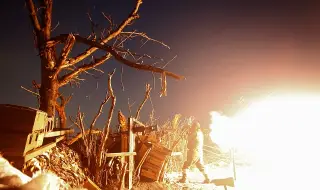
Russian and Ukrainian forces continued limited offensive operations on the second day of a ceasefire from May 9 to 11. Both Ukrainian and Russian authorities have accused the other side of violating the ceasefire on May 10. Ukrainian President Volodymyr Zelensky said that Russian forces carried out more than 150 ground attacks, 100 artillery strikes and almost 10,000 drone strikes between May 9 and 10. Zelensky noted that Russian forces, however, did not carry out major missile attacks, and the Ukrainian Air Force reported that Russian forces launched only 27 Shahed, Gerbera, Italmas and Parody drones between 00:00 and 08:00 local time on May 10, all of which Ukrainian forces shot down.
This is according to the Institute for the Study of War (ISW).
The Russian Ministry of Defense (MOD) similarly accused Ukraine on May 10 of violating the ceasefire by carrying out eight ground attacks; 676 artillery, MLRS and mortar strikes; and 6,331 drone strikes.
The National Aeronautics and Space Administration's Field Resource Management System (NASA FIRMS) signals from May 10 indicate that hostilities slowed further on May 10, but activity has not ceased. Russian and Ukrainian sources reported that the overall operational tempo in certain areas of the frontline continued to decline on May 10, despite persistent tactical combat missions that violated the ceasefire.
The proliferation of mutual accusations and continued localized activity on the second day of the ceasefire underscore the fact that a ceasefire without explicit enforcement mechanisms, reliable monitoring, and defined dispute resolution processes is unlikely to hold.
Russian President Vladimir Putin has vaguely hinted that the war in Ukraine may soon be over, although he has given no indication that Russia intends to end it. Putin responded to a question at a May 9 press conference about alleged Western involvement in recent Ukrainian long-range strikes against Russia, claiming that the "issue is coming to an end," after repeating the Kremlin's false justifications for its war in Ukraine.
Russian state media presented Putin's statement as if he had declared that the war in Ukraine was "coming to an end," even though Putin gave no indication that he intended to end Russia's war in Ukraine.
Putin said during the press conference that he intended to allow Russian forces to "focus on the final defeat of Ukraine," excluding Russian military equipment from the Victory Day parade, signaling that Russia remained committed to its maximalist goals of the Ukrainian government's capitulation. Putin reiterated his previous demand that any bilateral meeting with Volodymyr Zelensky be held in Moscow City and hinted that he would not meet with Zelensky abroad for peace talks. The Kremlin has routinely signaled its reluctance to hold an immediate bilateral meeting with Zelensky to end the war in Ukraine.
The Kremlin is likely playing to its domestic audience, which is increasingly feeling the effects of more than four years of war and Russia’s inability to repel Ukrainian strikes at long range.
Zelensky rejected Russian allegations that Ukraine sabotaged a planned prisoner exchange as part of a three-day ceasefire on Victory Day. On May 9, Putin accused Ukraine of sabotaging the 1,000-for-1,000 prisoner exchange as part of the Victory Day ceasefire, claiming that Russia had heard nothing from Ukraine on the subject.
Zelensky stated on May 10 that Ukraine was fully committed to the prisoner exchange and had already provided Russia with its lists detailing the 1,000 prisoners of war that Ukraine would return to Russia in the exchange, adding that the United States was acting as a guarantor in the exchange.
Russia appears to be honing its cognitive warfare efforts, which use flag-raising to achieve informational effects. ISW has increasingly observed AI-generated footage purporting to show Russian forces raising flags in several sectors of the frontline in recent days.
Russian forces switched to infiltration tactics in the summer of 2025 and have since increasingly relied on footage showing the raising of the Russian flag to claim progress in areas where Russian forces have infiltrated in small groups but have not established permanent positions.